ONE OF THE BEST running series in all of football is the Wing-T 20 series.
What makes this offense so difficult to defend is the misdirection philosophy and illusionary nature of the 20 series.
Even though the running attack of the Wing-T is extremely proficient, the back breaker for most defenses is the play-action passing game. This “waggle game” devastates defenses that overplay the run.
We’ve developed a defensive scheme that has had success guarding both the running and play-action aspects of the 20 series.
Defending Buck-Sweep Series
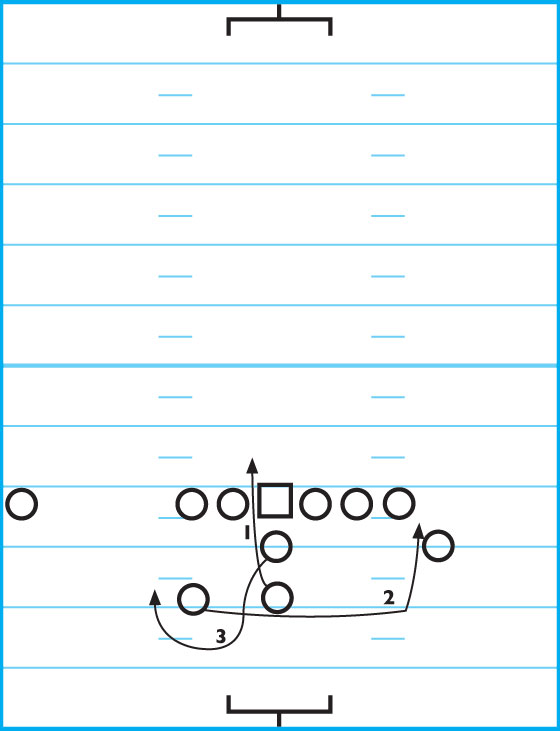
This series has the fullback running up the middle with its attendant blocking schemes, the halfback outside on the sweep or the waggle play-action pass out the backdoor.
DIAGRAM 1: Buck-Sweep Series.
Defending Play-Action Game
In our scheme, we’ve had a lot of success playing man-to-man coverage which allows us to get body on body with the opposition. Man coverage eliminates seams and avoids having your defenders standing around in open space, guarding nothing but grass. Wing-T passes, which seek to stretch zones horizontally or vertically, are then rendered impotent.
Never allow the offense to high-low a defender. As a matter of fact, we can double-team the FB and tight end in our base package. Against red motion (wing motion), we double-team the TE and TB.
A major key in defending the Wing-T passing game is to cut off the QB and not allow him to get on the corner with a pass-run option. The ends, through their basic techniques, must cut off the QB and not allow him to reach the corner.
DIAGRAM 2: Alignment, Player Designations.
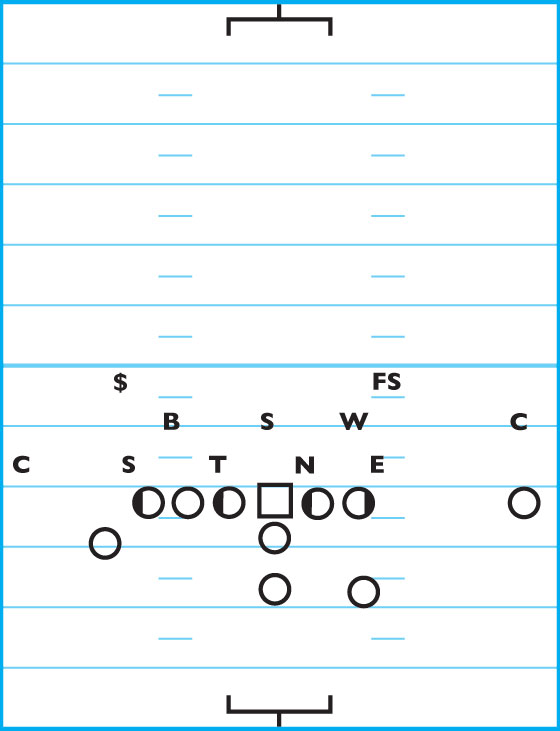
Our base defense is out of a 4-3 front with quarters coverage. However, against a Wing-T team, we play man coverage.
Diagram 2 shows the alignment and position designations.
Defending Waggle
DIAGRAM 3: Waggle.
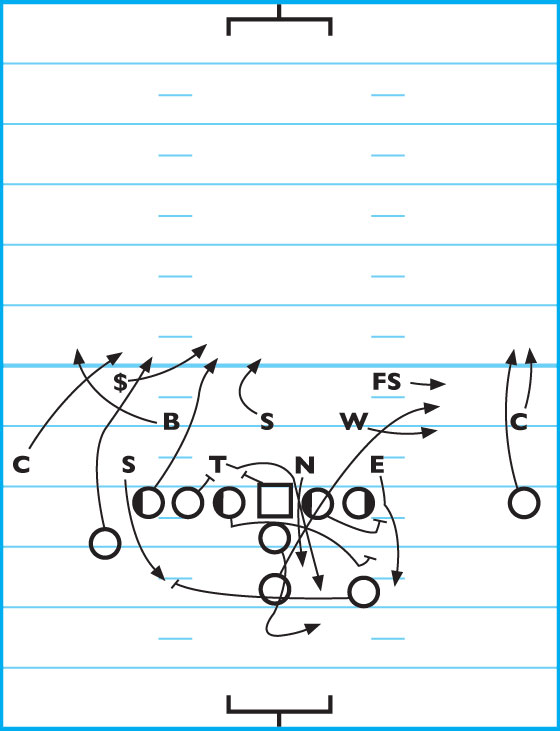
PLAYER ASSIGNMENTS:
Defensive Tackle: When the guard pulls away from the tackle, the center will turn-back block on the DT. The DT crosses this block and gets north to the QB, who will be pulled up by the end.
Nose Guard: Presents the OT with an uphill block. If the NG is coming off the ball, he’ll get great penetration. This ties up the backside OG. NG may even come clean to the QB.
“Stud” Defensive Lineman: With the FB away, the Stud defensive lineman explodes upfield. With the wing upfield on his pass route, the Stud will be left unblocked. Takes on the tailback. If the TB is definitely blocking, the stud slips the block and rushes the QB. If the TB is trying to slip the stud, the Stud plays the screen.
If the TB is still accelerating in this area, the Stud is taught to tackle him. This helps on any throw back. Tackling a potential pass receiver is not illegal if the QB has just faked a handoff to him (we remind the officials of this rule before the game).
Defensive End: The DE gets a down block by the OT and gets a quick flash from the on-side guard. The end must work upfield to get the QB pulled up.
“Bandit” Linebacker: On the waggle, the Bandit sees both the FB and OG go away. Bandit is responsible for a throw back to the TB or the TB screen. This player must first gain depth to defend the throw back. When the TB commits to blocking the Stud, the Bandit starts working back to the TB to better play a screen.
“Sam” LB: Both Sam’s reads, FB and OG, go away. Sam pivots and turns to the TE who will be on a drag. Sam collisions the end and assumes underneath coverage on him. This leaves the end double-teamed by Sam and the strong safety.
“Will” LB: On the waggle, both Will’s keys, FB and the OG, work toward him. The OG pulls to pin the end and the FB will probably be wider than the midline on his pass release because of the nose’s alignment. Will assumes underneath coverage on the FB with the FS over the top. Will can gamble and shoot the hip for the interception because the FS is over the top.
Strong Safety: The strong safety has the TE man-to-man with the Sam LB providing underneath help.
Free Safety: The free safety has the FB man-to-man with the Will LB supplying underneath help.
Strong-Side CB: The corner has the wing man-to-man.
Weak-Side CB: The corner has the split end man-to-man.
Defending Red Waggle
With wing motion, the strong-side CB makes a “Red” call. With a “Red” call, we go to our red-motion keys.
DIAGRAM 4: Red Waggle.
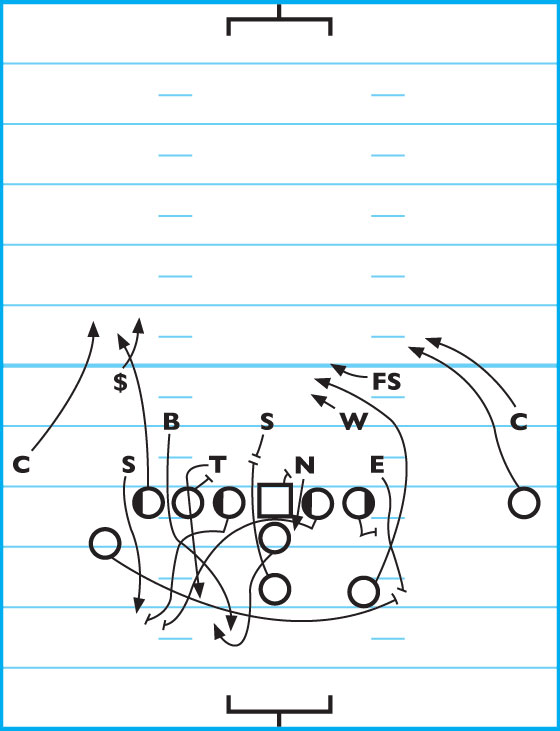
PLAYER ASSIGNMENTS:
Defensive Tackle: Expects the guard to pull either way. DT lightens his stance and cross-faces the down block of the OT. After he cross-faces, he’ll work north to the QB.
Nose Guard: Penetrates and “backdoors” the center to the QB.
Stud DL: Keeps his focus on the QB and keys the QB’s head. When he sees the QB’s face, he explodes upfield.
Defensive End: With red motion, the DE watches the TB. If the TB is on a pass release, he runs a course outside the end. The DE respects this as a threat to his outside shoulder. He collisions the TB and when he feels the TB’s release, the DE assumes screen responsibilities on the wing.
Bandit LB: With red motion, Bandit watches the strong-side OG. When the OG pulls toward him, he becomes a “run-through” player on the QB. With the QB pulled up and Stud drawing both guards’ blocks, many times the Bandit will be unblocked.
Sam LB: Sam takes his focus to the FB. Should the FB come down the midline, Sam LB tackles him. This is legal because the QB has just faked the ball to him. Tackling the FB eliminates a potential receiver. .
Will LB: Watches the TB, then matches the TB’s angle. Uses a catch technique and plays man under the TB with the FS over the top.
Strong Safety: When he hears the “red” call, he must echo the call. The safety will key the tight end and feel the guard. With the TE vertical, the safety assumes man coverage on the end.
Free Safety: Focuses on the TB. When the TB works upfield, the FS jumps him, while the Will LB provides man-under assistance.
Strong CB: Initiates the red package with his “Red” call. With red motion, the strong-side CB keys the strong-side OG. On the red waggle, the OG pulls to the corner. If the FB takes a wider course, the corner provides help to the Sam LB.
Weak-Side CB: Takes the No. 1 weak receiver man-to-man.