You can improve your overall defense in three phases – pursuit, tackling, and turnovers. Each drill we’ve included allows you to be fundamentally sound and take full advantage of any offensive mistakes. Every drill also allows you to get each player on your defense involved along with every position group. During the 2011 season, UAM was among the leaders in the Great American Conference in a number of categories: third in total defense, first in interceptions, first in tackles for loss, and second in takeaways. Nationally, UAM ranked 10th in TFL and 29th in interceptions.
Philosophy
Our 4-3 defense is simple for players and coaches, but hard for opponents to figure out. This system will allow you to get your best players on the field every snap to create an aggressive, violent, enthusiastic, and fundamentally sound defense. This is a gap control defense - alignment and assignments will be taught by coaches every day. Two safeties will allow the defense to play the pass more effectively, disguise coverage and zone blitz to confuse and frustrate offenses.
Foundation of the UAM Defense
Our Goal: The first and foremost principle of a defense is to prevent a touchdown or score. We must prevent touchdowns by not giving up the long run or pass and get the ball back for our offense.
Tackling: Tackling is the single most important thing we do on defense. We practice tackling daily in live and form drills. We should be, and strive to be, the best tacklers on the field. Ninety percent of tackling is desire. Our coaches teach the remaining 10%, but the rest comes from pride and the desire to do it. Take pride in being the best and most aggressive tackler on the field.
Takeaways: Our job is to take the ball away from the opponent’s offense and to score or set up good field position for our offense. Our goal is to knock the ball loose, force mistakes, make interceptions, and get takeaways. Takeaways and making big plays win games. Our players will be alert and aggressive and take advantage of every opportunity to come up with the ball.
Sixty Minutes
The trademark of the UAM defense is effort, toughness, and no mental errors. Our defense will play every defensive play in every game regardless of the score or situation in any game.
Pursuit Drill
Defensive players must learn proper pursuit angles to be effective. A good defense has 11 defenders swarming to the football on every play. By running perfect angles to the ball carrier, a defense can frustrate and dominate the offense. Getting more players to the point of attack quicker helps hide other weaknesses in your defense. Slower, physically weaker athletes will find some strength in numbers to make a play on the ball carrier.
The pursuit drill is necessary for any good defense. It is also extremely useful in planning out your defensive practice schedule. It is so important that we use our first group period to warm up our players with a pursuit drill. We take the first, second, and third defensive groups through one perfect time – all 11 players doing it right. We don’t let anyone stand around. Any additional players should be used as ball carriers or “rabbits.” Make the pursuit drill a part of the defense’s daily practice plan. Pursuit drills can also be used as a part of defensive conditioning.
To run an effective 4-3 pursuit drill you first need a total of 11 players. Fourteen cones are placed on the bottom of the numbers on both sides of the field. Each player will be given a number corresponding to a cone numbered 1-7. A coach is stationed in the middle of the field to direct the players to run to the defense’s left or right side of the field and find their cones. Cone 1 will be the boundary corner and backer, cone 2 will be for the end and whip, cone 3 will be for the nose, cone 4 will be for the tackle and Mike linebacker, cone 5 will be for the stud and rover, cone 6 will be for the free safety, and cone 7 will be for the corner away from the play (See Diagrams 1 and 2).
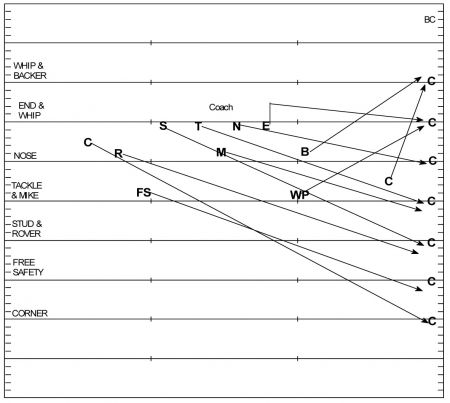
Diagram 1: Pursuit Drill – Right
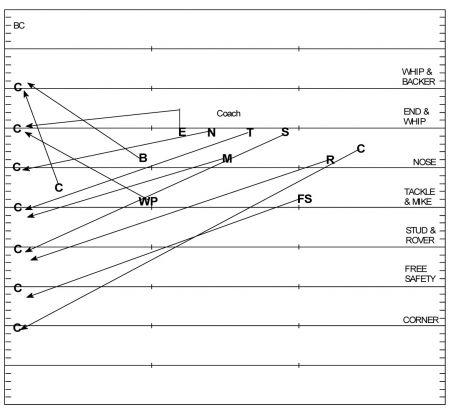
Diagram 2: Pursuit Drill - Left
Once they have approached their cone, each player should come to balance and shimmy at the cone. After all 11 have approached their cone and completed shimmying the ball carrier (located on the top of each diagram) the defensive unit will sprint down the cones and tag off on the runner while still shimmying their feet. After the ball carrier has cleared all 11 players, a coach will blow the whistle and all 11 players will do a cut away and sprint from the number to the sideline.
Tackling Circuit (Diagram 3)
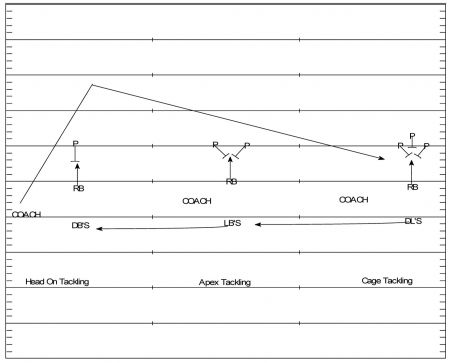
Diagram 3 – Tackling Circuit
The most important thing you need to remember if you want to prevent the other team from scoring is tackling. Tackling is, by far, the most important skill on defense and the one that can be taught the easiest. At UAM, we use a three group rotation among our DL, LBs, and DBs. Each station teaches a different tackling technique off of the fit of our defense – either inside or outside fitting.
Straight on Tackling
From the left side, between the sideline and the hash, will be our DBs. They will start with straight on tackling. This drill consists of a defender and a running back. The coach in this drill will be coaching “eyes, hips, and balance”, while making sure the defender is focused on putting his head on the same side the ball is on, keeping his head up.
Apexed Tackling
Between the hashes, in the middle of the field, will be the LBs who start out with “Apexed” tackling. This drill consists of two defenders and a running back. The coach in this drill will again be stressing “eyes, hips, and balance”, while making sure both defenders arrive on contact at the ball carrier at the same time. The focus of each one of the tacklers is to put half of their body on the ball carrier to create a complete tackle.
Cage
From the right hash to the sideline will be the DL. They will work on “Cage” tackling. This drill will consist of three defenders and a running back. This coach, as always, will be coaching “eyes, hips, and balance”. This drill is a spin off apex tackling with a third tackler heading at the running back in addition to the “Apex” tackle. Two defenders will arrive on contact at the ball carrier at the same time with the same focus. The third defender will complete the cage tackle by running to the ball carrier.
The players then rotate each position through each tackling drill which lasts two minutes per station. This is a very high tempo drill with the details of tackling being taught by our coaches. Poor tackling in games, practices, as well as in drills can also cause the players to lose their position on the depth chart.
Turnover Circuit (Diagram 4)
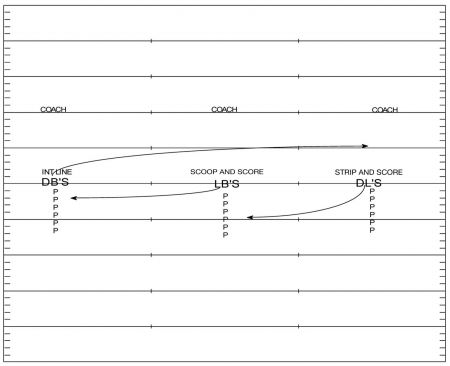
Diagram 4 – Turnover Circuit
Our defensive coaches want our players to be active and aware so they can force turnovers. When a defense can recover a fumble or intercept a pass, it can turn the momentum in the game and lead to victory as it did for us a number of times in the 2011 season. Our turnover drill helped us develop the ability to force turnovers. UAM finished second in the conference with 26 forced turnovers.
As we used in the tackling circuit, there will be a three position rotation among the DL, LBs, and DBs. Each station teaches a different turnover technique to help improve turnovers from game to game. From the left side, between the sideline and the hash, will be the DBs. They will start with the interception drill. Between the hashes in the middle of the field will be the LBs who will start out with scoop and score. From the right hash to the sideline will be the DL where they will practice strip and score.
Strip Drill and Score
To demonstrate this drill you will need a ball, a runner and a defender. This is a one man strip and score drill. This drill allows the defense to force a fumble without risking a big play by securing the tackle. The coach in the drill is coaching the details of having a secure tackle first. This is a good strategy when facing a high-powered offense. Players put themselves at risk by going for the strip without securing the tackle.
Scope and Score
To demonstrate this drill you will need a football and defender. The coach in this drill will flip the ball to the defender while making sure to coach the details of being under control - being bent at the ankles, hips, and knees. The defender secures the turnover and has the ball in his possession. The ball needs to be secured high and tight with the end of the ball covered by his hand. The player then has to accelerate to regain his speed.
Interception
To demonstrate this drill you will need a football and defenders. The coach in this drill will line up players in one line facing him to start the ball drill. The coaching points of this drill will be showing all defensive players the correct way to catch and carry a football. Defensive players are not used to running with the football, so make sure they are familiar with protecting the football. When players have cleared through once going straight ahead, then the coach will take them through a 90-degree angle from the other side.
About the Author: Keith Scott is now in his second season as Defensive Coordinator at the University of Arkanasas at Monticello. He previously coached at Central Arkansas, Mississippi Valley State, and Prairie View A & M. Scott has a Bachelor’s Degree from Arkansas at Pine Bluff and a Master’s from Prairie View A & M.