We have been running some sort of four-man front for the past 10 years, whether we were a 4-3 or, recently, a 4-2. We preach the same philosophy that all defenses advocate: “stop the run first” and having the even front as our base gives us the best chance to do this on a consistent basis.
Over the course of these ten years, we have flirted with odd fronts to help defend against spread teams until the last two seasons. It’s important that the defensive line work on defeating blocks from an outside shade and reading offensive linemen off slants. The odd front took time away from that. Linebackers need to recognize formation and get aligned correctly and throwing in another front seemed to stall out that process.
We switched to a 4-2 from a 4-3 to give us one more athletic player on the field. This meant teaching more to this player (our boundary safety) when the odd front was in the game. His rules of when and where to roll down and when to go high in various coverages changed with the odd front. The benefits of having a four-man front, like having great fits vs. the run game and getting proficient at the basics (base, reach, and down blocks) were not getting worked on enough. If these concepts were not being worked enough, I realized it was taking away from our major priorities which included taking on blocks, pursuing the ball, and tackling.
Our recruiting philosophy was just like it was when we were a 4-3. We recruit defensive ends to play our inside tackle positions, linebackers to play our defensive ends, safeties to play our linebackers and corners to play the five other positions on the field. I wanted to make sure the one thing I couldn’t control – speed – was never an issue on the field. So why pull these kids off the field? They’re fast enough, and with the ability of zone fires we could still play it safe vs. giving up the big play. Now, it came down to how to get the look we were searching for.
When inserting an offense, the first concept is taking advantage of uncovered receivers, whether they run the bubble to an uncovered area or throw it to him with space. Our alignment vs. 11 personnel is included in Diagram 1.
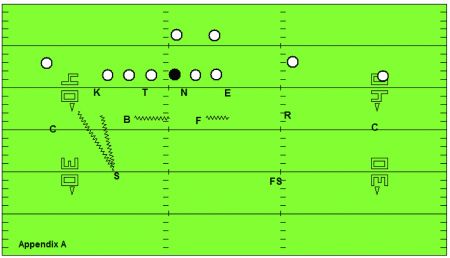
Diagram 1.
The crooked lines represent our Superman’s (weak side safety) pre-snap or post-snap action. When we drop him into the box we move our linebackers (Bill and Fred) over one gap. If we drop him outside to help with the one-on-one created to the single WR side, we keep the backers two-gaped and aligned over the uncovered linemen. Versus a 10-personnel situation and a 2 x 2 set, we must move our Superman pre-snap over the #2 receiver to not allow an uncovered player. I did not like this formation because if we walked our Bill (Boundary Linebacker) out (Diagram 3), we were going to show a two shell. If we moved the Superman down (Diagram 2) we were showing a one shell and showed our hand to the offense.
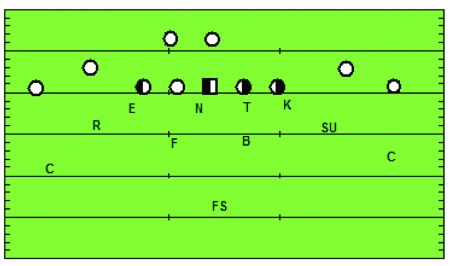
Diagram 2.
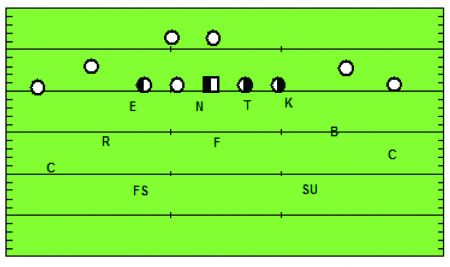
Diagram 3.
Obviously, showing a two shell gives you more options, and that was the advantage of the odd front because of the ability of the OLB to cover up the #2 receiver on both sides. Our answer to this is now to play what we call NASCAR. We play our tackle and nose in a two technique and slant them according to the front call. We stand up our defensive ends and align them in various positions. All other positions align by this principal, “Stay on the move and align as far as you can away from your responsibility so that if the ball were snapped you could still get to your responsibility effectively”. We are able to hold our two shell because of our Knight (Boundary End) having the ability to cover up the #2 receiver. (Diagrams 4 and 5).
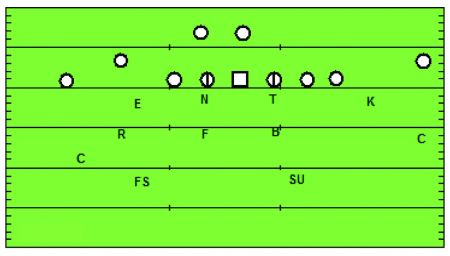
Diagram 4.
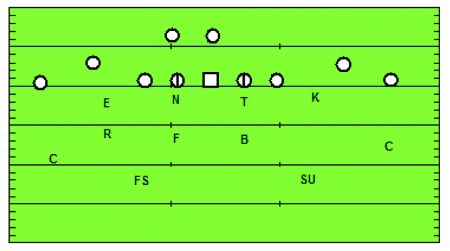
Diagram 5.
Diagram 6 is how NASCAR would look on paper. The lines signify the movement we want from all of our two-point players.
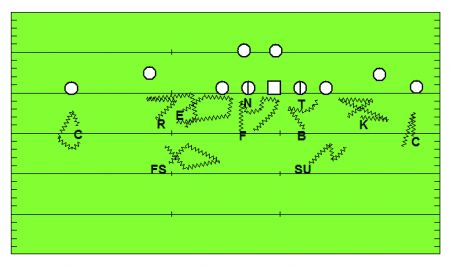
Diagram 6.
We run our entire 4-man front package from this look vs. every personnel group and any formation. The teaching process is reduced because the assignments are the same as what we inserted from day one with our 4-man front. The huddle calls are the same. The only difference is when the play call is tagged with NASCAR before the front. An example would be NASCAR Tiger Green (Front=Tiger, Coverage=Green) as shown in Diagram 7.
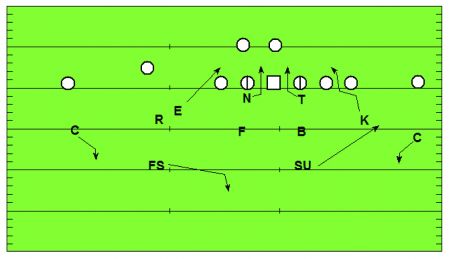
Diagram 7.
On paper it looks simple and from an assignment perspective it is simple, but the pre-snap movement creates confusion with blocking schemes and QB reads. Being creative with pre-snap looks and the angles NASCAR can create makes this change fun for our players. Although we scheme on third down to take advantage of the offensive scheme or offensive player personnel, here are two blitz packages we have used on third down in the past that have been effective for us (Diagrams 8 and 9).
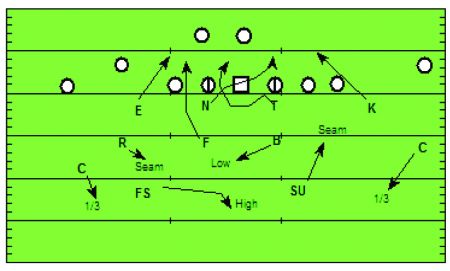
Diagram 8.
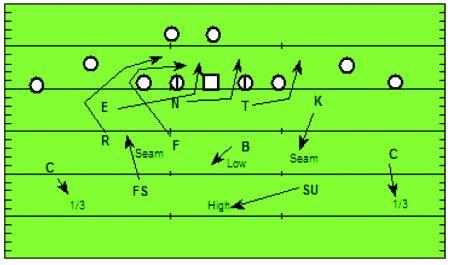
Diagram 9.
I hope this article can give you some ideas on making your defense more versatile vs. the various offenses you will face. This concept helped Gannon become more productive in all areas of our defense. It allowed us to continue our development on the basics of defensive football. We spend more time taking on blocks, pursuing the football, and tackling than we ever have in the past.
About the author: Brad Rzyczycki is now in his fifth season as both assistant head coach and defensive coordinator at Gannon College. He previously coached at Kentucky Wesleyan College, Saginaw Valley State, and his alma mater, Mercyhurst College. A four-year starter at cornerback for Mercyhurst, Rzyczycki holds both a Bachelor’s and Master’s Degree from the college.