Trying to stop today’s explosive offenses has become an enormous challenge for defensive coaches. Having to defend the spread option, power run game, vertical passing game and the single wing (Wildcat) on a weekly basis will definitely keep you up late at night. Designing a game plan that is flexible and well thought out can give you an edge over your opponent. Game planning for us is a merging of what we do well defensively and trying to take away what the offense does best.
Every offense has strengths and tendencies in their personnel groupings, down and distances and situations. We use film study to try to decipher their strengths and tendencies and come up with ideas within our defensive framework to stop them. On average, we break down three to four games of our upcoming opponent. Our breakdown sheet has around 18 categories from personnel and play name to formation width and pass concept. We also have our coaches draw up every pass route, run play and pass protection to get a feel of WR splits, blocking schemes and ball distribution.
After breaking down the opponent’s film, the first question we try to answer is, “What is the theory of the offense?” The theory could be ball control run, vertical pass game, spread option or controlled short pass game. Every theory is based on a set of beliefs, whether it’s numbers and angles, explosiveness or clock control. Knowing the theory of the offense will give insight into the play caller’s thought process and where the foundation of the offense originates from. The second question we want to get answered is “Who beats us?” This question is simply trying to figure out which offensive player or players do we have to stop – QB, WR or RB. Our game plan will center on taking away this key player. We also study the offensive personnel by their position groups (WR, OL, etc.) as well as individuals. It is also important to know who the backup QB is and have an idea what his ability level is.
Once the above questions are answered, we will begin looking at the offenses different personnel groups and looking at the run/pass tendencies within each group. We then will take it a step further and look at the run/pass tendencies by personnel, down and distance. We define our down and distances by first and 10, second and normal (1-6), second and long (7+). We treat third and fourth down as there own separate game plan. First and second down calls will constitute about 75% of the game, so the majority of our practice time will be dedicated to executing these calls. We will try to identify their favorite runs, pass concepts and protections by personnel and down and distance and create calls to stop them.
One device that has helped us over the years is to call the front and the coverage independently of one another. This allows us greater flexibility in trying to make the perfect call to stop their favorite run play and favorite pass concept. Within each personnel group and down and distance, we will have a base call, stopper call and pressure or blitz. All offense is rhythm and the more you can upset the rhythm, the better your chances of keeping points off the scoreboard. Another idea that has served us well over the years is scripting our calls. This has helped us mix fronts, coverages and pressures and prevented us from falling into a rut with our play calls.
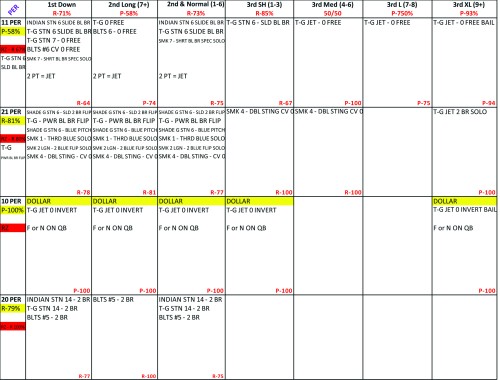
Once first and second down are completed, we move to third and fourth down. We break third and fourth down into four different categories – third and short (1-2), third and medium (3-6), third and long (7-8) and third and extra long (9+). We have separate philosophies for each down and distance and we will create calls that match those philosophies. Our goal on third and short is to stop the offense 55% of the time. We want to get penetration, fill all inside gaps and stop their favorite run play. Our goal on third and medium is to stop the offense 65% of the time. We want to disrupt WR routes with press coverage or squats and halves coverage, attack protections and defend the sticks. Our goal on third and long/extra long is to stop the offense 75% of the time. We want to stop the ball from being thrown vertically down the field and mix blitz looks with coverage looks (See chart 1).
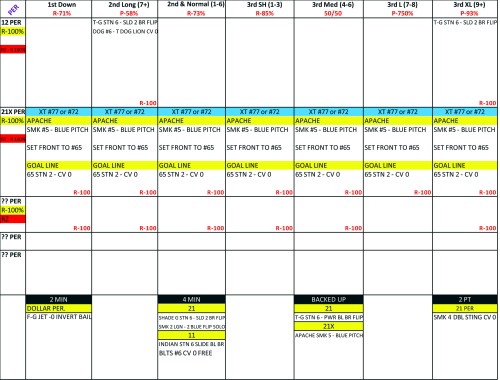
Once third down is down is complete, we begin to plan for the special situations that will occur during a game – red zone, goal line, two-minute and four-minute offense. On average, the offense will be in the red zone three to four times per game. Holding the opponent to FG attempts is a must. Realistically, if the offense gets four trips to the red zone per game and you can hold them to FGs 50% of the time, you are playing well on defense. Goal line defense will be different every week. Some teams will not get into bigger personnel on the goal line while others will. We will try to match the offensive personnel with our different packages. On most two-minute situations, the offense will not have a large formation package and usually rely on their most practiced route concepts. We try to put our best pass rushers on the field and give the QB different coverages every snap. Four-minute situations are usually high blitz circumstances for us. We are trying to stop the run and create negative plays and takeaways. The clock is our enemy (See chart 2).
Finally, a topic never discussed in any staff room is the word luck. Ten to twenty percent of the game comes down to luck. Sometimes you will have the perfect call on and your defender slips, the official misses a call or makes an incorrect call or the ball takes a lucky bounce for your opponent. Don’t panic. Understand there are forces out of your control and you must roll with the punches. Keep your confidence level up and dismiss any negative thinking. Your players will take their cue from you, and if you remain resilient – so will they.
About the Author: Mike Mutz was named the defensive coordinator at Blinn College in March, 2012. He spent the previous six seasons on the staff of Missouri Southern State University. Mutz has also coached at Sam Houston State, Ft. Scott Community College and Southern Illinois University. He is a 1997 graduate of Colorado-Mesa where he played defensive back.