The ability of a defense to pursue to the ball is their lifeblood. Pursue is defined as: to follow in order to overtake, capture, or defeat. Every defense needs to be trained to fulfill these terms if they are to be successful. Defenses are responsible for getting the ball back to the offense as quickly as possible. Training a defense to pursue the ball with a relentless passion is a powerful tool to accomplish this mission. Having eleven defensive players pursuing to the ball, while taking great angles, is an edge that all defenses must have. The purpose of our pursuit drills at Azusa Pacific University is to ingrain in our players’ the importance of always pursuing to the ball with an unbridled conviction to capture the ball carrier.
Your players will value what you emphasize. Therefore, we teach that a defensive player at all times must run to the ball (aside from a backside defender doing this job). Pursuing the ball is not a game-time effort. Rather, it is an all the time effort and must be continually emphasized throughout practice. I believe it is our responsibility to make sure the drills are efficient, fluid and fresh for our players. Creativity matters when teaching the defense how to pursue. We have the same demands each time we run a pursuit drill but we sprinkle in a variety of types of pursuit drills throughout the week. A lot of what we do is recycled from prior coaches, just with a different packaging. Some of the drills we use are the inspiration of prior coaches who understood the importance of instilling this desire to get to the ball.
In preparing our athletes for this, we walk through and teach our players in the meeting room what the drill is to look like before doing it on the field. We have different types of pursuit that we use throughout the week. After the team has finished their dynamic stretch, the defense will immediately go to what is referred to as our pursuit period (typically 4 to 5 minutes). We always start with a high-energy pursuit drill to set the tone for the practice.
Each time we run a pursuit drill, we demand attention to detail. The players are responsible to make sure the correct players are set and ready, chin straps buckled, along with all their feet behind the sideline. We always send the players on the field by saying “recall defense”. This is a phrase we use whenever we get a turnover and it is a cue for them to take the field. The players respond immediately by saying “get the ball back” while sprinting on the field to their positional alignments. If any player doesn’t take the field or run the drill with the effort and conviction that our staff demands, the group immediately returns to the sideline and repeats the drill again until it is done perfectly. It will most likely take a few tries to condition your players to what you are demanding. Listed below are four different types of pursuit drills along with diagrams of what we do and explanations of how they work.
Traditional Pursuit (Diagram 1)
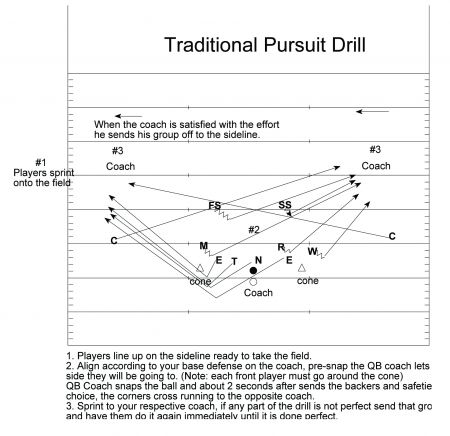
As a player, I was first exposed to this specific pursuit drill by Coach Rocky Long (current Head Coach at San Diego State). We would start our practices each day with this drill. The drill is broken up by depth chart, having the first string lined up on the sideline with their feet behind the line. The diagram below illustrates the positioning on the field for the drill.
In this drill, the players line up on the sideline, ready to take the field. They should align according to your base defense. Pre-snap, the coach lets the front know which side they will be going to. Each player must go around the cone. The QB Coach snaps the ball and after two seconds, sends the backers and safeties to the coach of his choice while the corners cross, running to the opposite coach. The players should sprint to their respective coach. If any part of this drill is not done perfectly, send that group to the sidelines and have them do it again until it is done perfectly.
Rabbit Pursuit
(Diagram 2)
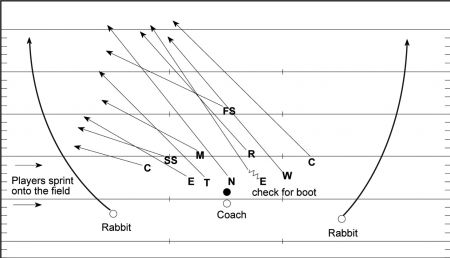
In this drill, the players sprint on the field and line up in a condensed base defensive alignment. At the snap of the ball, the QB Coach quickly throws the football to one of the two rabbits. The rabbits need to be fast and continue to run as the defensive players tag off and continue to let the rabbit run. As the defense gets better at this, the rabbit can begin to cut back changing the defenders’ pursuit angles. The players should learn to take great angles in getting to the ball. You can make an adjustment to this drill by lining up only on the back side of the defense and having them pursue the front side rabbit while focusing on purusit and taking the best angle to the ball.
Sideline Pursuit
(Diagram 3)
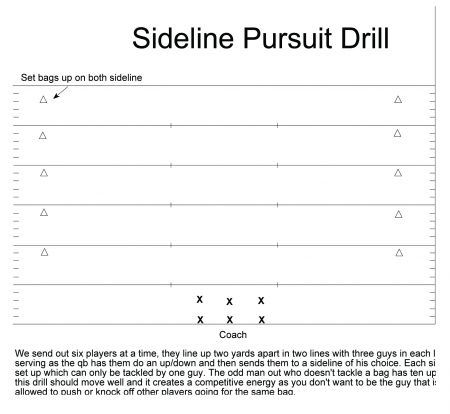
In this drill, we send out six players at a time. They line up two yards apart in two lines with three players in each line. The coach serving as the QB has them do an up/down and then sends the players to a sideline of his choice. Each sideline has five bags set up which can only be tackled by one player. The odd man out who doesn’t tackle a bag has 10 up/downs. The pace of this drill should move well and it creates a competititve energy as every player doesn’t want to be left out. Players are allowed to push or knock off other players going for the same bag.
Pass Route Pursuit Drill
(Diagram 4)
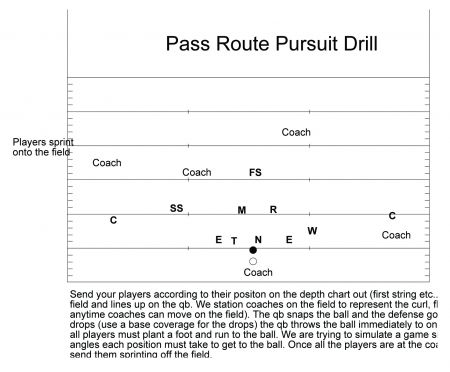
Send your players out according to their position on the depth chart. One coach represents the QB and the other coaches are stationed on the field to represent the curl, flat, post and corner routes. As the QB coach simulates the snap of the ball, the defense goes to their pass drops and the QB coach throws the ball immediately to one of the coaches and all players must then plant a foot and run to the ball. We are trying to simulate a game situation and the actual angles each position must take to get to the ball. Once all the players are at the coach, the coach will send them sprinting off the field.
Remember, your players will value what you emphasize.
About the Author: RBrian Wilmer just completed his 12th season on the staff of Azusa-Pacific University and his fifth as Defensive Coordinator. Also a member of the APU faculty, Wilmer is an Assistant Professor of Physical Education. A four-year letterman as a linebacker at UCLA, he holds both a bachelor’s degree and master’s from his alma mater.