The key to efficient defensive line play is gap control.
Like all coaching staffs, we meet to discuss what, if any, changes we would like to make that will allow us to become a better defensive unit. We will install our schemes for each position and how it relates to our entire defensive structure and we will also discuss and set goals for the defensive unit that we want to accomplish.
If a position coach would like to look at doing something different than what we have done in the past, we will discuss it and if we, as a staff, think it will help us improve and everyone agrees, then we will make the changes. Then, over the summer we will meet to review how spring ball went and what changes we may want to make for the regular season.
It is our philosophy that we put our best athletes on defense and” let them play”. We will always recruit defense first and our goal is to have a strong defense ever year. We try to keep things simple for our players on defense and teach each defensive player our entire defensive system.
I am very fortunate as the defensive coordinator to have some outstanding position coaches. Each position coach has over 20 years experience in coaching and one of them over 30 years.
DEFENSIVE PHILISOPHY AND D-LINE MOVEMENT
- GAP CONTROL
Our defensive philosophy starts with our defensive line play out of our base 4-3 defensive package. In our base 4-3, we will play gap control not only with the defensive linemen but with our linebackers as well.
What we look for in a defensive lineman is someone who is quick and strong and can move from one (gap) position to another when the ball is snapped. We are not always concerned with size of the defensive linemen as long as they are athletic enough to do what we ask of them. We use a lot of slants up front (gap control) to try and keep the offensive linemen occupied, which then will allow our linebackers the freedom to roam and get to the ball.
There are two defensive line slants that we use every day during practice called Toro and Aim. Toro is where the defensive linemen slant toward the strong side. The Aim call is where the defensive linemen slant toward the weak side.
We like to work on these slants every practice during the individual period. Or, if needed, we might also use some of the team period time if we are not satisfied with our defensive line movement. We believe that the more reps our players get, the better off we will be at executing these slants.
We bring our defensive linemen and linebackers together to walk through their gap responsibilities. It is very important that the linebackers are involved in this as well. They will need to know what gap responsibility they will have once the defensive linemen slants away from their original alignment.
What we have found that works best is to just use five big trash cans. We align the trash cans up to simulate an offensive line. We then will align our defensive line in a front call and let them work on slanting a man over to the call side. We do not always align in an even front and the slants can be run out of multiple fronts. It is important to know that in these slants, not all four defensive linemen slant.
In the Toro slant, the DE to the strong side will stay home if there is a TE. The DE on the strong side will align in a 6 tech (head up on the TE) and try and hold up the TE on the line of scrimmage. If there is not a TE, then the DE to the strong side will align in a 5 tech and play his base defense that he is taught. The other three defensive linemen will then slant towards the TE or strong side (one gap over) from their original alignments.
TORO/SLANT STRONG - In the Toro Slant, our defensive front four are cross face slanting toward the strength of the offensive formation. Strength is considered as follows - tight end, multiple receivers on one side of the formation, offset fullback, or even the wide side of the field, if the formation is balanced.
Alignment of defensive line (Diagram 1)
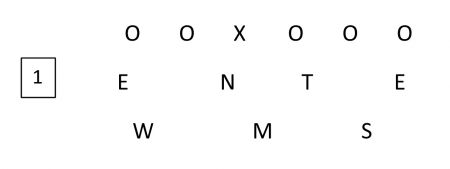
Diagram 1 – Alignment of Defensive Line
- Strong Side Defensive End: Alignment can be either a 7 tech (inside shade of TE), 6 tech (heads up on TE), or 9 tech (outside shade of TE).
- Strong Side Defensive Tackle: Alignment is 3 tech on offensive guard (outside shade).
- Nose Tackle: Alignment is shade on weak side of offensive center.
- Weak Side Defensive End: Alignment is 5 tech (outside shade) of offensive tackle on the weak side.
Alignment of linebackers (Diagram 2)
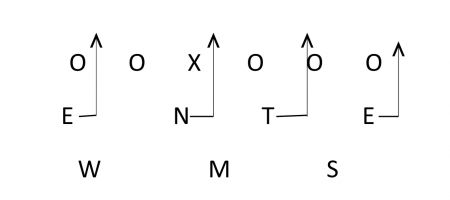
Diagram 2 – Alignment of Linebackers
- Will LB: 40 technique (stacked over weakside offensive tackle).
- Mike LB: 10 technique (shade on strongside of offensive center).
- Sam LB: 50 technique (outside shade of strongside tackle).
Diagram 2 shows the toro slant and gap responsibilities. Note: With the toro slant, we do not expect the strongside tackle to cross face the offensive tackle but simply outslant and remain in the “B” gap.
Diagram 3 shows the linebacker gap responsibility depending on whether the flow of the ball is towards the strong side or weak side.
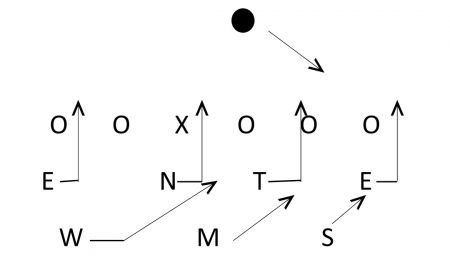
Diagram 3.
With strongside flow, our Sam LB runs to stack over the defensive end. If the defensive end is fighting the reach block and remains outside, then the Sam looks inside into the C gap. We call this the “Clear / Cloudy” rule. The Mike LB is downhill at a 45⁰ angle towards flow, attacking the “C” gap. The Will LB takes two shuffles towards the Mike LB and reads the strongside offensive guard and tackle. If neither the offensive guard nor the tackle is pulling on the counter play, then the Will LB continues to scrape down the line of scrimmage. If the Will LB reads the counter (pulling lineman), then he redirects back to the weak side. Note: We do not expect the Mike LB to help on the counter play. Also, we rely on the FS to take care of the weak side “B” gap (cut back gap) vs. a run play.
Diagram 4 shows the linebacker reaction if the backfield flow is towards the weak side vs. a toro slant call.
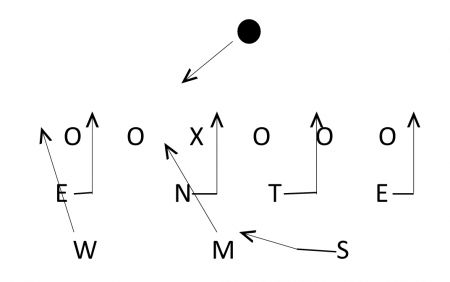
Diagram 4.
If the flow is to the weak side, the Will LB runs to stack over the defensive weak side end, but has “C” gap responsibility. The Mike LB has weakside “A” gap responsibility and the Sam LB shuffles, checks for counter, and pursues down the line of scrimmage.
AIM/SLANT WEAK - In the Aim Slant, our defensive front four are cross face slanting toward the weak side of the offensive formation. Note: The only change to our defensive linemen’s alignment when “Aim” is called is that we align our nose guard in a 2i on the weak side offensive guard so he can cross face the guard.
Diagram 5 shows the defensive gap responsibility in Aim slant.
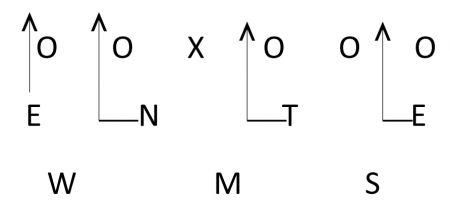
Diagram 5.
Diagram 6 shows the linebacker reaction to strong side flow vs. the Aim slant.
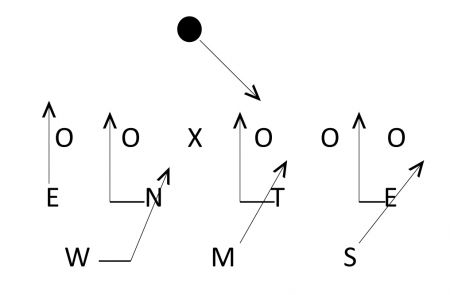
Diagram 6.
With strongside offensive flow vs. the Aim slant, the Sam LB runs to stack and has “D” gap responsibility, the Mike LB has strongside “B” gap responsibility and the Will LB has weak side “A” gap responsibility unless he reads the counter play.
Diagram 7 shows the linebacker reaction to weak side flow vs. the Aim slant.
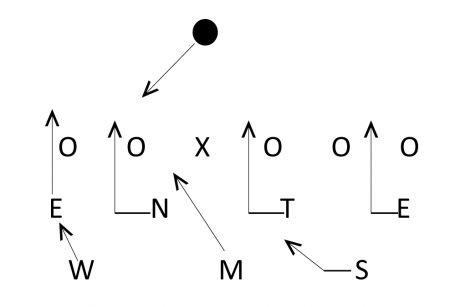
Diagram 7.
With offensive flow to the weak side vs. the Aim slant, the Will LB runs to stack over the defensive end, the Mike LB has weak side “A” gap responsibility and the Sam LB has down the line pursuit unless he reads counter strong.
Toro Various: We call this slant “Toro / Willie Pinch”. Diagram 8 illustrates this slant. If offensive flow is to the strong side, it is very important that the FS scrolls down to take care of the weakside ‘B” gap.
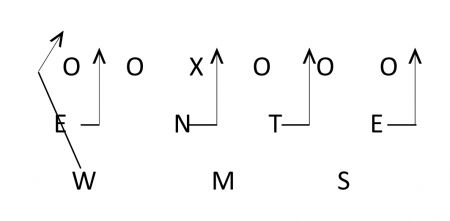
Diagram 8.
Aim Various: We call this slant “Aim / Sam Pinch”. Diagram 9 will illustrate this slant. During this slant, it is important that the SS scrolls down to take care of the strongside “B” gap on a cut back run.
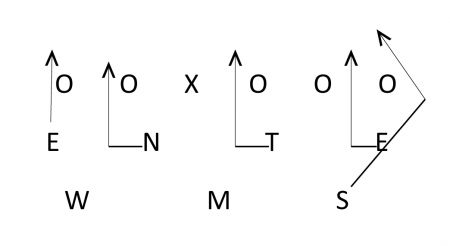
Diagram 9.
About the Author: Coach Matt Welch is into his tenth season at Friends University and his 27th overall. Welch, the Defensive Coordinator, led Friends to a #3 national ranking last season among all NAIA colleges. He also coached at Winfield High School (KS) and for 17 years as the Defensive Coordinator at Southwestern College.
Coach Bill Shaw has been the Linebackers Coach at Friends University since 20006. Shaw was the head coach at Ingalls High School (KS) in 1977-78 and served as the defensive coordinator at two different Kansas high schools (Wellington and Derby) from 1980-2005.