Part 1 of ‘Defending the Trips Offense’ covered our very basic defense against the spread offense. Although this base has worked extremely well, we have faced opponents who have strictly used the trips over several seasons, or who have very good athletes who make this offense more difficult to defend.
Because of this, we have incorporated several blitzes to add more pressure to the QB and to make it more difficult for the offensive linemen to pick up their blocks. We utilize several blitzes in attacking the spread. Our philosophy is to go after an opponent without leaving too many areas of the field uncovered against the pass.
Our two internal linemen – the NT and WSDE – are normally responsible for the A gap vs. the run and have certain other responsibilities against the pass. Their movement from side to side, or directly over the guard, allows us to utilize the Mike linebacker with the nose tackle more readily. When we call for a blitz, we use the word “Heavy” which indicates the player doing the blitzing. These calls are made in the huddle.
As the offense approaches the line, the designated player, along with all other players, will make a simultaneous call. Only the designated player’s call is the blitz that we will use. All other players will follow their base assignment. To limit confusion, you can have a “Panther” or “Wolf” call in the huddle, but unless you hear the word “Heavy”, “Panther” (P) and “Wolf” (W) are not involved in the blitz. An example of one of our calls would be “Panther-Heavy-Mike (M)”. This call tells “Panther” that he is to rotate to the trips and “Mike” is blitzing. When using “Heavy-Mike”, the strong side linebacker informs the NT where he will be blitzing. The nose tackle can position himself on either side or in front of the guard before the ball is snapped. Once the snap takes place, he moves out of the way of “Mike’s” blitz. Mike informs the nose tackle “A” and, at the snap of the ball, the NT will go to “B” gap (See Diagram 1).
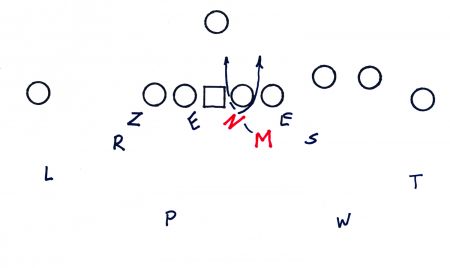
Diagram 1.
Mike can use any other call, but the NT is listening for “A” or “B” gap. (For example, the call could be Tango-A-Zebra). The “A” is what the NT wants to hear. Whenever we are involving two positions in a blitz, we are vulnerable somewhere in our under zone. To compensate for this, we have the “Nuke” call. The Nuke call lets the internal lineman know that he is responsible for pass first and run second. In other words, his initial charge is forward, stepping to contact, and then he retreats into the passing zone unoccupied by the blitz player. In the huddle, the call would be “Wolf-Heavy-Mike-Nuke” (See Diagram 2). Mike knows that he will be hitting the “A” gap, and that the NT will be dropping into Mike’s unoccupied zone.
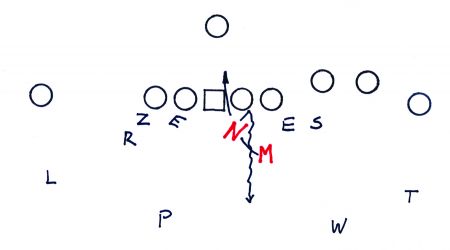
Diagram 2.
Our internal linemen love this call because they have the opportunity to intercept a pass. Like all blitzes, success depends on the ability of the defender to disguise where they are going when the ball is snapped.
Another blitz where Nuke is used is the “Sam” linebacker and the strong side defensive end. Sam will take a deeper position off of the LOS to allow the SSDE an easier opportunity to drop to his zone more quickly.When the call “Panther-Heavy-Sam- Nuke” is called, the strong-side DE steps initially to his outside and then drops at a 45-degree angle towards the trips side. Sam plays games on the outside of the DE until the ball is snapped. He finds an open area in the “B” gap and rushes the QB (See Diagram 3).
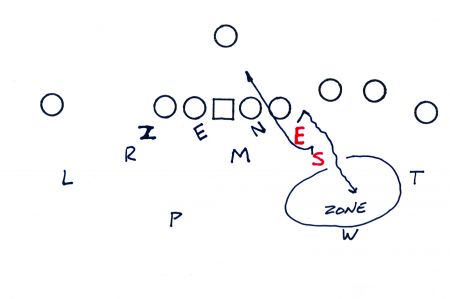
Diagram 3.
Our weak-side combination blitz involves “Zeke” (Z) and “Rambo” (R). Since Rambo is the inside linebacker, his call will be made, and he will inform Zeke where he will be blitzing. Like the strong-side blitz, Nuke will be incorporated because we don’t want to ever be vulnerable in the under zone. The call in the huddle is “Panther or Wolf -Heavy-Rambo-Nuke.” Rambo will then alert Zeke concerning which area he will be blitzing into. As the offense approaches the ball, Rambo, along with all other defenders, will be making calls. Only Rambo’s call is the primary call and he calls “B”. That lets Zeke know that he will step to his outside receiver. Rambo will be responsible for disguising his role in the “B” gap blitz (See Diagram 4).
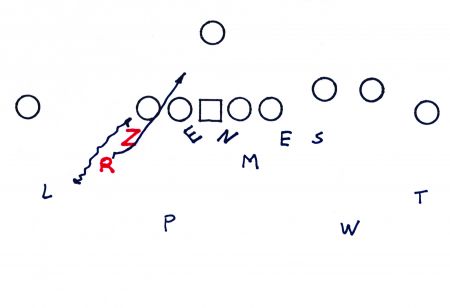
Diagram 4.
To incorporate our secondary into our blitzing scheme, we generally blitz the safety away from the trips. He works in unison with our weak-side defensive end, and this blitz has proven to be very successful. Since both safeties move up (in a Monster position) or remain in the normal alignment, it is more difficult to determine where they are going to be when the ball is snapped. This makes it easier to disguise this blitz.
The call is “Heavy-Panther”. Once again, Panther lets the WSDE know which gap he will be attacking. The Nuke call can be added, but we feel that pressure is more important on the weak side. Besides, we have Zeke and Rambo to cover our back door. When using safety and corner blitzes, we are always in a cover 3. The corners have their deep one-third and the other safety not involved in the blitz has the deep middle-third. An example of this call would be “Heavy-Panther-B” (See Diagram 5).
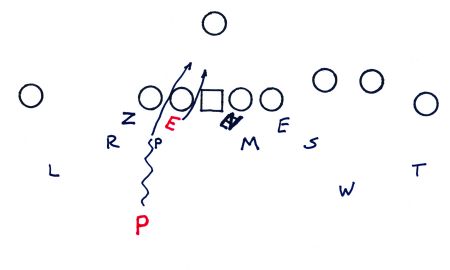
Diagram 5.
When utilized, the corner blitz is generally employed to the side where the TE is the last man on the LOS to his side. Corner blitzes are generally used against teams who run speed option away from the trips to the wide side of the field. By combining Zeke and Rambo into the scheme, we are not giving the QB a consistent read.
To make this blitz simple, Zeke always assumes the Nuke role. At the snap of the ball, he drops straight back into the quick pass zone. “Lion” (L) lets Rambo know which gap he will be hitting. If Lion is blitzing to the “C” gap, Rambo moves up on the pitch man and makes contact. We do not want the back to ever assume he isn’t going to be covered. Lion comes off of Rambo’s blind side and attacks any opponent in the “C” gap (See Diagram 6).
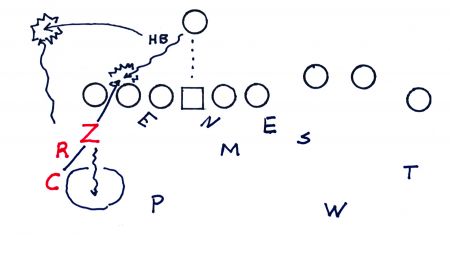
Diagram 6.
When the offense runs the option against this blitz, it is very difficult to get the correct read. When Rambo takes the pitch man, immediately the QB turns up into a real wake-up call. He will not see Lion until the last minute. The opposite blitz of this would be Lion taking the pitch and Rambo blitzing into the “C” gap (See Diagram 7).
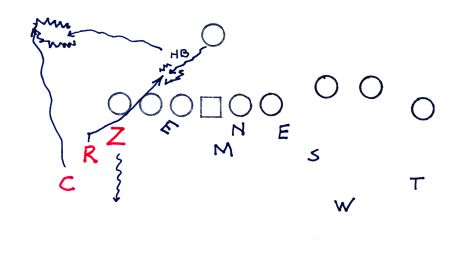
Diagram 7.
When scouting your opponent, you will find that they have certain tendencies. These range from split alignments to strategies when the back is to the left or right of the QB and include plays which are used when a certain player is in the game. Each week we plan on which blitzes will be used according to the above mentioned criteria. Wide-side middle and short-side also count in developing a game plan. We draw up on clear plastic sheets every formation that our opponents use, including their plays and the direction of these plays. From these drawings we determine the blitz packages for that game. As an example, we will use trips to the short side of the field and back to the trips side (See Diagram 8).
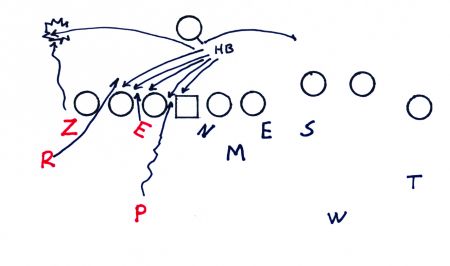
Diagram 8.
Looking at this sheet, we see five running plays back to the TE side with a direct hand-off to the back, one QB keeper to the trips, and one back-side screen to the TE side. By practicing against this formation and field position, this is an automatic key. When we see this formation, the players on the field will know that a “Heavy-Panther-Heavy Rambo” should be called. Both Panther and Rambo will alert the appropriate defender as to where they will be blitzing.
Our goal from day one is to teach our players how to use this defense. We start with calls in the huddle and evolve to on-field calls. We spend a great deal of time on formation recognition, what the offense could do, and where we are the most vulnerable. Our athletes have taken a very instrumental role in learning how to play this defense and where we could be vulnerable on each play.
This defense has been very successful against the trips offense. It has many built-in, fail-safe rules, as well as a very flexible blitzing package. It is an attacking defense and one that doesn’t want to see what the offense is going to do. It dictates the pace of the game by taking control of the LOS, passing lanes, and even the offensive game plan.
(Part III will cover various types of coverages and adjustments
that we use when motion is a part of the trips offense).
About the author: Mike McDaniels has coached in northern Wisconsin and northern Michigan for 22 years. His overall record is 72-48. McDaniels has written two books, “Winning Football With a Modern Passing Attack’ and the “Pro 3-4: Winning Football With a Multi-Purpose Defense.” He is currently teaching at Auburn High School in Rockford, IL.