I want to begin with the most important aspect of defensive play at ONU, our defensive philosophy. Our philosophy is based on four major principles that direct our athletes’ play during each down.
1. Effort: We constantly coach effort.
a. Effort in defeating blocks: We want to dictate block angles and force the ball where we want it.
b. Effort in pursuit: We strive to have everyone to the ball at a great angle on every down.
2. Discipline: Our coaches must be detailed teachers of fundamentals.
a. Alignment: Be in the right place in all fronts, based on responsibility.
b. Stance: Get in the proper stance for the scheme every down.
c. Read steps: the down is going to be won or lost based on the first two steps.
d. Read eyes: see the correct man in all fronts based on responsibility.
3. Turnovers: Our job on defense is to get the ball back to the offense.
a. Most drills that we perform daily will end with a turnover drill added in.
4. Tackling: Missed tackles are the number one point of failure in defensive football.
a. In all competitive phases of practice (inside run, 7 on 7, team), we thud everything.
b. Thud to us is full tackle, without grounding the ball carrier. We coach, head in the correct spot, shoot the hands, run feet for three steps, then release.
One way in which we constantly reinforce our philosophy throughout practice is with goal runs. In every competitive phase of practice we have to meet goals that are charted. If the goals are not met, we convene at our one yard high, 45 degree incline hill at the north end of our practice facility at the end of practice and meet the goals there with sprint work.
Goals to meet during practice:
1. Everyone to the ball on every play.
2. Create five turnovers.
3. Advance all balls on the ground (fumbles, incomplete passes, interceptions)
4. No TDs during two minute or goal line drill.
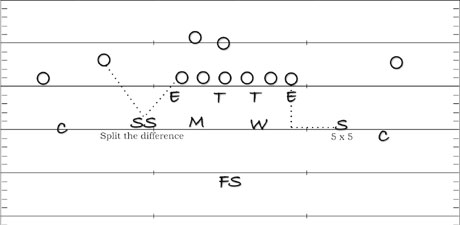
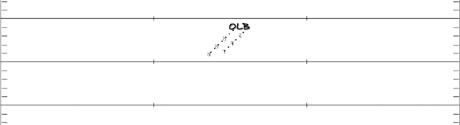
With the ONU defensive philosophy covered, we can shift the focus to how we defend the spread offense. In our 4-4 defense vs. the spread, the OLB is the most important defender on the field. He is the primary contain player on runs to him; pitch from the QB to the cutback player on runs away; and our ‘slice’ player on passes. He will be in a ‘split the difference’ alignment between the EMOL and #2 receiver and a 5x5 alignment if there is a TE or single width (See Diagram 1). The stance of our OLB is an inside foot forward stagger, with outside foot at 45 degrees, eyes in on the near back looking through the EMOL. The read step for our OLB is a three-step shuffle at 45 degrees with eyes in on the near back looking through the EMOL (See Diagram 2). At the end of the read shuffle, he will know if it is run or pass.
|
|
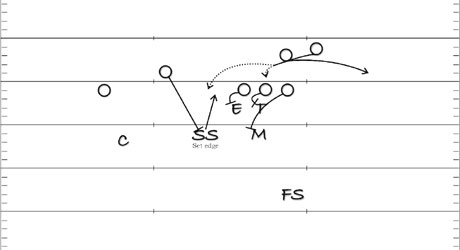
If it is a run to him, near back flow and a reach by the EMOL, then he will retrace his shuffle stem and set the edge. We want him to force the ball back inside, at the LOS, on all runs his way. He will take on all blockers coming from inside; that is, generally TE on Zone, with a rip by his inside shoulder, and squeeze the blocker as he gets downhill. Our OLB will take on all crack blocks by #2 with a rip by his outside arm and attack the ball at the LOS. He will take an outside-in angle and make the ball cutback that is setting the edge for containing the play (See Diagram 3). Our OLB CANNOT get cracked downfield and must attack the LOS if a crack is coming!
|
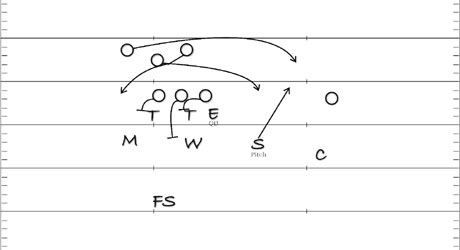
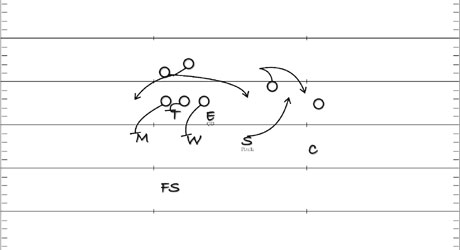
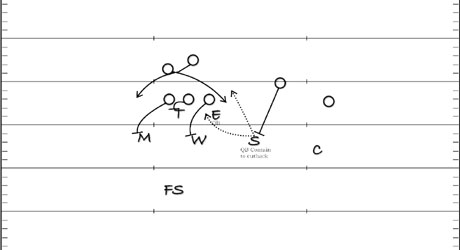
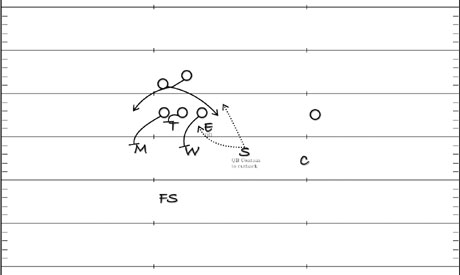
When the near back and the EMOL flow away (read zone away), then he will retrace his shuffle stem. As he comes down the stem he checks #2 to see if he is retreating to become the pitch-man on the option. This read will also apply if there are two backs, and the pitch-man comes from the backfield (See Diagram 4). If #2 is the pitch-man, then he will play inside-out to take the pitch away. The DE is the primary QB player (See Diagram 5). If #2 is not a pitch-man, or if there is a single width, the OLB will play QB to cutback. To play cutback he will stay behind a four-yard fence, find a window and fill it over the top and downhill NOW! (See Diagrams 6 and 7). If the QB keeps, and there is no pitch threat, he will play the ball outside in, making sure that he forces the LOS to take away the crack threat.
|
|
|
|
In our 4-4 scheme, the OLB must have a great stance, good read steps, correct pre-snap read eyes, and a proper angle on his shuffle stem. The angle of attack on blockers and ball carriers is very important. We generally want the QB to carry the ball on all option looks. This is due to the fact that the QB, on keep is more inside, and our FS can run the tight alley if the QB gets loose. Also, the athletes that are called on to be the pitch-men are generally more dangerous running threats than the QB.
We utilize a variety of schemes and responsibilities in our defensive game plans as we prepare for a spread option offense. The 4-4 is a staple of those looks. A variety of looks by our defense creates less predictability and forces the offense to truly read the defense as the play develops.
If you have any questions you can email the author at: DustinHada@GridironStrategies.com
WHAT IF?
Q1. What are the primary responsibilities of the outside linebacker if facing trips within the spread formation?
In our 4-4 vs. trips we put both OLBs together on the trips side and will balance back up vs. any motion. His run responsibility does not change. The Will backer (on the one WR side) must now play to pitch (speed option), and the weak side DE is the primary QB player on zone away. Versus the pass, we defend the flood first with both OLB\'s taking flat drops, one at 7-10 and the other at 15-17.
Q2. Are there specific situations against the spread where you’ll have the OLB blitz? Is it dependent on down and distance situations?
We use our OLB in combination blitzes with the Mike or Will backer or in situations where the game plan deems it productive to use the blitz. We look at man-to-man match-ups, tendencies, and protections to give us a good idea of the downs that we will bring pressure.
Q3. What are the primary ways an OLB can read a play pre-snap? Is it the formation, alignment, quarterbacks eyes, personnel grouping or a combination of all these things?
The first indicator, pre-snap, is the down and distance, along with formation. By knowing the scouting report for that week we can get a good idea on what to expect. After knowing the D & D and formation, a good indicator for run/pass is the stance of the OT. Next would be the QBs eyes. The QB will always check safeties, but if the QB looks at the cornerbacks he is probably checking coverage for pass.