IN THE LAST quarter-century, no offense has come along more difficult to defend than the spread offense. Much like the dinosaurs or gas-guzzling cars, the days of traditional, drop-back quarterbacks at the high-school and college level are numbered. Now, teams are incorporating a mobile QB into their offense. This QB kills you with his arm and his legs. With a mobile QB in place, no offense puts that player to better use than the spread.
While defending the spread may seem like a daunting task, there are methods, strategies and some practical considerations available to alleviate the problems a spread offense presents to a defense.
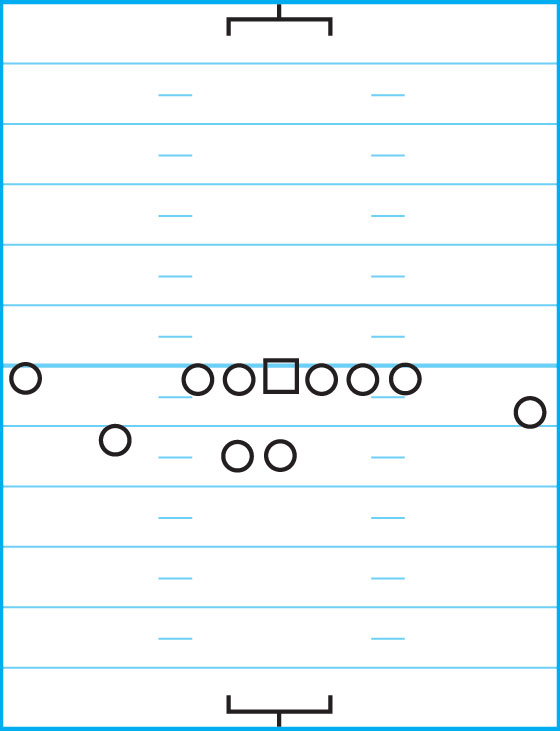
For practical purposes, the spread offense lines up in an offensive set like the one shown in Diagram 1. The mobile QB has four or five receivers available for passes, which puts a tremendous strain on the defense. A spread offense with a veteran QB at the helm is even more dangerous. An experienced signal caller reads blitzes, figures out zone coverage and know when and where to pick apart your defense. Whether the offense settles for dinking and dunking with short passes or goes for a long home-run pass to beat your man-to-man coverage, a veteran QB running a spread offense is difficult to defender.
Diagram 1: Spread Offensive Set. With a mobile QB in the shotgun formation, the spread offense typically goes with this set, which causes the defense fits if its not prepared. The QB has four or five options available for passing or if the team likes to run, a spread offense softens your defense in the middle.
preseason considerations
A change of defensive thinking is critical to stopping the spread offense. Typically, making a slight shift in your defensive philosophy is easier done in the preseason, rather than during the season.
During the preseason, take a look at your upcoming regular-season schedule. Mark the teams that use the spread offense.
The next step is to design your practice schedule with defending the spread offense as a priority. For example, during the early days of practice, teach coverages and alignments against a spread offense first. Most coaches typically use early-season practices to defend two-back sets. By learning to defend a spread first (by understanding the coverage schemes against four or five wide receivers), the defenders are in better shape to contain a typical two-back set.
Think about this — if you only work on defending two-back sets in the early stages of practice, what happens when the team you first scrimmage comes out in a spread? They are going to run all over you. This brings down the confidence of your squad and sets them up for disaster at such an early stage of the season. Plus, the players lose confidence in the ability of their coaches to prepare them to face this type of advanced offensive set. Your season is off to a lousy start and you haven’t played your first official game yet.
know what the offense wants to accomplish
Knowing what the offense is trying to accomplish by using the spread is the most important factor in defending this type of set. Some teams want to spread your defense to run and pound the ball at you. Others spread you to throw the ball. Rarely does a team have a good balance of running and passing out of the spread.
This is where doing your research, studying film and scouting your opponents becomes critical. After studying film, you should know what your opponent wants to do with the spread, especially in certain situations. Don’t over-analyze the play selection of the offense. Just get a general sense of the offensive strategy of that team’s spread set. Once you know what the opposition wants to accomplish, your defenders are in a better position to stop it.
to blitz or not to blitz
Coaches have all sorts of philosophies to stopping the spread. Some want to blitz, blitz and blitz again to disrupt the timing of the QB with the WRs. Others play a zone to force the offense to drive the ball down the field instead of beating them for one big play.
If you are going to blitz, make sure you have the athletes who can get to the QB. When a team comes out in the shotgun and utilizes a three-step drop, the ball is coming out of the QB’s hands quickly. By not getting to the QB when blitzing against the spread, your defensive backs have increased pressure put on them. Plus, with your linebackers heading toward the QB, you have less bodies available to defend the short passes. Most offenses are going to have hot calls as soon as they read the blitz, which means the pass is coming quickly out of the QB’s hands.
If your team has the ability to get to the QB, go for it. But, if not, don’t set them up for failure by blitzing on every down. Sprinkle it into your defensive scheme occasionally but don’t rely on it.
coverage schemes
After figuring out your blitzing philosophy, switch your attention to your coverage players. Are they capable of handling the WRs one on one? If so, then you have more defenders available in the box to deal with the inside reads of the QB.
If your DBs can’t handle one-on-one coverage, then you have to play zone. Now, your biggest concern becomes tackling. Playing a 3 Deep or 4 Deep coverage allows the offense to complete short throws. For your defenders to be successful, they must tackle well.
After emphasizing in all players the importance of proper tackling when defending the spread, the attention turns to the actual coverages. Disguising and varying coverages against the spread is an absolute must. Work with your secondary to show different looks. Try to get them to show man-to-man coverage, then drop back into a zone and vice versa. The more confusion the defense creates, the better chance it has at success.
Keep in mind, disguising your defense is not easy. Players need time to develop this skill. Don’t walk onto the practice field the Monday prior to playing a spread team and think you can get your defenders ready to disguise defenses in the matter of three or four days. It must be a consistent part of your defensive package.
Varying your coverages is critical as well. Sitting in a zone, especially if your opponent is adept at throwing, does you no good. The offense is too good not to take advantage of the easy throws to pick up first downs. At some point in each drive you have to play some man-to-man coverage to keep the offense honest and to take away those easy throws.
practice,
preparation
You cannot prepare adequately for a spread team in one week. Of course, if you play several teams in a row who utilize the spread, then your practices can focus solely on defending it. However, for most teams that’s not the case.
To incorporate the spread into your practices, even during the weeks when you’re not preparing to face the spread, dedicate some time during your seven-on-seven scrimmage period. Work spread plays into the seven-on-seven drill everyday.
Also, when facing a spread team, during that week’s practice, have your first-team offensive players (who don’t play both ways) be part of the spread workouts with the defense. The hardest part about simulating the spread in practice is not having the best athletes on the field to showcase the speed of the package. If there is a significant dropoff in talent from your first-stringers to your second-stringers, it’s in your best interest to have those offensive starters on the practice field. The starting defense benefits by seeing a much faster, crisper team that better simulates the opposition and the offensive players get some excellent work against the first-string defense.
alternative plan
When becoming fully prepared to defend the spread, be sure to have a good back-up plan in place. This includes adjustments in scheme or personnel you can utilize if you get into some trouble during the game. Of course, these adjustments must be practiced as well.
By practicing these adjustments, as well as preparing your players for any type of situation, you create confidence among your players. They are ready for anything and are confident that you as a coach has them ready to face all situations in a game.
Plus, you aren’t panicking on the sidelines during the game if things start not going your way. You don’t have to draw quickly on a white board on the sidelines and the players don’t have to see you sweat (once again keeping their confidence high in your abilities to handle pressure). This especially holds true if you feature a lot of two-way players. It’s difficult to make in-game adjustments when half of your defensive unit is on the field with the offense.
Defending the spread is going to cause your team fits. As long as your defense is prepared, well-coached and calm — even during times when it seems like the offense can’t be stopped — you can have success defending this intricate offense. While there might not be any universal method to slowing down the spread, it is possible to have success if you continue to stress preseason preparation, scouting, knowing your personnel, tackling, disguising coverages and overcoming adversity with alternative plans.