When discussing the 46 or Bear Defense, most coaches chalk up the defense with an 8 man front, utilizing blitzes and man coverages to:
• stop the run;
• make them throw and make them throw fast.
However, Coach Rex Ryan taught me a few variations of the 46 that looks like a man coverage but is actually a combo coverage.
The combo coverage variation has been good to us the past 16 years. It is our initial adjustment to twins, trips and double tight trey formations. The adjustment gives the pre-snap read of man free (man coverage with a free safety over the top) with 5 man pressure or man coverage (no help over the top) with 6 man pressure.
Huddle call is 6, which is our base 3 deep – 3 under zone. We give up the flats, but will not let you beat us deep. If you throw in the flats, we’ll come up and rock you and dare you to do it again. We believe that we are more patience than the offense and that they won’t dink it down the field consistently (See Diagram 1).
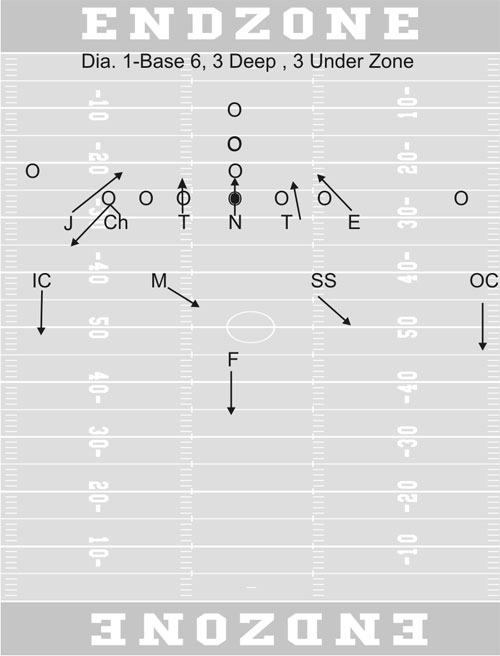
Alignments of the Backers (Hit Men) and the Defensive Backs (Palace Guards):
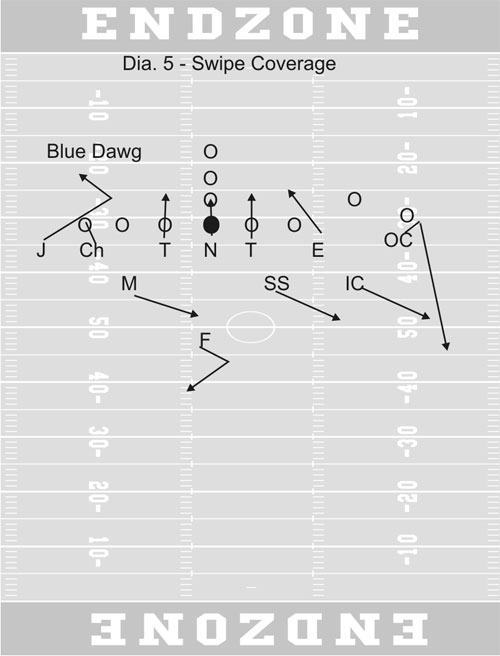
The Free Safety aligns in the middle for the formation and keys the G-C-G and QB triangle. His depth depends on the scouting report information, receiver splits, down and distance and field position. When the Free recognizes the proper formations he’ll yell “flop” (corner over) and then “Swipe” which is the defensive check call. “6” has now become Swipe (See Diagrams 2 & 5).
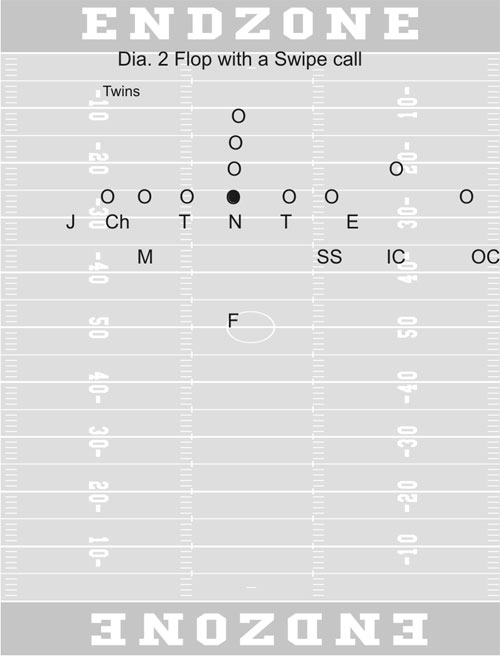
We flop our Corners, so they are on the same side (See Diagram 2). Corners yell “flop” when they recognize the formation and everyone echoes the call and adjustments needed.
The outside Corner aligns with an inside press technique, outside shoulder to the inside shoulder of the #1 receiver. His feet, hips and shoulders are square to the receiver and his eyes are on the belt buckle. He is listening to the snap cadence (See Diagram 2).
The inside Corner aligns 1 yard inside and 5 – 7 yards off the #2 receiver in twins or aligns in the apex plus one step outside, between the #2 and #3 in trips or double tight trey. His depth depends on the scouting report information, receiver splits, down and distance and field position. He focuses on the #2 receiver during the pre-snap read but reads the OT to QB on the snap of the ball (See Diagram 2).
The Strong Safety, based over the weak offensive tackle, has his heels 4.5 yards off the ball in twins and double tight trey or is in the apex plus one step outside between the #3 receiver and the OT in trips. He has a hard focus on the near back and a soft focus on the OT (See Diagram 2).
When the Strong Safety has to leave the box, he gives out a “Jayhawk” call which alerts the Mike and Charlie backer to adjust their alignments (See Diagram 2).
The Mike backer is head up on the strong OT in base and slides over towards the weak-side with a Jayhawk call. His adjusted alignment depends on the scouting report, but usually he’ll end up head up on the weak OT. He has a hard focus on the near back and a soft focus on the OT (See Diagram 2).
The Charlie backer is our strong outside backer. He aligns with an inside shade on the tight end. He splits the crotch of the tight end with a two point stance and is squared up on the LOS. His eyes are on the belt buckle of the tight end (See Diagram 2).
Our Jack backer is the strong side defensive end. His stance is also a two point stance with the outside foot forward and he is tilted towards the ball, at a 45 degree angle. He is 1.5 yards outside the tight end and has a hard focus on the tight end’s hip and a soft focus on the QB. The Jack squeezes the LOS as much as possible (See Diagram 2).
Run Responsibilities:
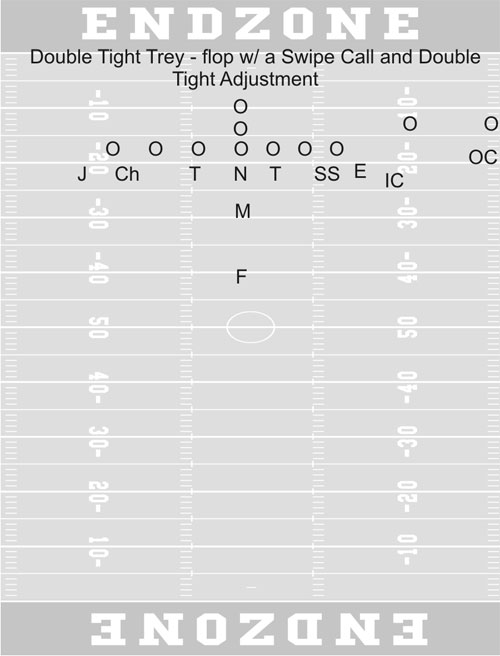
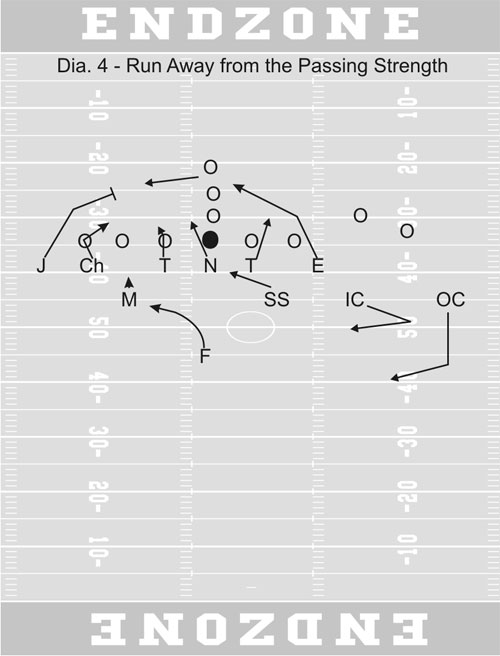
Free Safety: with low hats by the OL, he’ll start forward in the direction of ball flow. He executes a “J” angle as he approaches the LOS keeping the ball to his inside. He has pitch on pitch on weak side option and is the garbage man on strong side option, meaning he checks off dive-QB-pitch as he attacks the ball (See Diagram 3 & 4).
Corners: are secondary run support on all runs. With wide runs to the weak side, they will help with contain.
Strong Safety: has C gap on ball and weak side A gap on ball away. He has QB on option. In a Jayhawk adjustment, he takes outside runs to his side, and is slow to flow cutback on plays away (See Diagram 3 & 4).
Mike: he is a free hitter and has QB on options. Ball away he has back-side A gap. In a Jayhawk adjustment he takes the weak-side C gap on ball and weak-side A on flow away. And has the QB on option (See Diagram 3 & 4).
Charlie: anchors down the strong side C gap and takes what shows on option, typically the veer back. In a Jayhawk he has strong side C gap play and strong side A on play away (See Diagram 3 & 4).
Jack: anchors the outside and forces everything inside. He slow plays the QB on option but takes pitch. He has “BCR” on play away, which is Bootleg, Counter, Reverse, and he must stay at ball level with his pursuit (See Diagram 3 & 4).
Pass Responsibilities:
Free: with high hats by the OL, he’ll open up at a 45 degree angle to the passing strength side and read the QB’s eyes. If the QB is adjusting and hot reads to the #2 or #3 receiver on a hot throw, the Free breaks to the ball and either picks it or unloads on the receiver. If the QB is dropping back, rolling out or executes a play action, the Free drives deep at a steep angle to the passing strength for 3 steps trying to give the illusion of man free, then whip turns to the weak-side and is the deep help for the Charlie and Jack, like a cover 2 safety (See Diagram 5).
The outside corner echoes the “swipe” call and sets up in bump coverage. Then right before the ball is snapped he slide steps to outside leverage on the #1 receiver, pivots on his outside foot, punches his outside arm towards the receiver’s outside shoulder and sprints back to deep outside third zone. He is reading the EMLOS’ hip to the QB’s eyes for a run, quick throw, 3 step throw or option. He’ll react to the short throws when the ball is in the air. We call this our “bail” technique (See Diagram 5).
If he is caught in his slide, he physically punches the outside shoulder of the receiver and works on staying over the top.
The inside corner echoes the “swipe” call and with a pass read he’ll “swipe” over the #2 receiver and take the flat area zone the #3 receiver. He reads the routes by the receiver and adjusts his angle accordingly. He re-routes any receiver that crosses his face (See Diagram 5).
The Strong Safety echoes the “swipe” and with a pass read opens up and swipes to the curl zone over the #2 receiver. He’ll re-route any receiver that crosses his face. If he needs to leave the box to get to his proper alignment then he’ll yell out “Jayhawk” (See Diagram 5).
The Mike echoes the “swipe” and with a pass read, will swipe to the passing strength hook zone over the #3 receiver, rerouting anyone who crosses his face. He adjusts to the proper alignment with a “Jayhawk” call (See Diagram 5).
The Charlie echoes the “swipe” call and with a pass read he has the tight end man to man using an inside trail technique. His first step is always towards the tight end’s crotch, so he is in a good position to wall off the inside. He will adjust, but still takes the tight end with a “Jayhawk” call (See Diagram 5).
The Jack echoes the “swipe” call and yells out “blue dawg” meaning that he blitz and engages the back if he crosses his face. He blitzes off the corner but if the back tries to flair, he’ll take him man to man with an inside trail technique. We tell him, if he knocks the back down, he won’t have to run very far (See Diagram 5).
Offensive Adjustments and Defensive Counters:
One of the first things that offenses have done to our flop adjustment is to shift the tight end out and get one on one with our Charlie. When the Free reads this he adjusts his drop to get there sooner to help out Charlie. We have even adjusted his alignment to have him move over to the hash nearest the tight end.
We have also checked out of our flop in the huddle and then the corner just stays on the tight end’s side.
We have also had the Free take the tight end with loose man technique and had the Charlie take the deep hole in the middle. He must be fast to do this adjustment.
With motion we can either check into “Swipe” or back into “6” depending on the original play call.
Hopefully, you can see how a base 3 deep, 3 under coverage has checked into a solid combo coverage with cover 3 on the passing strength side and man, with help over the top, on the weak-side.
With the illusion of press man on the passing strength side, we have been able to get the offense to check into fade routes or deep throws and therefore have gotten most of our team’s interceptions out of this coverage check.
I realize that I didn’t cover any DL techniques that are huge with this front and coverage but that is for another chalk talk. There are also some smaller details left out because of the size of the article but I have tried to cover the main areas.
With today’s Spread and Wing-T, which is what we face the most often, we don’t get to play this great defensive coverage much any more, but still use it when we see a team that will play with a twins, trips or double tight trey look.
The Jonathan Randall Coaching File:
1984- 1987 – Rocky Mountain College Secondary, Linebackers and DC (85-86)
1987-1988 – UNLV
Graduate Assistant Defense
1988-1991 – New Mexico Highlands U DC (88, 90, 91) Secondary (89)
1992 – 1995 – Great Falls High School Secondary
1996 – 1999 – Nebraska Wesleyan U DC
2000 – Charles M. Russell HS Freshmen Defensive Coach
2001 – Present – Clover Park HS DC (01, 02) Head Coach & DC (03 – present)