For a positional coach, preparing to coach the Outlaw safeties is a nightmare. They play a demanding position that requires them to shed blocks, tackle in space, cover man-to-man, play quarters coverage and as a free safety, blitz hard core. For the purpose of this article, we will discuss a few fundamentals of the Outlaw position including stance, reads, keys and drills.
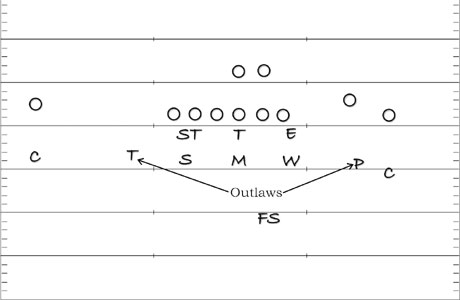
While at Rowan, our staff was broken up into four position coaches: Defensive Line, Linebackers, Outlaws and Secondary. This allows us to spend the maximum amount of time with our players on the knowledge, fundamentals and effort required to play each position in this defense. Our ‘Tango’ plays to the strong side of the formation and is a linebacker type of player with explosive ability. Our ‘Prof’ is considered our second boundary corner and plays to the weak side of the formation. Without question, he is our most athletic football player on defense. Both Outlaws must have an ability to play fast, be relentless, and use good technique (See Diagram 1).
|
The Outlaws use three types of stances: Stagger, Base and Tilt. The stagger stance is used because we want to give the impression that we are blitzing. It is a heel-toe stagger with our ball foot up. We will use the stagger when we align 3x3 off of a TE in a pro set, or 4x4 off the end man on the line of scrimmage (backside) in a split set.
One quick way to get our players in this stance is to tell them they are baseball outfielders waiting for a fly ball. The palms of their hands should weigh on the top of their knees with a 45-degree bend to the back and be relaxed. On command, the players drop their far foot back on a heel-toe stagger. The inside hand falls just below the sternum, while the outside hand falls closest to the line of scrimmage. Both hands are in a strike ready position. Our weight should be on the balls of our feet, with 60% of the weight on the foot closest to the ball.
The next stance is our base. It is used when we are leveraged to #2 in a twins set or man-to-man on a wide receiver. We are looking for an athletic stance with our inside foot slightly forward, feet shoulder width apart, weight balanced, with a good bend. Our focus is on the inside hip of the man.
Lastly, our tilt stance is designed to keep leverage on a tight end. We are cocked in a 45-degree stance, typically into the boundary. We want to stare down the ‘V’ of the neck of the tight end and look in at everything in front of us. In this stance, we are very run heavy; therefore, we are 1x1 off of the TE by alignment.
We believe that one of the most basic fundamentals in coaching this position is teaching our players their read keys. Typically, in the beginning of the practice week, we focus on our run reads. By the end of the week, we are stressing more of the pass game. This flows better with our philosophy of less contact as the week progresses.
Our main run reads focus on power, zone, option and trap. We like to use our own players in a pre-practice ‘Reads Drill’ segment to get them acclimated to the specific blocks of our opponents. The idea is for our players to have a general understanding of how they are being blocked and what an offense is trying to accomplish by blocking us this way. We like to focus on these everyday reads to stay simple and ensure that our kids understand their responsibilities in the run game (See Diagram 2).

|
With a three-man surface (TE, OT & OG), we are going to read the TE to the rear back triangle. In a two-man surface (OT + OG), we will read the uncovered guard whether we are aligned on a removed #2 wide receiver or not. When we get a down block from the TE to double-team our strong tackle, we want to hug the double team on a spill angle course. When we see this, we want to get hot and hit the near back heavy. If the running back has to bounce his course outside, that is acceptable. But, we don\'t want a power football team to be able to slam it into the C gap. On the kick-out trap, we want to keep our edge, stay low and try to keep it tight to the down block. Spending time with Mark Reardon, the DC at Villanova and Jeff Casteel, the DC at West Virginia, was very significant in helping us with our gap fits and responsibilities for this defense.
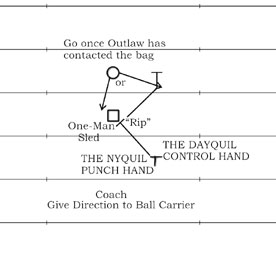
The Explosion Drill is great for attacking blockers and staying low (See Diagram 3). When attacking a blocker, I like to refer to our punch-control points as DayQuil and NyQuil. The NyQuil is the inside, punch hand that delivers a blow to the sternum of the opponent and is used for shock momentum. The DayQuil is the outside, control hand that keeps us in our D gap responsibility. From this position, we like to work push-pull drills that concentrate on fighting off blocks and working our way to the ball carrier.
|
Our coverage reads are mostly done in our Cover 3 or 4 zone. I will talk about our Cover 3 reads in pass support.
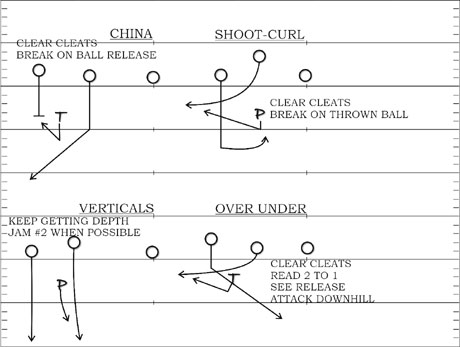
In Cover 3, our rules state that outlaws are curl-to flat-players. More importantly however, we want to be physical with wide receivers in the pass game. In 3-step action, we want to read-step peddle by clearing our cleats, not bailing out. We will read off of the #2 WR to #1 WR. We teach our players that there are standard rules that exist with wide receiver combination routes. For example, if the #2 WR’s route goes outward, then #1’s route is coming in. Does this happen all of the time? No, this is what we want our players thinking when we see this happen.
Once pass is recognized, we want to jump the 3-step game when the ball is released. In the 5-step game, we want to be physical and disrupt the #2 wide receiver’s route. We work on these keys in a ‘Box’ Drill (See Diagram 4). On command, the wide receivers run routes are dictated by the coach. The Outlaw should always attack downhill vs. the 3-step game. If the #2 gets depth in his route vs. 5-step, the Outlaw will look to disrupt #2 and be late to any hitch by #1.
|
A great drill I used to see Gary Blackney doing when he was the defensive coordinator at the University of Maryland has been implemented in our program (See Diagram 5). The ‘Terps’ drill is especially important because it incorporates every aspect of being a defensive back including the back peddle, turn and open, speed turn, break, and a ball skill. Our kids get after each other in this drill because by the time the ball is thrown their legs are a little tired and dropped balls always cost 10 push-ups. It\'s fun to incorporate incentives into our drills!

|
The Outlaw safety is an all-encompassing position that requires coaches to teach multiple football skills. The fundamentals of stance, reads and keys help our Outlaws play fast and explosive. The Reads, Explosion, Box and Terps drills help our players understand the critical fundamentals of playing this position.
Mark Hendricks recently became the Secondary Coach at James Madison University. He previously was the Defensive Coordinator at Rowan University. You can reach him at MarkHendricks@GridironStrategies.com.
WHAT IF?
Q1. What if, in your base 3-5-3 alignment, you face a 2 x 2 set. Would you realign the Outlaws differently?
It all depends on the coverage. Any 2-high coverage will force the safeties or OLB inside of the #2 WR. With a 1 high safety, coverages such as Cover 3, the safeties can align outside of the #2 WR. This allows the LBs and FS to pursue the ball carrier inside out. Outside leverage can also take away the bubble screen by alignment.
Q2. What if you face a trips set to one side. How does the configuration change in getting set for this offense?
The LB’s will typically gap align to the passing strength in a trips set. This allows the weak outlaw safety to really get into the box vs. the run game. To the trips side, the strong safety won’t get out-numbered if the LB splits the difference between #3 and the end man on the line of scrimmage. Going against the spread offense is all about being sound on alignments, so you’re not getting outflanked.
Q3. What if you face a double tight end set? Where do you position the Outlaws?
Seeing a double tight set is great against the run because the 3-5-3 is still an 8-man front. When you get a double tight set, the Outlaws will screw down their alignments a little tighter than 3x3, depending on the down and distance. With a tighter alignment, the Outlaws should be prepared for play action and bootleg by working their reads in practice.