If you can control the ability to get free runners at quarterbacks in blitzing scenarios, then why wouldn’t you? The utilization of some read techniques can affect slide protections and produce positive numbers at the point of attack.
We use a “shizzle” technique on our defensive line to put the math in our favor. The term shizzle stands for ‘Shock and Shed’ to the inside vs. all base or reach blocks. The opposite zone or slide protection movements that work away from the defensive linemen are covered by playing the opposite gap through the backside of the offensive player. Our guys start their initial steps exactly the same as if they were playing their play-side gap. Our goal is to get a great strike and work to control. The difference occurs when the block is at them. They now post-rip to the opposite gap instead of the near gap. This movement has been effective in the run as well because it makes it difficult on zone blocking schemes. They don’t expect a player to move late to the inside gap.
Let’s apply this concept into our blitz schemes. When we achieve third and long situations we move to a ‘shuffle’ alignment. This means we get into decoy alignments. In the diagrams you can see our initial alignment and how we can make this work out of our four-man front blitzes and our three-man front pattern read blitzes (See Diagrams 1 and 2).
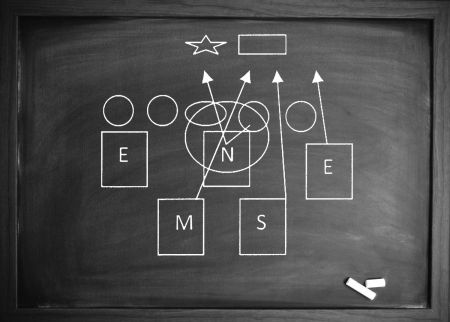
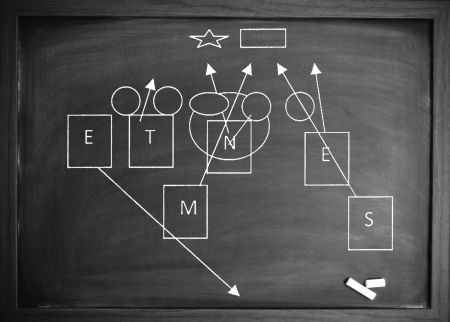
In our ‘Gut Blitz’, the nose guard’s job is to occupy a two-for-one on the near guard and center. For the purpose of this article let’s assume we have a bead on their slide protection tendencies. Let’s say they are sliding to the 3-technique. As a result, most gap-slide protections will have a four-man slide toward that direction with the guard being the last player who will protect any movement going back to the man side. Our 1-technique will not slant immediately to the opposite A gap, but rather he will use the shizzle-read concept as he attacks the center’s shoulder. With the center sliding away from the nose and towards the 3-technique – he now will play the opposite A gap off the center’s butt.
With the nose not crossing the center’s face, it forces the guard to stay on the nose. Mathematically, the pass protection now has the blitz-side guard on the nose and the center will be protecting the slide side A gap. Fortunately, for our blitz , we are not attacking that A gap and as a result have occupied two blockers with only one defender. Now we have the ability to blitz both backers into the man side B gap producing a 2 on 1 on the running back. The man-side tackle is locked on the 5-technique and with only the back remaining, we have the free runner we schemed for.
This is only one example of how we try to produce mathematical advantages in our blitz package. Our goal is not to produce one-for-ones because that means they can block us. If we do our job on first down, then we can earn the opportunity to keep the math in our favor on second and third down. Don’t settle for one-on-ones because you have to hope your players are better than your opponent. Find ways to win with lesser players. Find the math advantage in your blitzes, coverages, and run fits. We preach these concepts so our guys understand our objectives in game planning. I like the shizzle concept because it is easy to execute. Our players aren’t worried about keeping the outside arm free. Rather, they are ready to hit that post player hard and, if he comes at them, he will be striked cross face. If the post man moves away, then our players stay square and bend hard to squeeze the air out of that space.
About the Author: Ben Murphy completed his third season as defensive coordinator at Wisconsin Lutheran College in 2010. He also serves as the team’s strength and conditioning coach. Murphy previously coached at Northern State University. He is a graduate of WLC and a four-year starter in the defensive line.