Blitz Building The 3-3 stack defense with multiple blitz packages can cause confusion for any offense.
Last fall, Bates College finished #1 in the country in Division III in turnover margin which was truly a team statistic. We made the decision to switch to the 3-3 stack defense four years ago and have become a true ball hawking defensive unit. This past season, we finished with 32 takeaways in 8 games and scored four defensive touchdowns. We are a pure zone pressure team outside of the hot zone and out of 612 snaps on defense in 2012, we blitzed 386 times.
Our entire defense is based on the theory that we force our opponents to execute under extreme pressure while maintaining consistent fundamentals so we do not give up big plays. We are committed to stopping the run and never letting our opponent dictate to our defense. We want to force TFLs, QB Sacks and turnovers by physically assaulting the opponent with our style of play.
By being able to create confusion, we can force an offense to commit a significant amount of practice time preparing for the wide variety of blitzes they will see. This, in turn, takes away practice time for things they want to do offensively. By using zone blitzes, we can put pressure on the quarterback plus have maximum coverage versus limited receivers. We want to play our defense with extreme intensity, discipline and aggression.
We believe in the 3-3 stack defense because it allows us to have simple adjustments and alignment rules. The defense can adjust very easily to every situation, formation and play. This allows us to disguise and have more multiple blitz packages. The simplicity also allows us to communicate with confidence and play faster.
Our basic philosophy and strategy
Blitz Mindset
1. Play Fast
2. Cause Havoc
3. Cause Turnovers
Vs. Run
1. Blitz Hard and Fast
2. Control your Gap
3. Make a play
Vs. Pass
1. Ball is coming out
2. Attack Protections
3. 1 on 1 = Land it
Bates Defensive Priorities
• Stop the Run - No one will run the ball successfully against our defense. We will commit as many people to the LOS as necessary in order to stop the run.
• Control the Pass - We are primarily a zone coverage team. We will take away the long ball and force our opponent to throw into our underneath coverage. By becoming proficient in disguising our intentions and being sound in our drops, we will break on the ball, create collisions, turnovers and incomplete passes. All 11 sets of eyes are on the ball.
• Tackling - We will be the best tackling team we can be. We will emphasize fundamentals in practice. We will punish ball carriers and develop the attitude necessary for a physically-dominating defensive team.
• Pursuit - We will have 11 people going to the football on every play. It doesn’t take a great athlete to run with great effort to the football – it takes a football player with a great attitude.
• Turnovers - We will create a minimum of three turnovers per game with our attacking and aggressive style of play. We will work these fundamentals every day, which will develop a competitive attitude to “get the ball out” and result in us scoring on defense or more possessions for our offense to score.
Building Your Blitz Package
To design an effective blitz package for your defense, there are specific priorities to consider:
• Who are you? Are you a zone or man pressure defense? Are you a base defense that pressures or a pressure defense that plays base? We blitzed 386 times in 8 games or 47 times per game.
• Do what your players can do well - for us, it’s zone.
• Your objectives are to stop the run, take the ball away and eliminate explosive plays.
• You have to be able to defend and pressure multiple offensive schemes from spread to two-back offenses.
• You must dictate to the offense - have a rule that no one gets you out of your pressure scheme.
• Have a default, minimal checks system and good disguise. Play fast and physical.
An effective blitz package allows you to:
• Not huddle and handle the speed of today’s offenses.
• Be multiple and involve everyone.
• Change pressures week to week with no new teaching.
• Have the ability to pressure from formational and field tendencies.
• Dictate to the offense with minimal checks.
To be proficient in creating turnovers, which is a major part of every blitz package, drills should be practiced daily. Here are some that can be very effective:
Takeaway circuit drills
1. Punch and Rake - Near Arm/Far Arm.
2. Two man strip with scoop and score.
3. Cloudy/clear fumble recovery.
4. Ball drills: DL - tip and catch; LBs - punch and drive; DBs – high point.
5. Blitz on the QB - frontside/backside strip.
6. Two-man fight for the ball.
7. Bag agiles with scoop and lateral.
8. Team pass pursuit and INT drill.
Try to chart ball disruptions involving all positions – D-line, linebackers, corners, and safeties.
You can build an effective blitz package by following this strategy:
• Have your own pressure philosophy
• Teach blitz directions
• Teach blitz paths
• Have blitz families
• Practice direction calls, defaults and disguises
• Signal procedures to players
• Wristbands - LBs/DBs and D-line
• Label each specific blitz
• Make sure your players understand coverages.
An example of pressure philosophy - pressure is the staple of your defense. Blitz a high percentage of the time and create big plays.
All great defensive players love to blitz, attack play aggressively and play on the edge.
Create an environment that is full of energy and fun for the players to take ownership in. The paths of all blitz categories will be multiple but the premise will remain the same. Fill gaps hard and fast to be sound vs. the run while attacking protections and creating overloads vs. the pass.
Blitz Directions – What we use that can be used in your system (Diagram 1).

• Strong = passing strength
• Weak = opposite pass strength
• Title = to the TE
• Open = 2 man surface
• Bomb = to the RB
• Away = away from the RB
• Field = on hash
• Boundary = on hash
• Wing = TE/WR only
Blitz Paths – examples you can use in your system (Diagram 2).
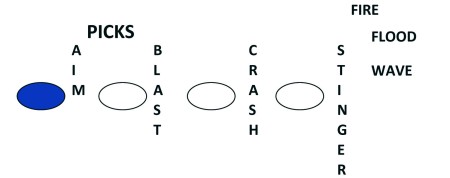
AIM – Key the OC - down block = bend, reach block-maintain gap, vs. RB pick up = 2-way go vs. O-line pass set – 2-way go.
BLAST – Key the OG – down block = bend, reach block-RIP and maintain gap, vs. RB pick up = 2 way-go, vs. O-line pass set – 2-way go (see the QB).
PICK – Aim and blast exchange between 2 LBs
CRASH – Key the OT = Down block = bend, reach block = rip through and maintain gap, vs. RB pick up = 2-way go, vs. OT pass set = 2-way go (See the QB).
STINGER – Aim one yard behind OT/TE, key near back. Run to = attack the back’s inside shoulder, vs. fan block by OT Rip, vs. fan by TE = bang it, run away=bend and chase.
FIRE – Aim five yards behind OT and two yards O/S NB, key near back. Run to = attack the back’s outside shoulder. Run away = play boot and reverse. vs. pass = upfield shoulder of QB.
FLOOD – 2 off the edge = 1 fire and 1 stinger between safety and LB.
WAVE – 1 fire and 1 blast (Mike)/crash (S/O) with DE long stick by DE to a gap.
Blitz Families – examples we use that you can use in your system -
• Pressure categories:
• Jokers – 1 inside LB making a four-man rush
• Apaches – combination of 2 inside LBs = 5-man pressure
• Cherokees – combination of 1 ILB and 1 safety = 5-man pressure
• Mohawks – combination of one or two safeties =4 or 5 man pressure
• Gangs – combination of 3 second level defenders = 6 man pressure
The paths of all blitz categories will be multiple but the premise will remain the same. Fill gaps to be sound vs. the run and attack protections to get extra blitzers vs. the pass.
About the Author: Chris Kempton is now in his seventh season as the DC and linebackers coach for Bates College. He previously coached at Colby College and was also a high school coach in Maine for six seasons.