This is the second of a three-part series on the philosophy and strategy of football by Brett Steuerwald. A legendary coach in upstate New York, Coach Steuerwald reflects on 54 years as a coach and 44 as the head coach at Shenendehowa High School in Clifton Park, NY. His overall record was 319-88-4. He received numerous local, state and national coaching honors and led his team to three state championships. This article is on being the best player you can be.
Don’t Be Satisfied
No matter how good you are right now, you can always get better. Everyone around you is working to improve and you must outwork them to achieve your goals. Football is a many-faceted game and offers numerous opportunities on both sides of the ball. Some players take a while to discover where they are best-suited to help their team and earn playing time. When dealing with high school boys, coaches need to remember there is a tremendous developmental change in young men from eighth grade to twelfth grade. An eighth grade fullback may become a tight end or center as a senior.
Players should learn as many varied skills as possible and be willing to adapt to both opportunity and desire. To illustrate that, at our year end meeting of returning players, I ask each athlete to write down on a 3 x 5 card their top five personal goals for the coming season. Then I ask them to flip the card over and right down team goals we should realistically aspire to for the coming season. I then ask them what would they do if their personal goal was in conflict with the team goal? Then, it is put in a more personal way.
For example, a player this past year was a back-up fullback behind two returning starters. We happened to be in great need of some help at guard where the player would greatly increase his playing time. I totally support the player’s position choice and it is clearly up to him. Another way to contribute to your team could be to play a major role on the scout offense or defense so that the player can show his potential and ability.
Be, Know, Do
What do coaches want of players?
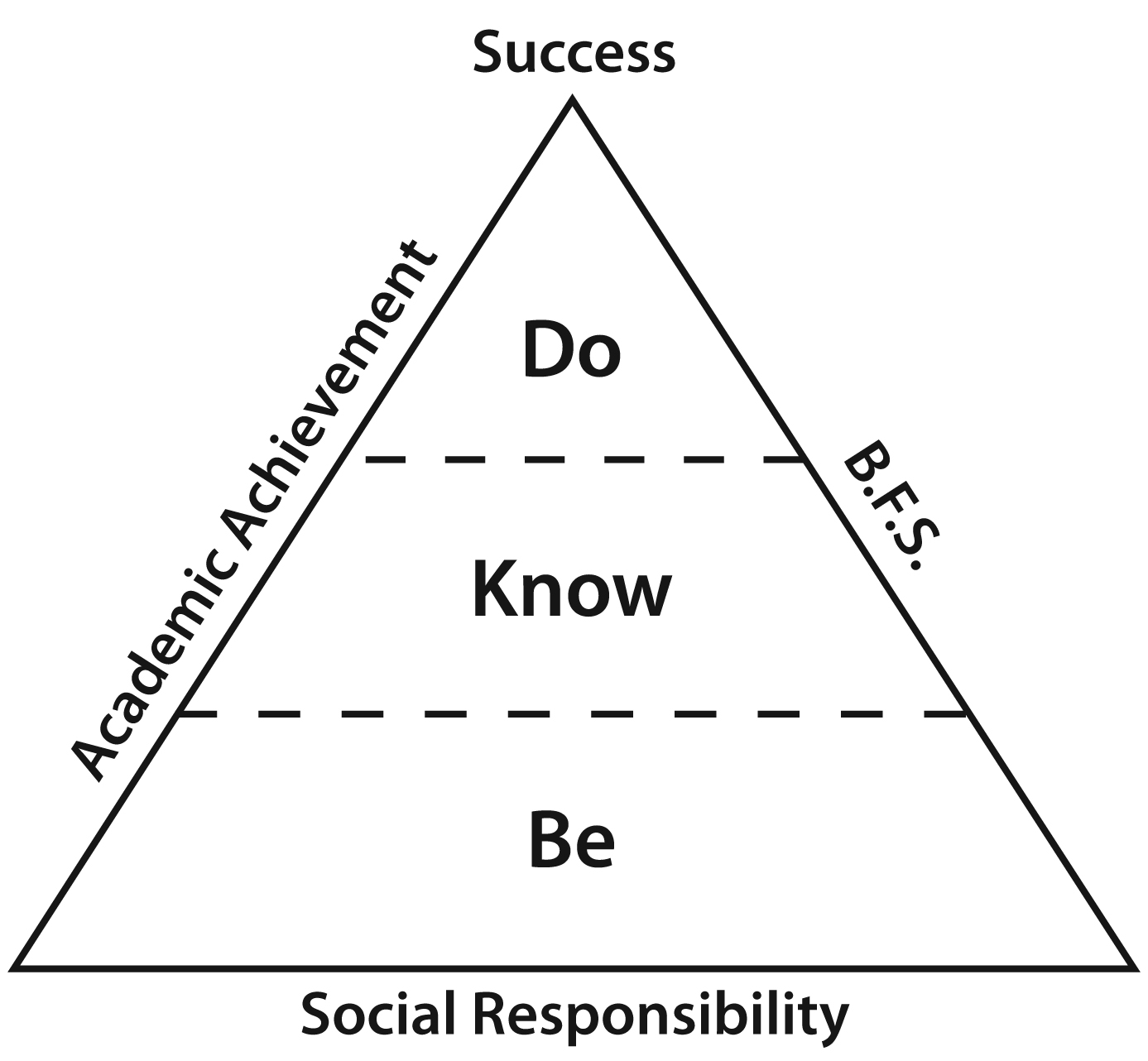
At Shen, football players are very visible and high profile people in the student body. In all cases, it is a universal truth that privilege brings responsibility. We expect our players to live up to a higher standard than any other sport or activity. To help visualize this, we have a Pyramid of Success that stresses BE, KNOW, DO. It is to be a person of character who can be counted on for exemplary behavior and be a standard for teammates and younger athletes. You must believe in yourself and be a tough and aggressive player without being nasty. Be respectful to all, keep your training pledge, and make everyone see you as a contributor to Shen’s tradition of excellence.
Next, know your job. Execute your offensive and defensive skills with both knowledge and understanding. Be versatile seeing the big picture and be able to help teammates if they are confused. Know how to apply solutions your coaches have taught you when faced with a challenge or problem during the intensity of a game. Never stop trying to learn more and more. Knowledge is power and the ultimate key to success.
At the top is DO. All things below are not important if you do not go out and do your job after the kickoff. What you do is the justification of all your commitment and preparation and what it really means to be a Shen football player. Excellence in life is not an accident.
Opportunities for Self-Improvement
Your coaching staff is always with you for practices, scrimmages, and games. However, to pursue the expectations that are part of the Shen mystique, we ask players to go well beyond that level of commitment. First is the morning workout program starting in December on Mondays, Wednesdays, and Fridays at 6:00 am for one hour which is devoted to all phases of player development. This includes strength, speed, agility, and in the spring, outside on the field for skill development. Varsity coaches are there to monitor and help but also keep individual improvement records. This is not a mandatory program but attendance is taken. Multi-sport players must first meet the demands of that sport but also try to find a day they can get in a morning workout that will not conflict. Over the years, we’ve had an average attendance of 40-50 athletes. The group is primarily 10th and 11th grade players who will be trying out for the varsity next year.
Younger class players are welcome but they have an after school program available to them. We have a football candidate sign up meeting in early March. This gives coaches the opportunity to check on players they haven’t seen previously or new ones who may have moved into the area or skipped the previous year. It also gives the coaches updated contact information and the chance to explain summer expectations. These would include our own multi-school skill development camp in late June. Then, three or four 7-on-7 competitions during the summer and team camps just before the season begins.
Another phase of opportunity, outside those conducted by the Shen staff, is position-driven and can be very developmental. Those would include QB/receiver camps and linemen camps as well as a multitude of college camps that cover all skills. I strongly encourage players that feel they could be successful as college players to pick out their two-three favorite colleges and make an effort to go to camp there. In doing so, you can get a feel for a campus environment and coaches you may be working with and whether or not it is the right fit for you. The bottom line is simple – your players have to believe that these are efforts all of your opponents are doing. Match it if you want to win.
Player Driven Development
Coaches clearly love to be in charge and monitor every phase of their players’ preparation and progress. This may not always be possible but may also be a negative in the long run of the development of young men who hold themselves accountable in all their endeavors. Shenendehowa has a background of moderately upper middle class living where students may be given advantages not common to inter-city schools or small town rural schools. That is not a guarantee that all is simple at Shen.
We have a considerable number of one-parent families and also a number of families with both parents working until early evening so that they can afford their homes. They should be very pleased that the coaches keep their children busy at school until practice ends so they don’t have time to make poor social choices. We also have to deal with family commitments that take the entire family to vacation spots for weeks at a time. What, then, do we do with a player when we know he is going to be gone 6-8 weeks during the summer?
First, we want to verify his schedule and remind him of what he cannot miss. That would include school physicals and scheduled practices. A miss would cause him to be ineligible for early season games. Next, I would remind him that the laws of gravity are not suspended wherever he may go. Even without equipment, he can do a program of push-ups, pull-ups, sit-ups, dips, and use stretch ropes for individual muscle groups. Speed and endurance drills can be run literally anywhere.
Speed is a combination of good form plus length of stride and frequency of stride. Distance running can be mixed with speed play or outbursts of speed for every 30 to 60 seconds for 10 seconds. Another great developer is to find a moderate hill incline and walk off 0-50 strides. Then, run alternate uphill and downhill sprints. Uphill is a power run to develop power and frequency of stride. Downhill is obviously a faster run but it increases length of stride so you get a feel of what it is like to take a few 10ths off of your normal 40-yard dash time.
You can also work with a length of stretch cord and a partner to do assistive and resistive running to increase overall speed time. Many players have the means to join health clubs, have personal trainers or have weight training equipment in their homes to contribute to their personal development. One reservation I have in today’s world is that you must caution all players against inappropriate use of banned or questionable substances. There is no substitute for hard work and time spent on a task to achieve desired goals.
Multi-Sport Participation
During my years as a football coach, I also was the Director of Athletics and Physical Education. As such, I took a very strong position that no coaches should tell their team members that if you want to be on a specific team, you can’t do anything else. Many of my best players were great all-around athletes that had excellent careers in multiple varsity sports.
When I retired, I had 28 physical education teachers and we offered 36 varsity sports for boys and girls with three or four levels for the majority of team sports. I have been known to say to my staff when I become czar of the world I would make every boy and girl play two varsity sports and never try to specialize in just one until their senior year, if then.
As you can well imagine, I did not always have agreement, but at least I explained my philosophy. Football players must absolutely have the choice and use it to experience all that their school has to offer in their development. In our smaller classification schools, other sports could not exist without dual sport participation. It is also no surprise that the smaller schools with the best programs may dominate many other sports with the same athletes. In high school, I played football and baseball and was cut from the basketball team. I wasn’t very big but I was slow. I got by because in the huddle, if a player did not know what to do, they would say, “Brent, what do I do now?” And I knew what to tell them. At Notre Dame, I tried to be a walk-on but was in way over my head so I played and coached Interhall football for four years and loved every minute of it. I have never looked back without a deeper appreciation of the life I have lived.
Review Past Performance
Visual reproduction of game performance of both you, the athlete, and your opponents is a vital key to personal improvement. Technology has made tremendous strides and now gives unlimited opportunities to both coaches and players to analyze and improve accordingly. In my early years, I did not have anything but film that we really could not replicate. Back then, coaches had to meet directly with players to show, explain, criticize and correct. We were not allowed by league rules to film opponents and, therefore, had nothing to rely on but scouting reports. The films were always in game sequence and made it hard to switch back and forth from offensive teaching to defensive teaching.
Video tape improved the process dramatically and then duplication and replay equipment evolved quickly. DVDs then allowed a much easier disbursement of varied information and self-analysis. It also allowed players to show their skills and their potential to college recruiters. Now, the HUDL technology allows players to share their football experience with their family as well as colleges all over the country. Nothing, however, tops the visual evidence of an over-penetrating defensive end, lazy team pursuit, poor tackling or missed assignments. Film analysis by coaches or players individually creates teachable moments that cannot be duplicated any more forcefully. Film does not lie or make excuses.
Be an Example and Inspiration
I learned many years ago that a wise man once said the best way to lead was by example. Then I learned an even wiser man said the only way to lead is by example. This world is made up of a great variety of personalities and talents. If not, life would be exceedingly boring. Identifying who your leaders are takes time and patience plus realizing there are many players who can fit into that category. We, as coaches, tend to think that the loudest, most aggressive player is the one everybody looks up to and wants to follow.
What if he is that way when standing around in the group but during practice you see him giving less than a great effort or has a coach giving him criticism and correction. On the other side of the spectrum is a player who impresses because he walks softly but carries a big stick. He is always hustling, seldom makes mistakes and is always encouraging to his teammates.
During my years as head coach I never selected captains until the end of double sessions and after cuts had been made. I made it clear that our captains are selected, not elected. I did, however, by proper ballot, ask all team members to list by priority the top three they perceived as the senior players they felt would be the best captains. Prior to the vote, I would define the challenging role team captains must handle as the leaders and their liaision status between the coaches and their teammates. After practice that day, the coaches would meet, tally the team opinions poll and determine whether we would appoint 1, 2 or 3 to this privilege.
The vast majority of the coaches and team members were in accord but, if not, I made the final determination. Then, during each week of competition, the coaches would pick a player who had an outstanding game performance and make him a captain for the week. About 20 years before my retirement, the captain came to see me and asked if they could pick a starter who was making a great effort or select a backup player and make him a game captain for one of our playoff games. That has become a tradition and is highly valued by the player and the team. Remember, every player can find ways to be a leader and inspire teammates by example.
Meet Commitments Beyond the Field
Every year of my career, it was a practice to give out a t-shirt with a saying on the back meant to be a focus or rallying point for that particular season. They were paid for by our booster club who took great pride in that yearly responsibility. Before giving those out, I would tell a story of what that saying means and why I want them to incorporate that into their lives beyond football.
One of my favorites was the word “W I N.” What it stands for is What’s Important Now – not just win or you’re a failure.
As players, throughout your life you will face choices big and small which can impact your life. My best advice to my players was to always assess what’s important now as these choices arise. For example, school is out at 2:45 and we start stretches at 3:15. If you are not on time, you will pay a price for being late so meeting with your girlfriend is not as important as getting to practice on time.
After practice, store your pads properly in your locker, assess what you should take home to be washed and then shower and go. Don’t get involved in towel snapping or messing around that will lead to injury or damage. If you’re driving home, don’t burn rubber or speed-up on campus. Security reports those incidents to the coaches and it could lead to a suspension of driving privileges. If you need to call home for a ride, knock on the coach’s office door and ask politely to use the phone. Don’t be like the player that asked me to use the phone, then called his mom and said, “come pick me up” and hung up. I made him call back and told him exactly what to say, “Mom, practice is over and I’d really appreciate it if you could pick me up and mom, I love you.” She then asked her son if the coach was there? She then said to me “I just want to thank you; I hope he learned a lesson today.”
After a player gets home and has dinner, should he offer to help clear the table or dry dishes or jump on the computer or phone to talk with friends? More importantly, should he focus on assignments and get them done to help his academic status? Day in and day out, we are all faced with choices. Remember always that life is cause and effect. Choose wisely or pay dearly.