ONE OF THE PASSING formations that had been giving our team the most trouble was the Spread Split Gun. To combat this formation, we developed an aggressive blitz call and a maximum-coverage scheme that thwarted its effectiveness.
Since we’ve implemented these two calls into our defensive game plans, we’ve seen less and less of this formation.
Blitz Call
The following blitz call puts a lot of pressure on the Spread Split Gun formation. The blitz call is “Red Exit Strong — Dog Weak” and the coverage call is “40 Spy Hot.”
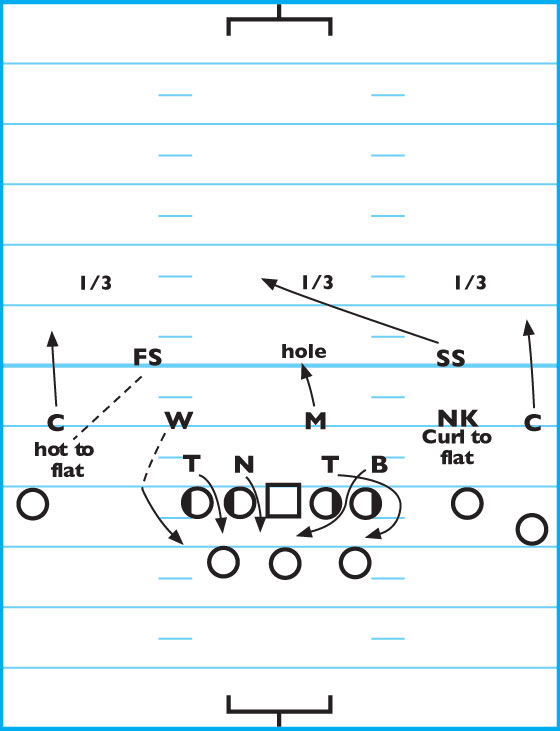
DIAGRAM 1: “Red Exit Strong — Dog Weak” Blitz Call. The original alignment is a standard 4-3 look with a Cover 4 shell behind it. The Twins formation requires that you “reduce” or move the nickel linebacker out of the box and into a coverage position. As the quarterback calls his cadence, the defenders start to cheat into their new alignment to play Cover 3.
The free safety rolls down to play the hot route from the No. 1 receiver on the weak side and then is responsible for coverage in the flat. The strong safety moves into position to play the middle third of the field.
The nickel/outside LB on the strong side is responsible for the curl to the flat zone. The Mike LB drops into the middle hole to cover drag or dig routes.
You’ll get good pressure from both the twist on the strong side and the dog blitz on the weak side with five rushers.
Against the run, your defense stays sound because you account for every gap, with the Mike LB responsible for the strong-side A-gap.
Max-Coverage Scheme
When we want to apply maximum coverage against the Spread Split Gun, formation, we use a man-under, 2-deep zone look. This coverage scheme is so swarming, that it forces the QB to hold on to the ball longer and allows the defensive front four enough time to get pressure.
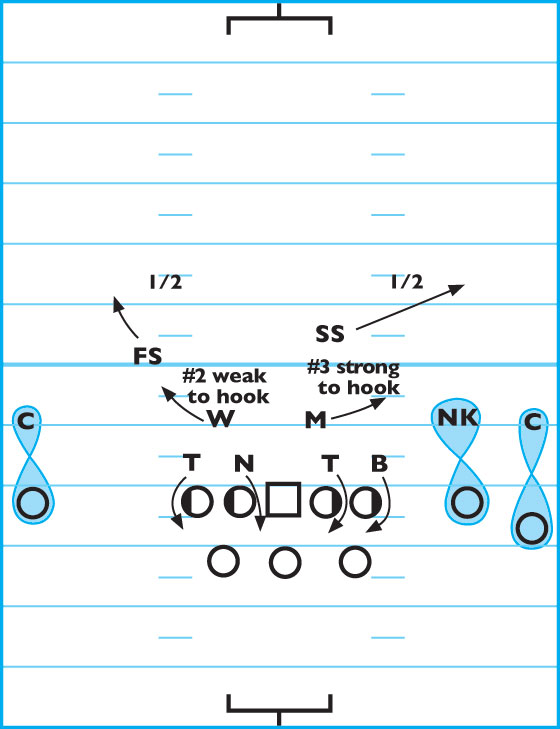
DIAGRAM 2: Max Coverage (Man-Under, 2-Deep Zone). Similar to the blitz call, the initial alignment shows a base 4-3 front with a Cover-4 shell behind it. The corners play at a depth of 6 yards, while the safeties play 10-yards deep.
Against the run, all the gaps are protected by the Mike LB on the strong-side A-gap, and the Will LB watching the weak-side B-gap. The corners play the No. 1 man with outside leverage and the Nickel LB plays the No. 2 receiver on the strong side with inside leverage.
If the backs release, they should be picked up by the Mike and Will LBs. If both backs stay in for pass protection, the Mike and Will LBs drop-hook and look to defend against any crossing or dig routes.