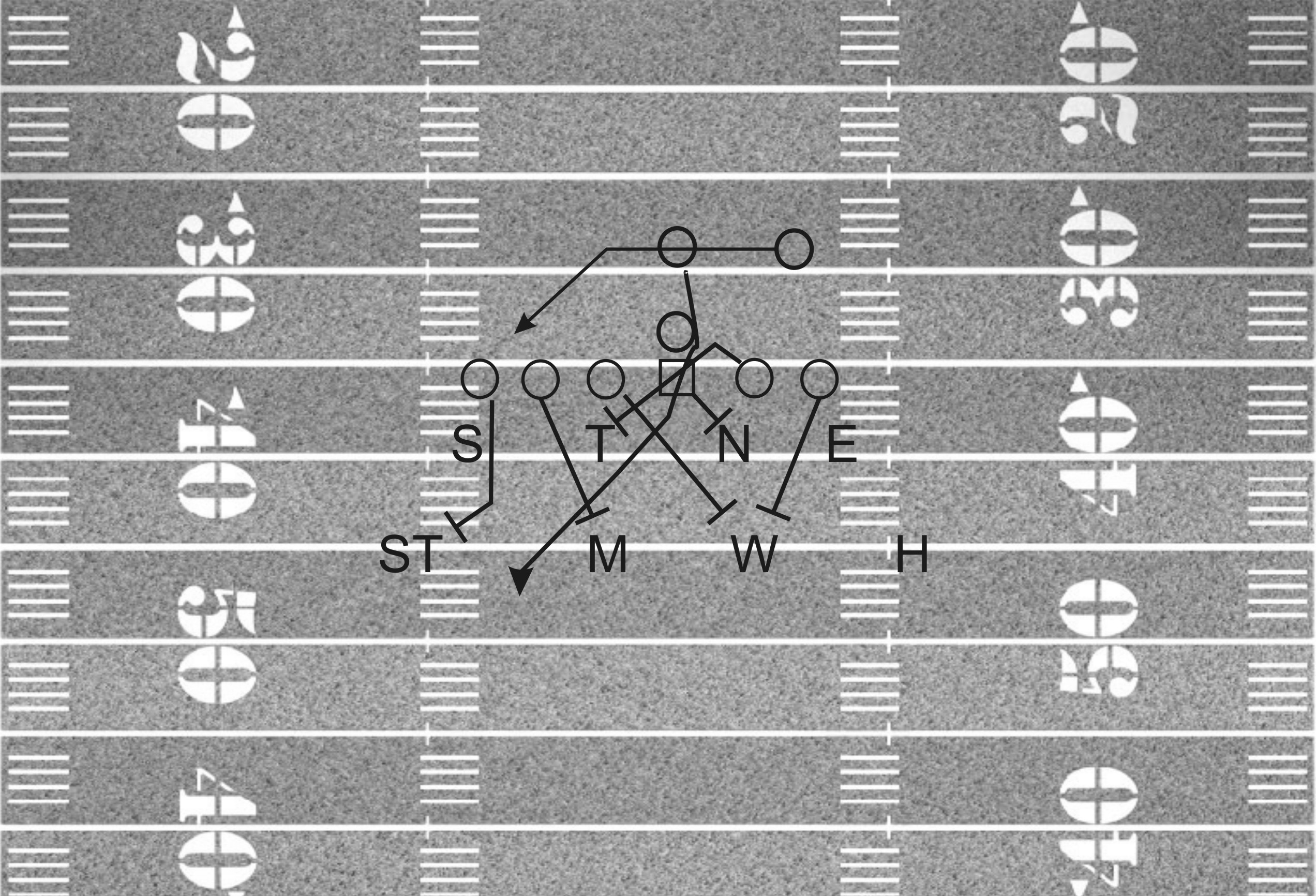
This discussion will address one of the oldest and most basic offensive plays: the Trap (See Diagram 1).
Every offensive scheme, including the spread, has this play built into its arsenal. The trap is designed to hit quickly and take advantage of an overly aggressive defensive line. It is one of the most demoralizing plays in football because it strikes at the very core of the defense. The play is not personnel dependent, but rather can be executed by a large powerful offensive unit as well as a quicker athletic front. It is also not subject to down and distance. It can be equally efficient on first down as it can be on third and long. In other words, this play is very effective and must be drilled repeatedly if we expect to become a complete defense.
We have always been an even front defense and have settled on the 4-2-5 as our base package. This gives us the ability to adjust our defense to the multiple offensive formations and schemes we encounter. In the past we preached ultra-aggressiveness to our front four, which consequently caused our defense to be cut in half by the trap. After spending a very frustrating season watching our 3-technique catching pulling guards under the chin, we knew it was time to change and give our players a complete set of tools. We decided to expand on the approach we utilized for teaching linebacker play. They were already reading offensive linemen. So, it was a smooth transition incorporating this skill set into our defensive line technique. We documented base offensive blocks and assigned a specific defensive line technique to each.
By naming each block we identified the precise technique required to combat each scheme. We settled on five distinct offensive line blocks: #1 The Drive Block – “Steel Rods”; #2 The Double Team Block – “Sit on a Stool”; #3 The Reach Block – “Push & Pull”; #4 The Pull Block – “Squeeze it Down”; and #5 The Down Block – “Claw & Bend” (See Diagram 2).
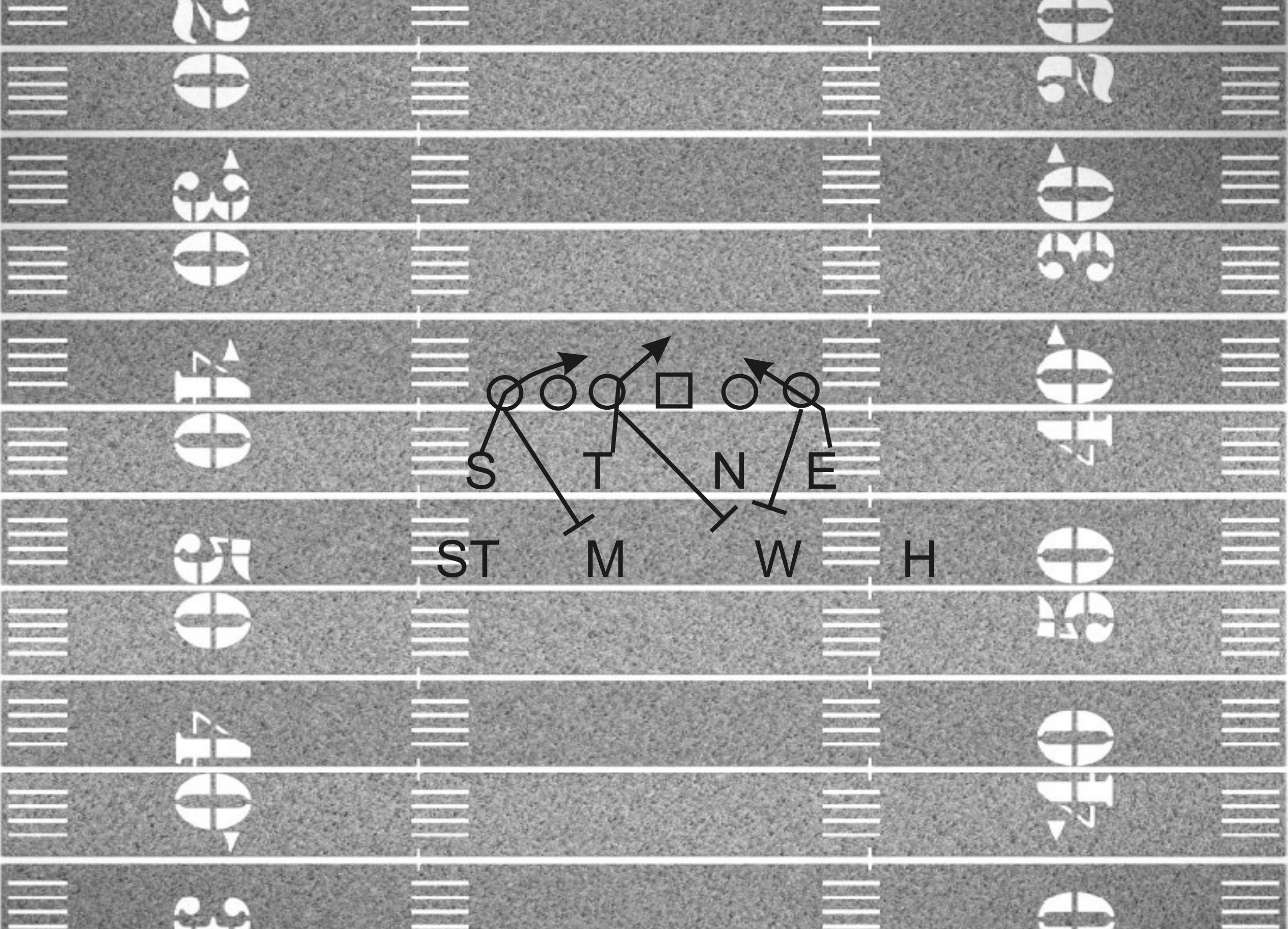
Not only does this give our players a specific course of action to deal with on each specific block, but it holds them accountable as well. Additionally, naming and connecting the technique to the block provided our players a visual picture associated with their responsibility. They practice and drill ‘The Big 5’, as we like to call them, on a daily basis. We now preach reading the V of the neck and letting the eyes pilot the hands and feet to the target. The player assumes his fundamental stance, shoots his hands, reads his visual key and executes the corresponding technique for the specific block he sees. This simple concept has allowed our front four to become exceptionally aggressive and attack with purpose as well as precision.
The front eight are primarily working in four separate pairs. The Mike and Tackle are both reading the strong side guard, the Will and Nose are doing the same vs. the weak side guard, and the outside linebackers (STrike and Hawk) along with the defensive ends (Stud and Eagle) are reading the end man on the line of scrimmage.
Additionally, we can flip personnel. The four strong-side players as well as the four weak-side players travel together (See Diagram 3).
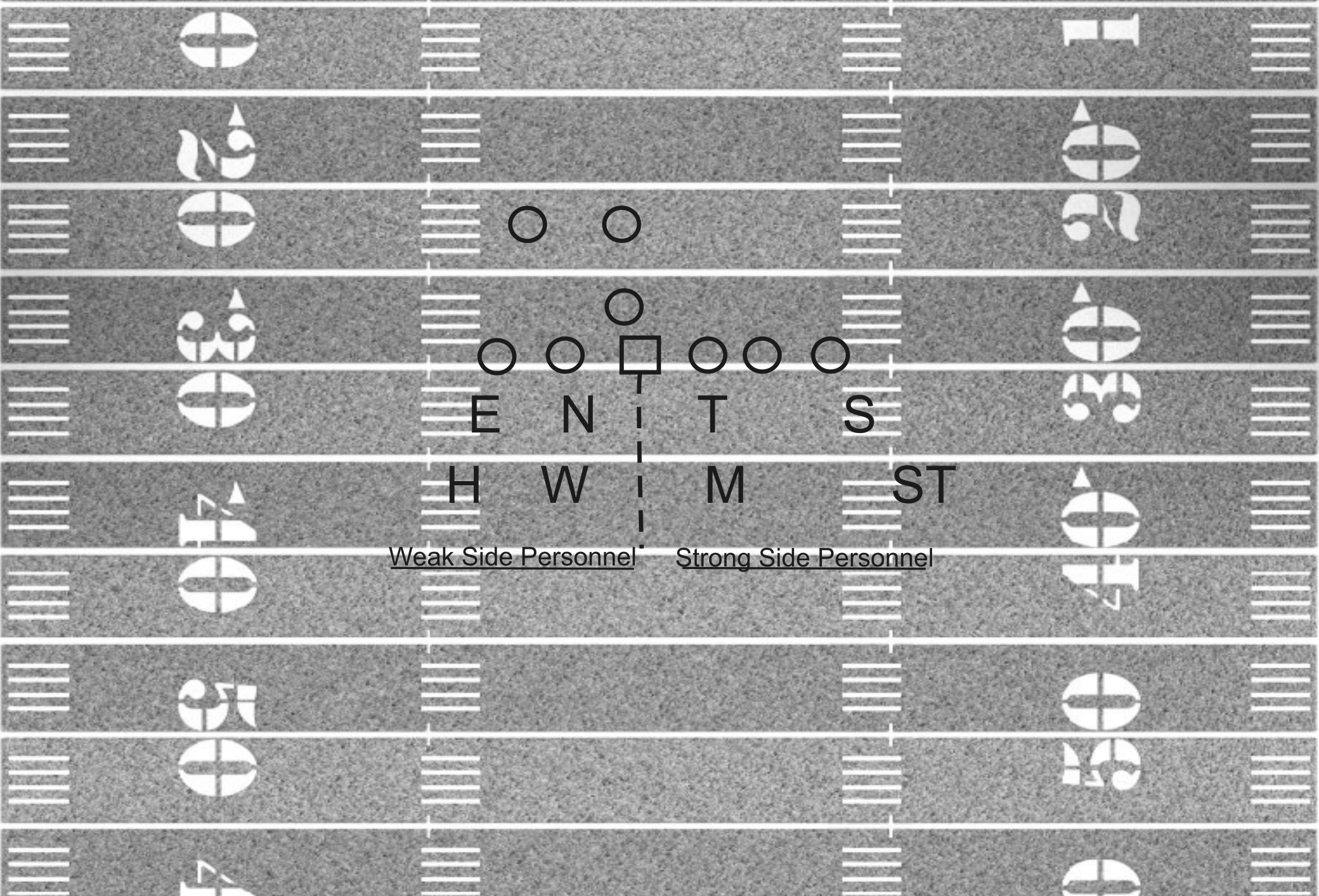
This produces consistent reads, which, in turn, allows our players to become very skillful with their technique. We have found, for example, that playing Mike and Will are two very different positions and by flipping our personnel, we enable them to play at a much higher level. This seems to be true for each of the stations, so we drill them on both flanks, anticipating the possibility of being caught on the wrong side. In simple terms, we work both defensive ends especially hard vs. a tight end. This tandem relationship allows us to detect and destroy the point of attack from multiple angles. We read and strike with a specific technique designed to either spill or force the ball carrier to the free hitter.
Weak Personnel/Strong Personnel
The trap was undeniably in consideration when we modified the particulars of our defensive structure. With that in mind, we will discuss the base blocking rules for the trap out of a 21 personnel formation; that is, the focus will be on the interior scheme. The strong-side guard executes a down block to the Will linebacker while the weak-side guard pulls inside and traps the strong side tackle (3-technique). The center replaces the pulling guard to the nose (1-technique) as the strong-side tackle veers down attempting to seal the Mike linebacker inside. The point of attack is the strong A-gap. As stated earlier, they are attempting to take advantage of the 3-technique charging upfield. We feel our work with the Big Five has prepared us to attack this play as opposed to merely defending it.
The tackle is reading his visual key (strong guard) veering down and inside to the weak-side linebacker. He shoots his hands to stop the guard’s path and “Claws and Bends.” We make every effort to get hands on the offensive lineman and reduce his ability to get down onto the linebacker. Our defensive linemen know if their visual key is block down, another offensive lineman is coming to kick him out. The player gets his inside foot and hip working down the LOS searching for the first bad color. We don’t wrong arm, but stated more accurately, wreck the puller from the inside up. The objective is to put him back into the mesh point, thus spilling the ball carrier.
Because the trap hits so fast the runner typically does not have time to spill and frequently runs into the back of the pulling guard. The intent is to get under and into the pulling guard’s down-field shoulder. This, by itself, when done correctly, destroys the ball carrier’s path. Realistically, however, we do not always get to the correct shoulder in defending the trap which leaves just enough room for the play to succeed.
This is when working together comes into play; the Mike linebacker is reading the same guard as the tackle. In the past, however, our linebacker would wobble too far inside, reducing his ability to attack the trap. The guard’s inward path naturally pulled him inside, thus making the offensive tackle’s assignment easier to execute. Our problem was with recognition: is this a trap or is this weak zone? We resolved to always play trap first so, consequently, the moment weak zone is realized we attempted to physically put the guard back into the LOS, effectively closing the cut back lane. We work hard for this recognition so when the Mike linebacker reads his guard down block he “Runs into the Tackle.” In other words, he steps directly forward into the tackle’s path and “Throws the Bone” with his outside arm (forearm shiver). We have found this puts him into an ideal position if the running back sneaks through the point of attack.
The weak-side players also have a job to do against the trap. We like to think our defensive linemen can get hands on their visual key every time, but practically speaking, we find this rarely occurs against The Pull Block. The nose is taught to sink his hips as he recognizes the guard pulling inside and explode into the center who is a replacement for the guard, “Squeezing It Down.” We know if the lineman pulls, another blocker is coming to replace him. The Will linebacker is working in combination with the nose and is drilled to “Play Trap First” as soon as he recognizes the inside pull. He attacks the inside half of the strong side guard (See Diagram 4).
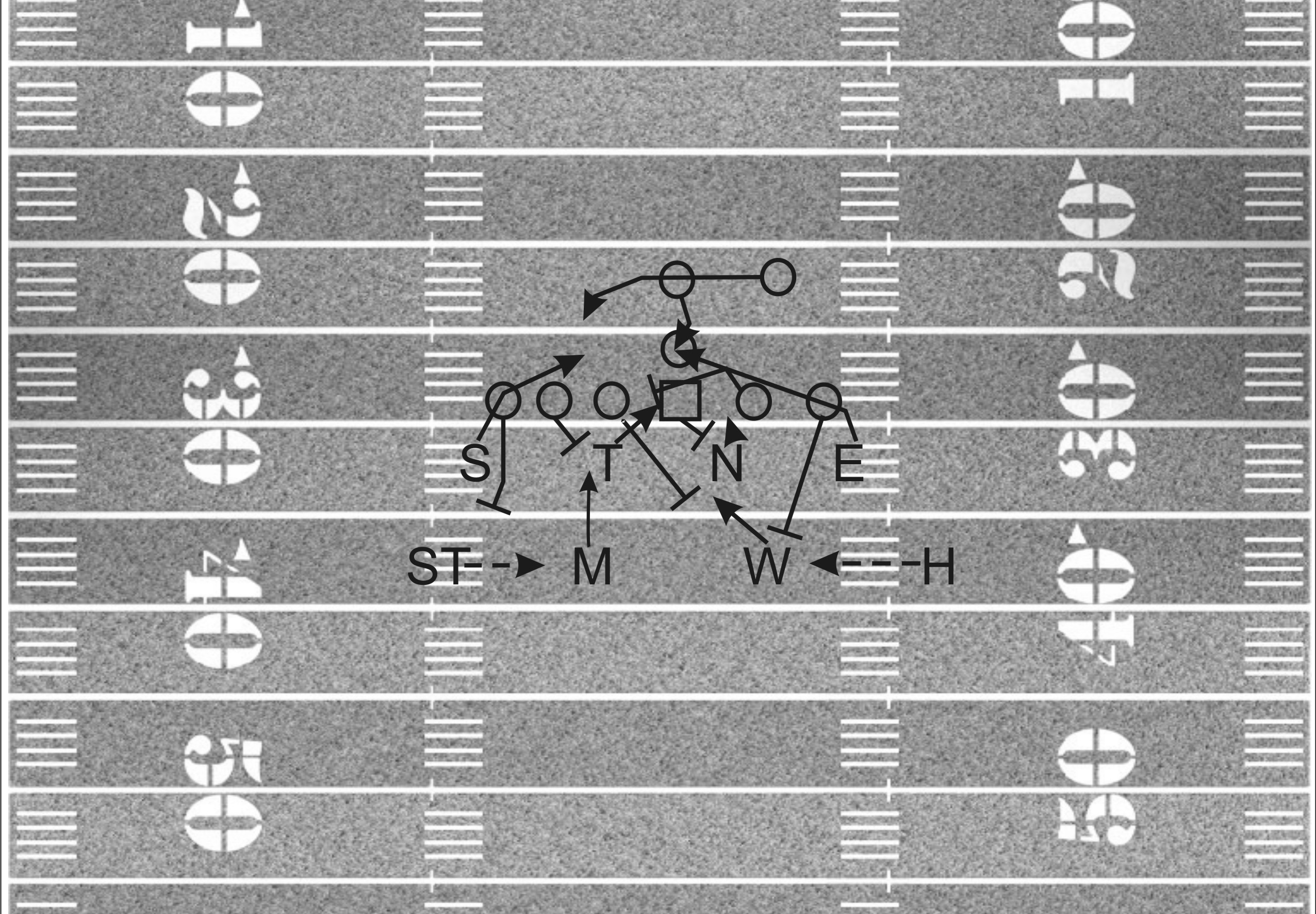
It is essential, if we are to remain gap sound, that the Will linebacker fit on the inside shoulder of the guard. When there is no down block from the guard (sweep or power) the Will linebacker will either run through the A-gap or flatten out and scrape for a cut back.
The two sets of perimeter pairings also have specific ways to play the trap. We include both the strong and weak personnel as one because their technique is identical. If the EMLOS blocks down, the defensive end will “Claw and Bend”, looking to attack the next bad color if that is the blocker or the ball carrier. Our defensive ends know if the EMLOS down blocks they do not have contain responsibilities. Many times the defensive end will tackle the trap because quite often he is unaccounted for on this play. We cannot ask the defensive end to attack down the LOS at heel depth and be a contain player as well, but if the EMLOS drives or pass blocks the defensive end becomes the force player and sets the edge.
Remember, the outside linebackers are working with their defensive linemen just like their inside counterparts. So, if the EMLOS blocks down and the flow is away from the outside linebacker, they will Vice; that is, shuffle to the Fence which is an imaginary line extending four yards off the LOS directly behind the defensive end’s pre-snap alignment. They become our cut back and reverse players. When the EMLOS blocks down and the flow is toward and outside the offensive tackle, they Force (edge players) and attack the first bad color and set the edge. And finally, if the outside linebackers detect a drive block and the flow is inside the EMLOS, they Vice. The difference now is that the defensive end becomes the force player based on the drive block and the outside linebacker becomes the free hitter. We do not see this much on the trap play but was included to briefly clarify how we fit up on the weak side isolation plays.
We feel confident defending the base trap but understand and anticipate that modified schemes exist. The most common variation we see is a false pull from the strong side guard. This widens our 3-technique, thus making him very susceptible to the trapper. Furthermore, our Mike linebacker typically will false step and enlarge the gap vs. this look. We attempt to detect this tendency through film study and work to slow play the outside pull and our Will linebacker is now unaccounted for. He plays Trap first whenever he reads the guard’s inside pull. More often than not, we find our defensive scheme remains sound despite unconventional plays.
The only alternative to our basic foundation for defending any play is to either stunt and/or blitz. We have found this keeps the players engaged without compromising the speed at which they attack their primary read with correct technique. One such option is to stunt as we anticipate the trap. Our primary response for any team determined to run this play or one altering the basic blocking pattern is to have our tackle play for trap. We simply tag our call with Trap. This tells the 3-technique to execute an inside pinch stunt directed at the center’s near hip. If we guess right, we coach the tackle to stuff the veering guard into the oncoming puller. If we are wrong, we teach the 3-technique to become A-gap responsible. This subtle variation to our normal technique is very beneficial and not easily detected by the opposition.
After implementing these tactics we became a very difficult team to trap and discovered how sound the overall structure was to defending the entire run game. This system allows us to achieve nine players in the box vs. 21 personnel and adjust to the countless formations modern offenses throw our way. From the difficulty associated with this single play we discovered a very fundamental foundation for defense. We continue turning our players loose but do it now with a focused purpose.
About the Author: Lawrence Quadrio is currently the Defensive Coordinator for Spanish Springs High School in Sparks, NV. He has coached at Spanish Springs for seven seasons, starting as linebackers coach for the junior varsity. Quadrio then became linebackers coach for the varsity and was promoted to DC in his second year at the school.