The 5-5-1 “2-Level” defense (2LD) is the creation of Dr. John M. Thomson of Prince Edward Island, Canada. (Football Defense of the Future: The 2-Level Model, Prentice-Hall, 1988). It features five defenders in the first level who attack gaps, five in the second who mirror potential receivers and bump to motion, and a new and unique position, the Deep Safety (DS), who lines up between 25-30 yards deep and cuts off the field vertically at +18 yards (See Diagram 1).
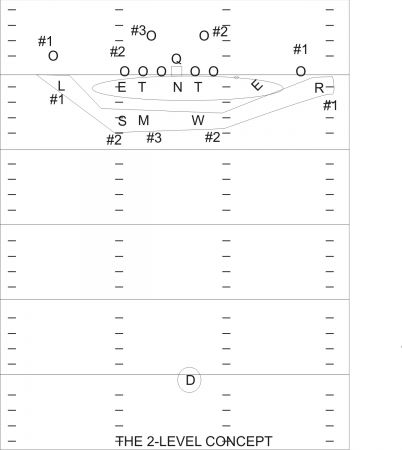
Running forward, the DS can cover much more ground than a traditional free safety – and he arrives at the point of impact with much greater momentum and force. With training, the DS can prevent the deep pass and the breakaway run from becoming cheap scores for the offense, allowing the other 10 defenders to aggressively attack the offense’s game plan.
The 2LD offers the offense very few clues to its intentions before the snap, and renders most reads useless by making them identical – you can play man, zone, man blitz, zone blitz or combo coverages, even after bumping to motion, without tipping off the offense.
I have used the 2LD exclusively since 1988. I have kept in touch with Dr. Thomson regarding his system, and recently spoke with him at length about adapting his original concepts to the popular spread offenses that are sweeping the game. I will present a few of the resulting key ideas on fine-tuning the 2LD to attack the spread in this article.
First, the core 5-5-1 alignment can be adapted by adding zone pressure to the usual man and zone coverages (See Diagrams 2-4).
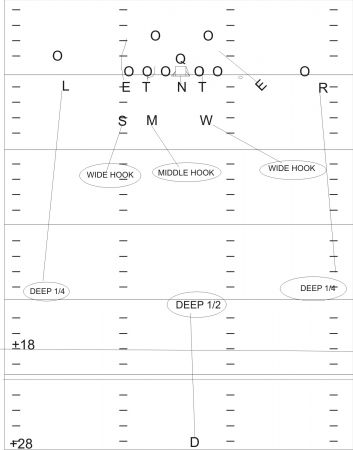
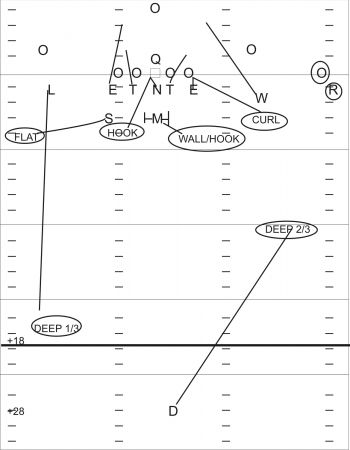
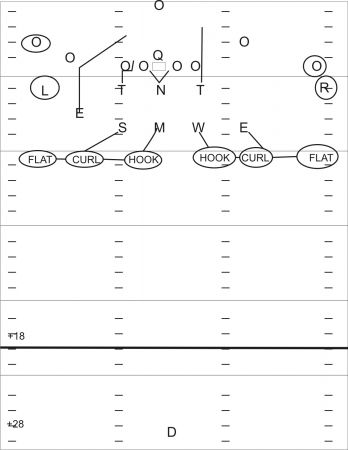
This makes the base 5-5-1 personnel group much more versatile and even harder for offenses to read. However, other personnel groups can also be added to counter spread personnel groupings. Replacing the ends with second level (SS/OLB type) defenders gives the 2LD a 3-3 Stack look (See Diagram 5).
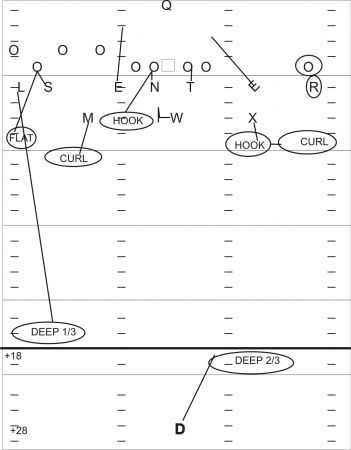
The left end blitzes, Sam and the right end play Curl to Flat, and Mike and Will play Hook to Curl. Len and Ron man up on the #1 receivers to each side in this combo coverage. The DS enforces the end line at +18 yards deep.
With the removal of one tackle and the insertion of a sixth second level defender (Rover, “X” in Diagram 6), the 2LD takes on yet another different look, useful for Red Zone passing situations (See Diagram 6).
Here the defense rushes three and drops eight against an open quads look. The Deep Safety covers the weak deep 2/3, and Len takes the strong deep 1/3.
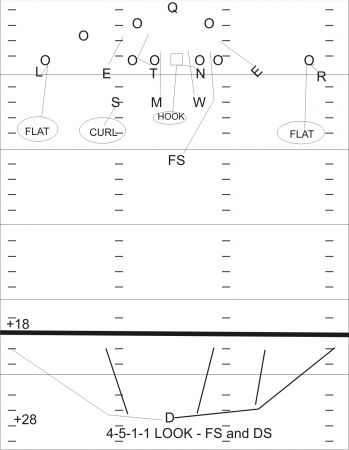
Finally, the defense can replace a tackle with a traditional Free Safety (FS) playing at 12-15 yards deep, underneath the DS at 28 yards, in a 4-5-1-1 look. The FS can double cover, rob, spy or blitz (See Diagram 7) as the game plan requires. You can also play a robber coverage by dropping Rover back from a 4-6-1 look, or bringing a second DS down from 28 yards from a 4-5-2 look, just before the snap.
The FS blitzes, giving a 6-man rush, while four defenders play zone and the DS enforces the end line at +18 yards. Len and Ron bump the #1 receivers to their side, then drop back to cover the flats.
I hope this article has given you a taste of just how versatile the 2LD can be. By eliminating the cheap touchdown and giving 10 of your defenders the green light to attack at all times without giving any keys to the defense, the 2LD is just what the doctor ordered to handle those pesky spread teams on your schedule.
And oh, yes – against the double tight end look and a full house backfield, the 2LD turns into a slanting, stunting 5-5 Stack with a Deep Safety ready to dish it out to anyone who gets past the first two levels of defense.
Ted Seay has coached at the high school, college, and international level. You can reach him at TedSeay@GridironStrategies.com.