Most coaches who run the 4-3 defense have an “ideal” make-up of players that they would like to field against their opponents. Myself, I prefer two big (250 pounds or more) defensive tackles; tall guys for pass-rush ends; mobile, agile and hostile guys preferably over 6 foot at the linebacker position; and some fast, good tackling kids at the corner and safety spots. That’s my personal ideal for the 4-3.
Now, what happens, as it does all too often at the high school level, when one doesn’t HAVE these ideal kids? What happens when depth is non-existent and starters get injured? What is the back-up plan? What happens when the team doesn’t have enough guys to platoon, and the tackles are sucking wind? How to adjust? Well, in this article I would like to show some variations that have worked for us, helping us to overcome a limited player pool.
Starting Up Front:
Since we are a smaller school (600 kids or so), many seasons we don’t have the luxury of being able to fully platoon. As a result we have had to find creative ways to rest our big men for offense. One such idea that was very successful for our team was using some unconventional players at defensive tackle. Our DC in 2006, Justin Heimiller, recycled a great idea, and used two very tough back-up corners as D-Linemen in third down situations. Both guys were around 5’6” and 150 lbs with gear on, but their quickness served them very well. Many times these two players were in the backfield before the opposing line had even fully come out of their stance. While it started as a way for us to rest guys, and to pressure QBs with quick line stunts, their roles grew as the season progressed, and our “Micro-Machines” began to see more use against teams that used misdirection as well as passing teams. By the end of the season, teams who watched film on us began to have to change up their stances, counts and protections more and more to account for our quickness off the line. Indeed, often they felt it necessary to double-team our smaller tackles which allowed our linebackers unblocked shots at opposing QB’s. So, if those back-up skill players you have standing around aren’t doing anything, using them to rest your big men on defense might work for you, too.
We often have a dearth of defensive ends here at Arcata. Those body types tend to go play “futbol” (also known as “That OTHER Fall Sport”) in our area. If a kid has the right body type, then he seems to have S-L-O-W feet. The other problem we get are kids who may have the physical skill set, but can’t seem to get the concept of leaving their outside arm free, much less be in a position to contain a roll-out QB or chase down the toss. In both these cases, one simple adjustment we have made is to run a reduced or “pro” front 4-3. We run our tackles at a double two technique and bring our ends in to head up over the offensive tackle. (This is a 5 tech in our parlance, but a 4 tech in the more traditional numbering). The primary downside of this method is that it leaves the outside contain solely on the shoulders of our outside linebackers (See Diagrams 1 and 2).
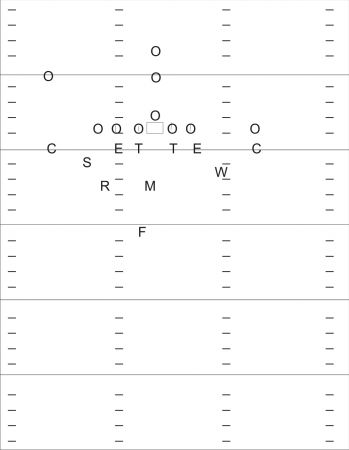
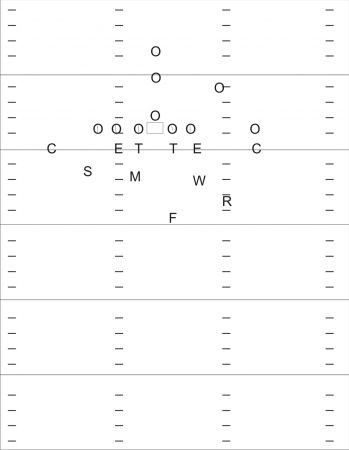
While this style of front can leave us vulnerable to a mobile QB, it has worked well for us in flushing out drop-back passers, and keeping “three yards and a cloud of dust” type teams limited in their ability to run power on us. Also, this set has the advantage of making reads easier for our D-ends, making them into “attack the line” single-gap players, more like our defensive tackles. And lastly, when we are blessed with size, but not necessarily speed, crowding the line with four “buffet bashers” can be both effective and intimidating to the opposing offense.
Linebackers:
Here in our part of Northern California, we rarely get the combination of mobility, height and size that makes a prototypical linebacker. Like most high schools, we make do with what we can get. Most commonly, we will put our more mobile, smaller guys at the Mike and Will position and put our larger or taller guys at Sam since they are usually taking on the trap and need some size. On those occasions where we have smaller LB’s we are also more likely to run crowded fronts, allowing our LB’s to run the outside plays down, and leaving more of the inside run responsibility upon our esteemed guys in the trenches. Also using Over and Under fronts allows us to use these smaller guys to pressure the edge and disrupt option reads (See Diagrams 3 and 4).
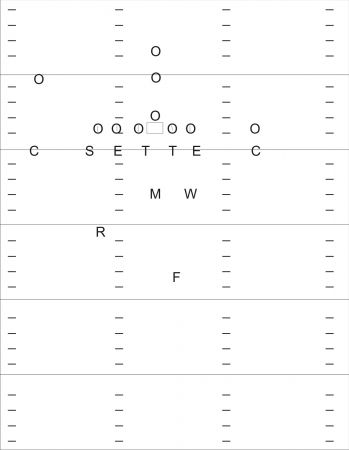
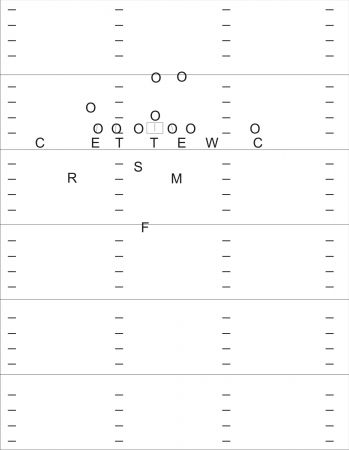
When we have “slower” kids who have trouble recognizing fronts, or when we are facing teams with high-tempo offenses we will scrap the strength of formation and run either Sam and Will to field width (Will being the wide side player) or we will run a Roger/Louie set instead. Indeed with our “Mutant” defense, which is made up of first year kids, and other “talent challenged” types, we keep it very simple and run this set. (We use the Mutants on third and long when we either need a break for our regular defense, or just need a boost. They are also our block kick team.)
Finally, when our line has been good, we have used twists, stunts, and stemming to maximize the effectiveness of our line and force double teams or protection breakdowns. This has been a big factor for us in covering a lack of premier linebacker material, allowing players that are not normally ideal to flourish in the position.
Corners:
We have, over the years, devised a number of coverages to help us be effective with our average talent level. Much of it however breaks down into some basic parts. With smaller, quicker kids that have good “football smarts” we like to run zone. We give a bit of cushion, taking away the deep ball, with the concept that they are going to be more effective coming forward and making receivers pay the price for the catch than trying to play pick-off with superior talent. With rookies, or just plain slower kids, we prefer to run a bump ‘n’ run man with cover 2 behind, or a “cushion” man with zone underneath. In both cases we are trying to interfere with our opponents’ timing rather than try to match up with them.
When there is an obvious disparity in talent or speed between our two corners we have run a wide/boundary mix, teaching our boundary corner to use the sideline to his advantage. We will take a surer tackler over speed for the boundary corner since he is left in solo coverage more often. The wide side has more help, between the Linebackers underneath, and the Free or Rover above in most coverages.
Safeties:
We’ll deal with the Free Safety first. For us, because we ask so much of the rest of our defense to be aggressive and take the risk, we put our “safest” player at Free. This needs to be a smart player, one who rarely gambles, and knows how to stay in position and watch the field. This can be a shorter player, provided he is a good tackler, and can be a step slower, provided he can make up for it with good football smarts. We ask our Free to be aware of the whole field, and see things in tendency instead of focusing on a single player, even when he is in coverage. We work film and scouting reports with him very similarly to the method that we do with the QB’s.
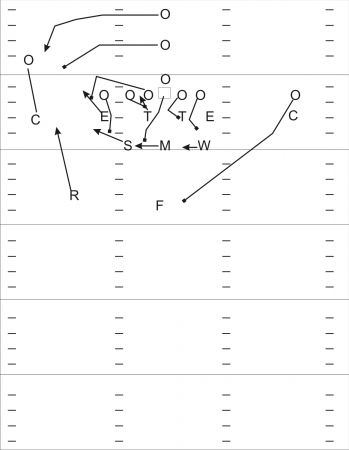
Our Strong Safety, or Rover, is a pivotal player in our type of 4-3 Defense. We rarely let him sit back in Cover 2 or 4 and play a true pass coverage safety role. Often he is a hybrid or “tweener” player for us. For instance, against slot teams, he’s a third corner; against sweep and option teams he’s our outside alley player; and against the inside run, he acts as the linebacker to our linebackers, creating an additional level to our defense. We usually will put our fastest player in this spot, taking aggression and quick reactions over specific awareness. We would rather have a fast wanna-be linebacker type in this position than a slower but more intelligent guy (who we would probably put at Free instead). We have to count on him to make up for any mental mistakes with quickness of foot. Think Tasmanian Devil in football pads. Having an aggressive Rover can make up for many weaknesses in other areas when we put our best athlete in this position and train him well (See Diagram 5: Rover’s Attack vs. the Toss).
In a non-physical perspective we like to have our best leaders at the Mike and Free positions. Both these guys need to be the “man with the plan” helping the rest of the defense play like tigers on the field. We have had kids that made up for a lack of physical prowess with toughness, leadership, and just plain bravery. One of our best linebackers was only 5’6” but played like a giant on the field, keeping hopes and hearts up, driving guys to their best effort.
I thank you for your time, and would like to thank the many coaches I have worked with over the years for giving me feedback and ideas that have coalesced into this group of concepts. As one of my former Head Coaches said, “We may not always win, but darn it, EVERYONE goes home knowing how good our defense is.” It is my hope that you found this article helpful.u
Steve De Marino is a former coach at Arcata High School (CA). Mike Mari, the Defensive Coordinator and Assistant Head Coach at Mendocino College, also contributed to this article.