Alignments, Responsibilities
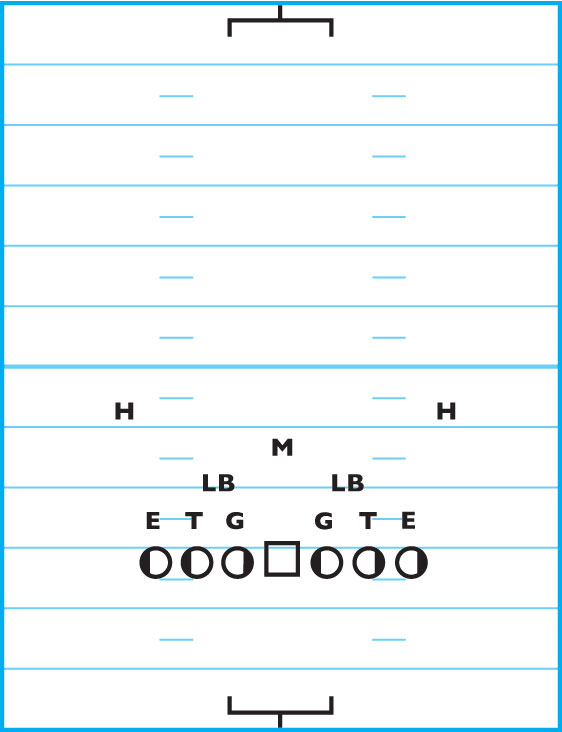
DEFENSIVE GUARDS:
Alignment: Face on the inside shoulder of the offensive guard. Look through and over the shoulder pad straight into the backfield.
This alignment keeps the OG off the linebacker and monster, leaving them free to pursue the play. It fills the hole to the inside and makes a 1-on-1 block by the OG more difficult when the offense wants to run up the middle.
It also forces a double-team on one of the DGs to open up the middle, leaving the monster free to come up and tackle. Since one DG is being doubled, that leaves one DG free to slip inside to help stop the play. Or if they’re both being blocked 1-on-1, it can leave both DGs free to pursue plays to the inside.
Stance: 4-point stance with head-up and outside foot back.
Initial Movement: Drive straight through the OG and drive him 1-yard into the backfield. Utilize a hand shiver or forearm into the OG.
Responsibilities: Align properly and attack the OG. Neutralize 1-on-1 blocks and any lead blocker. Read and break double-team blocks. Read and react to cross blocks and traps. Provide a good pass rush. Change alignments as dictated by the offense. Be quick and aggressive.
DEFENSIVE TACKLES:
Alignment: Face on the outside shoulder pad of the offensive tackle. Look through and straight into the backfield. This alignment keeps the OT off the LB, prevents the lead blocker from taking out the LB and and forces the ball carrier toward the outside.
Stance: 4-point stance with head up and inside foot back.
Initial Movement: Drive through the OT and force him to the inside, literally filling the hole with the OT. If no one blocks you, beware of a trap. Watch double-teams from the end.
Responsibilities: Align properly and attack the OT by jamming the hole inside. Keep the OT off the LB. Break double-team blocks. Stop traps and cross blocks. Provide good pass rush. On an option play, take the first threat. Take proper pursuit angles.
DEFENSIVE ENDS:
Alignment: Outside shoulder of the offensive end.
Stance: 2-point stance with inside foot back.
Initial Movement: On the snap, drive the OE with his inside foot sliding into the backfield 1-yard. Keep shoulders parallel to the LOS and outside foot back. Utilize forearm shiver or forearm.
Responsibilities: Align properly and attack the OE or the wing back on every play. Force a tight receiver to the inside. Turn sweeps to the inside or string them out so that the pursuit can make the tackle. Read and react to keys. Help stop the reverse. Take the pitch man on the option. Stop traps and cross blocks.
LINEBACKERS:
Alignments: 3-yards off the LOS between the DG and DT.
Stance: 2-point stance upright, with weight on the balls of the feet. Feet will be parallel.
Responsibilities: Don’t give ground against the run. Provide a good pass rush on blitzes and sprint-out passes. Take the proper pursuit angles. Do not over pursue. Watch the quarterback on the option.
MONSTER:
Alignment: Head up, over the center, 5 yards off the ball. This may change anytime a LB moves from his normal alignment. Always shift to the side vacated by the LB.
Stance: 2-point, upright stance with feet parallel.
Initial Movement: Key on the center. Secondary keys are the OGs. On the snap, whether it’s a pass or run play, take 2-steps back. If you read pass, yell “Pass!” and backpedal into coverage. If the center comes out to block, meet the charge with a hand shiver or stiff forearm. Be aggressive.
Go to the block and don’t wait for it. When the OG and center are double teaming a DG, then the play is probably coming up the middle.
Do not read into the backfield. Fakes and counters may deceive you and force you out of position. Don’t bite on play-action fakes.
Responsibilities: Align properly and read keys.
DEFENSIVE HALFBACKS:
Alignment: Line up on the outside shoulder of the last tight receiver at a depth of 8-to-10 yards.
Initial Movement: Take 2 steps back on the snap. This reinforces that the DHB’s first responsibility is to cover the pass. Avoid having the DHB coming up to stop the run and having a receiver get behind him. He should come forward only if he can confirm that it’s a running play.
There are several keys to read on a tight receiver. If the receiver blocks down hard, then read sweep. If he blocks out, then anticipate an off-tackle play. If he hooks the DE, then expect a sweep or quick pitch.