OUR FOOTBALL TEAM has run the 3-4 stack defense for over 10 years. Playing in the competitive North Central Conference, our defense has finished first in scoring defense (fewest points allowed) in seven of the past 10 seasons and has never finished lower than third. In that time, the program has won five conference championships and a NCAA
Division II National Championship.
Understanding the nature of the defense your team plays is essential to being a great player within that system.
DIAGRAM 1: Base 3-4 Stack Front.
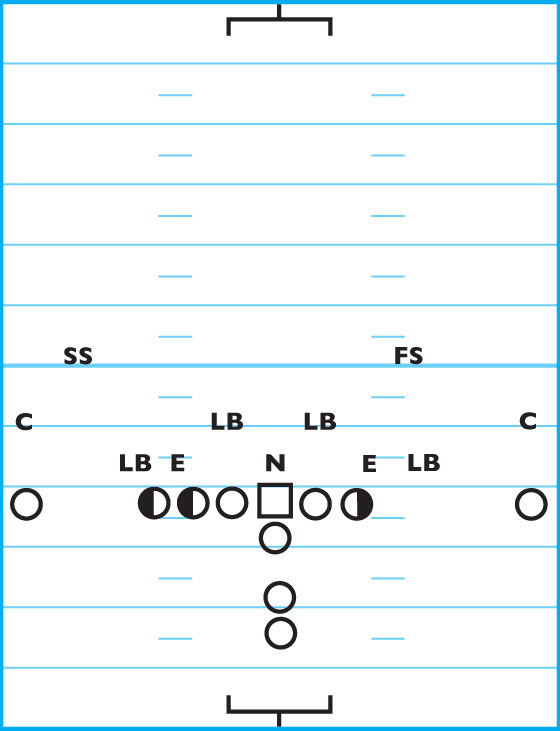
When introducing your linebackers to a 3-4 stack defense, do not start out talking about assignments and techniques. Instead, start by giving them a basic understanding of the strength and weaknesses of this defense as well as the basic concepts of how an offense can and will attack it.
Strengths Of The 3-4 Stack
There are several inherent strengths of the 3-4 stack defense. One of those strengths is that it forces the ball inside.
DIAGRAM 2: Forcing The Ball Inside.
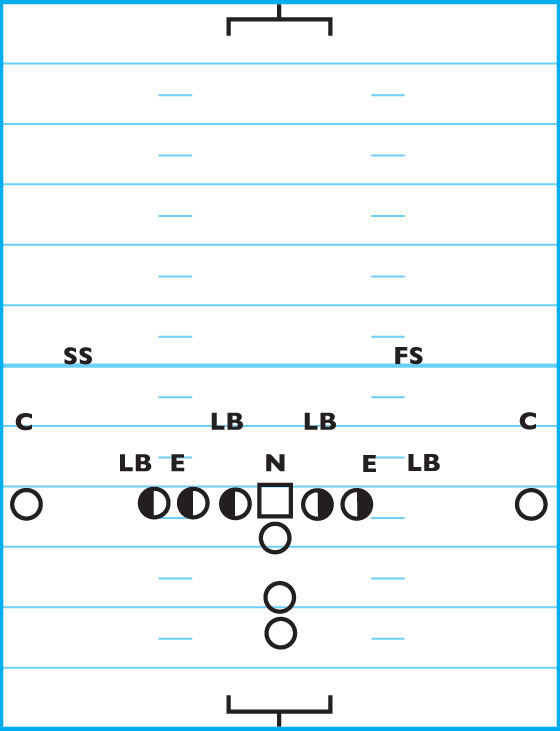
Force the ball inside by utilizing outside leverage with all seven front defenders with the exception of the noseguard. By initial alignment it’s very difficult for the offense to over-leverage the defense to the outside.
DIAGRAM 3: Weak-Side Overload.
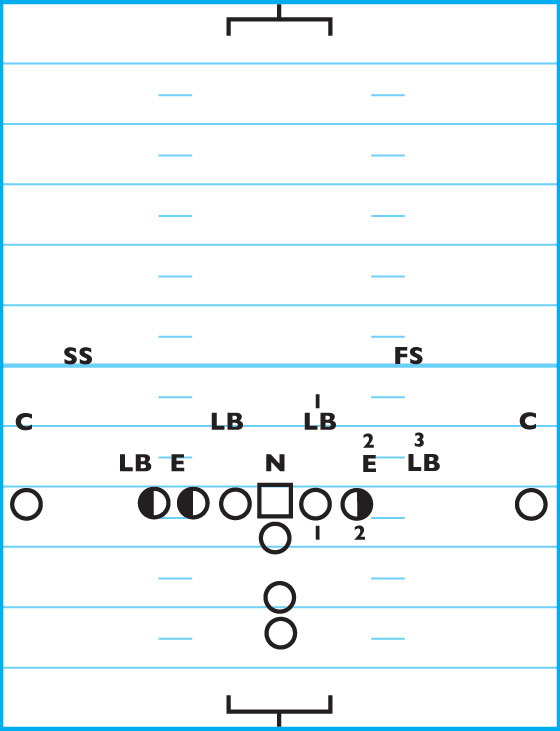
This alignment outnumbers the offense on the weak side. It forces the ball to the strong side (tight end side) against most offense formations due to the weak-side overload.
One of the greatest strengths of the 3-4 defense is that it’s very adaptable and flexible. It gives you the ability to easily create a variety of defensive fronts that offenses must prepare for on game day. In the best-case scenario, the variety causes doubt and confusion among offensive players. This works to your team’s advantage because confused players miss assignments and are tentative coming off the ball.
Even in the worst-case scenario, the offense still has to limit the number of practice repetitions against various run defenses during the week. They must also account for each defensive front that your team uses.
Having a four-player secondary also makes it very easy to create 8- and 9-man fronts to stop the run.
D-Line, LB Movements
Another valuable aspect of the 3-4 package is that you’re able to run a variety of defensive line and LB movements.
These movements add a lot of flexibility to your package and tend to give offenses a great deal of difficulty as they rarely see the same stunt combination twice in a row.
With the ability of all four LBs to either rush the passer or drop into pass coverage, the 3-4 gives you the flexibility to play multiple coverages from similar looks and alignments. This package also allows you to play the same coverage from multiple looks, and gives you two ways to disguise your defensive coverage:
1. Line up the same way again and again and still execute a variety of coverages.
2. Line up in several different looks and fronts, while executing the same coverage again and again.
Overcoming Inherent Weaknesses
Although no one likes to admit that their defense has any weaknesses, the reality is that if you have inherent strengths then your defense must also have some inherent weaknesses. The 3-4 stack defense is no different and you want your players to understand what those weaknesses are so they can be prepared to defend against them.
DIAGRAM 4: Gap Responsibilities.
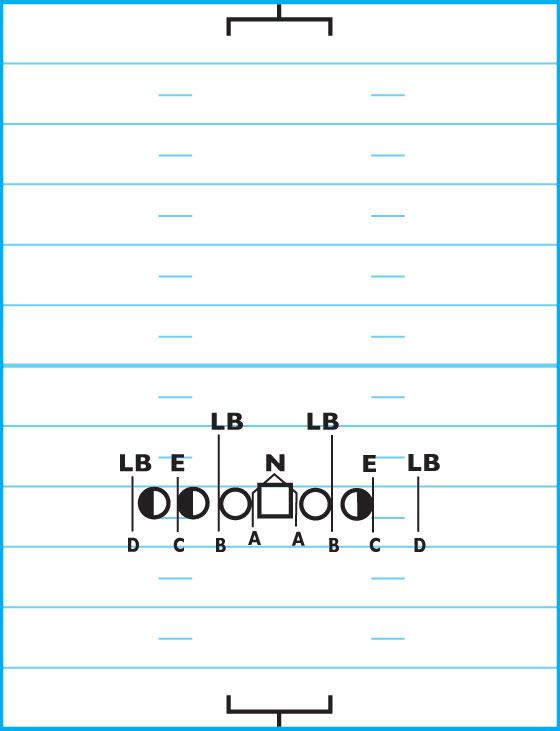
The first weakness is that in this base stack front you’re weaker up the middle because the nose guard is a two-gap player. The NG is the only player in the front seven that we continually ask to be a two-gap player.
There are several things that you can do to account for this weakness. First, place one of your best defensive linemen at that spot. Next, use a variety of defensive line and LB movements to help free up another player to help in the middle. Your defense will thrive with this technique due to the fact that offenses in general do not have a lot of plays that directly attack the A-gaps.
The two-gap technique is very beneficial to the entire defensive concept because if the NG can two-gap, that frees up another player somewhere else, whether it’s in the front or in the secondary. Be careful, however, when you ask one player to be accountable for two gaps, as that’s a difficult task and therefore an inherent weakness with the stack front.
Another weakness is the fact that you’ll have to “check” or change coverages vs. certain offensive sets and motions in order to keep the front intact and your designated “rush” LB consistent with the huddle call. Our team does this because we like to keep our front intact and we don’t move the inside LBs outside of the box (except against no-back sets).
Lastly, because we’re not a “corners over” team, we’re forced to make some other adjustments to unbalanced sets.
How Offenses Will Attack
Once your players have an understanding of what the inherent strengths and weaknesses of the stack defense are, it’s important that they develop a concept of how offenses can and will attack your stack front.
How the offense will attack the stack defense is largely determined by your opponent’s offensive set. In our program, we break offensive sets down into three simple categories:
- Two-back sets.
- One-back balanced sets (any one-back, 2-by-2 formation).
- Trip sets (any one-back, 3-by-1 formation).
With the two-back offense, how and where they attack will be dictated by location and depth of the backs.
I-Backs. With I-backs, the offense is able to attack all points of the defense with the running game. However, the weaknesses of I-backs for the offense are that these backs aren’t in a good position to run pass routes, nor are they in a good position to pass protect because they are located directly behind the QB. Therefore, you should consider I-backs primarily a running formation and treat it as such with front calls, movement calls and coverage choices.
When defending the running game against I-backs, your LBs need to recognize the difference between full-flow and split-flow plays. Full-flow plays are those in which the fullback and the tailback head in the same direction (lead plays). Split-flow plays are those in which the TB and FB go in opposite directions (zone and misdirection players). Full flow indicts a fast read and fast flow by your LBs.
Split-flow plays are a slow read with slow flow and the LBs look for a zone run or counter play. Your LBs are also taught that in order to directly attack the weak side (opposite the TE), it must be a full-flow play as the stack front outnumbers the offense to the weak side.
Two-Back, I-Strong Sets. A two-back, I-strong offensive set presents a predominately strong-side run attack, which is why we often tie this set in with our trips to Y (TE) concept. Counter is the only play that an offense can run that’s designed to attack the weak side. Plays that cut back can also threaten the weak side but not directly.
When the FB crosses back to the weak side (split flow), it indicates an inside running play and thus slow flow for the inside LBs. With I-weak there are no strong-side lead plays. Runs to the strong side include inside zone and counter.
The offense can run weak-side lead plays, but they’re difficult to execute because of the variability of the movements in your defense. You can use the weak-side outside LB and defensive end with both on and outside alignments against the weak-side offensive tackle.
Because of these movements we’ve found that offenses tend to stay away from running to the weak side or they must spend a significant amount of practice time preparing for these movements.
Split-Back Offenses. Split-back offenses are able to attack both strong and weak with man- and gap-blocking schemes. They’re unable to execute zone-style running plays because of back depth and alignment. The depth and width of the running backs will determine the type of plays the offense will run. Tighter split backs (over the guards) indicate more of a running threat and the ability to run inside with dive or quick trap plays.
If the split backs are wider (over the OTs), then the backs are more of a passing threat and perimeter run threat (such as a quick pitch). With wide split backs, the backs are more of a passing threat because they’re in an excellent position to get out in the pass routes and in good position to pass protect.
One-Back, Balanced Sets. When looking at one-back, balanced offenses, the depth of the running back is the major determining factor for what types of runs the offense will attack your defense with. If the back is at 6 to 8 yards deep, they’ll attack with zone (inside and outside), counter and draw plays.
The negative for the offense is that it’s very difficult for the RB to effectively pass protect from 7 yards or deeper. Also, a RB that’s this deep isn’t in good position to attack you in the passing game with a variety of routes.
If the offense places the back 3 to 5 yards deep, then expect dive and trap running plays. Since you know that the back isn’t deep enough to effectively run zone or counter-style plays — you can eliminate those plays from your defensive thinking.
From this tighter alignment, however, the back is in better position to pass protect. This is why offenses often move up their backs on pass plays — giving your defense a good indicator for what type of play is coming.
One-Back Balanced Back-Depth Clues. The one-back balanced, back-depth indicators also hold true for trips formation (1 back, 3-by-1 formations). Plus, the type of trips formation also gives your defense an additional indication of how the offense will try to attack the stack front.
On trips to Y (TE) it’s almost impossible for the offense to run weak (except for the counter trey) due to a lack of numbers. Therefore the LBs can start to “cheat” by knowing where the offense will run the ball.
On trips to X sets, the offense will have difficulty in running outside plays to the strong side (TE) due to the unblocked corner. Your LBs can again eliminate certain plays.