Read this issue as text
Page 1
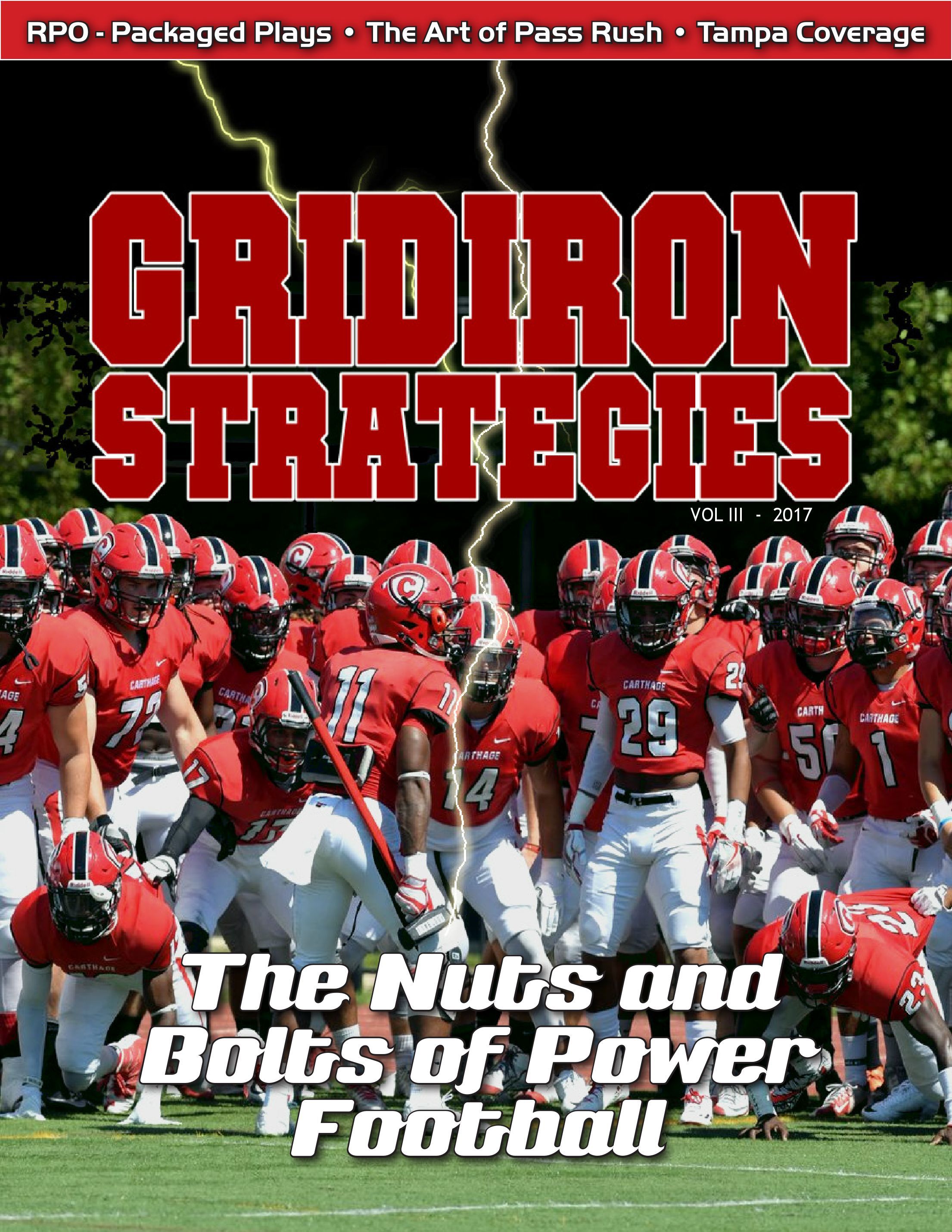
RPO - Packaged Plays • The Art of Pass Rush • Tampa Coverage VOL III - 2017 The Nuts and Bolts of Power Football 1 www.GridironStrategies.com
Page 2
VOL No. 3 - 2017 IN THIS ISSUE 3. Letter From the Managing Editor 4. RPO Packaged Plays – Kristian Johnson, Assistant Coach, Tyler Junior College 8. The Nuts and Bolts of Power Football – Joe Hensel, Offensive Line Coach, Carthage College 17. Tampa Coverage – Zack Wilkerson, Defensive Coordinator, Hardin-Simmons University 22. The Art of the Pass Rush – Payam Saadat, Defensive Line Coach, Cal Poly 25. Returning to Play Following Injury: Basic Assessments to Determine Functional Status – Bryan Dorrel, Assistant Professor, Tarleton State University 28. From the GS Archives: The Quad Option – Rick Martin, Offensive Line Coach, Marlboro County High School (SC) – from the August-September issue of GS – Vol. 9, Number 2 - 2009 2 www.GridironStrategies.com
Page 3
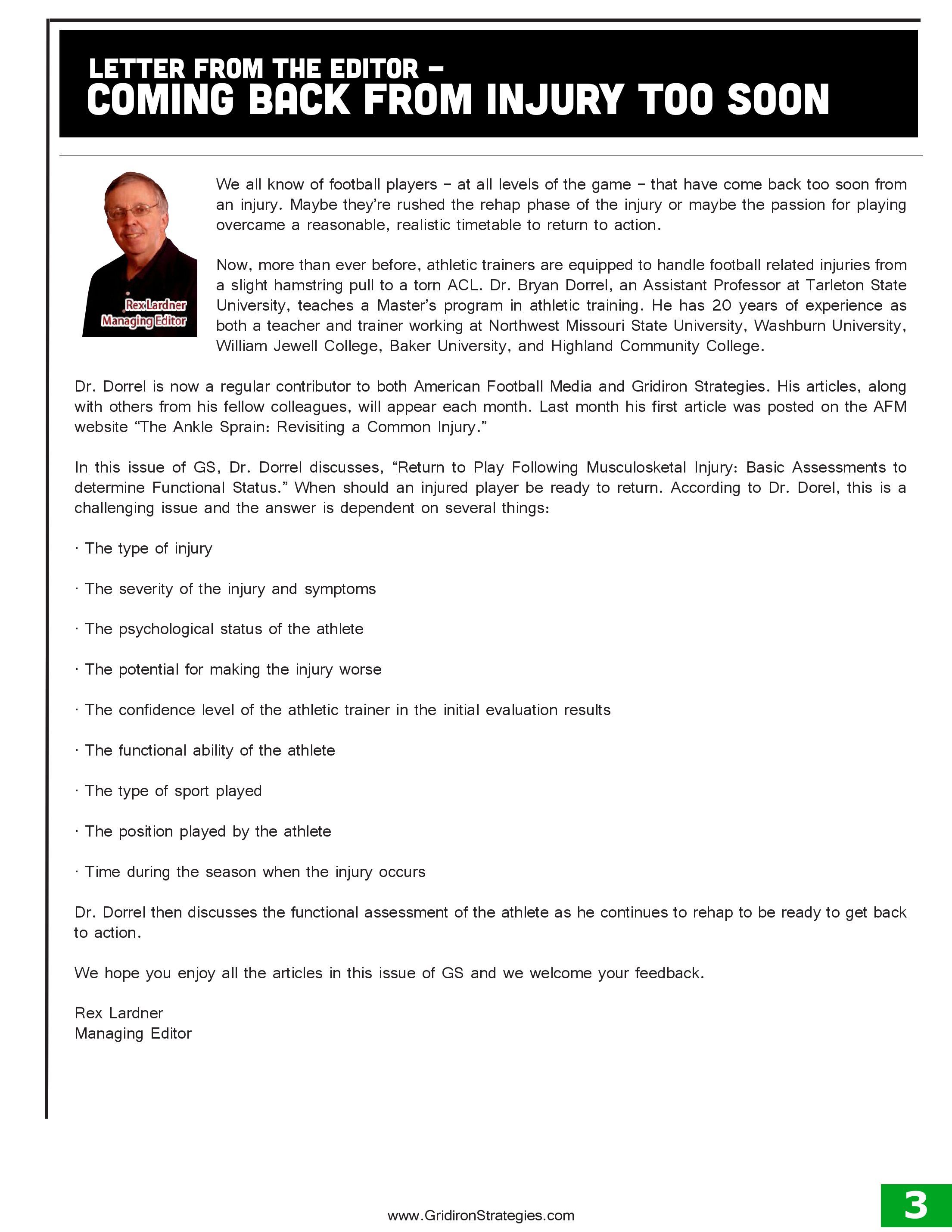
Letter from the Editor - Coming Back From Injury Too Soon We all know of football players – at all levels of the game – that have come back too soon from an injury. Maybe they’re rushed the rehap phase of the injury or maybe the passion for playing overcame a reasonable, realistic timetable to return to action. Now, more than ever before, athletic trainers are equipped to handle football related injuries from a slight hamstring pull to a torn ACL. Dr. Bryan Dorrel, an Assistant Professor at Tarleton State University, teaches a Master’s program in athletic training. He has 20 years of experience as both a teacher and trainer working at Northwest Missouri State University, Washburn University, William Jewell College, Baker University, and Highland Community College. Dr. Dorrel is now a regular contributor to both American Football Media and Gridiron Strategies. His articles, along with others from his fellow colleagues, will appear each month. Last month his first article was posted on the AFM website “The Ankle Sprain: Revisiting a Common Injury.” In this issue of GS, Dr. Dorrel discusses, “Return to Play Following Musculosketal Injury: Basic Assessments to determine Functional Status.” When should an injured player be ready to return. According to Dr. Dorel, this is a challenging issue and the answer is dependent on several things: · The type of injury · The severity of the injury and symptoms · The psychological status of the athlete · The potential for making the injury worse · The confidence level of the athletic trainer in the initial evaluation results · The functional ability of the athlete · The type of sport played · The position played by the athlete · Time during the season when the injury occurs Dr. Dorrel then discusses the functional assessment of the athlete as he continues to rehap to be ready to get back to action. We hope you enjoy all the articles in this issue of GS and we welcome your feedback. Rex Lardner Managing Editor 3 www.GridironStrategies.com
Page 4
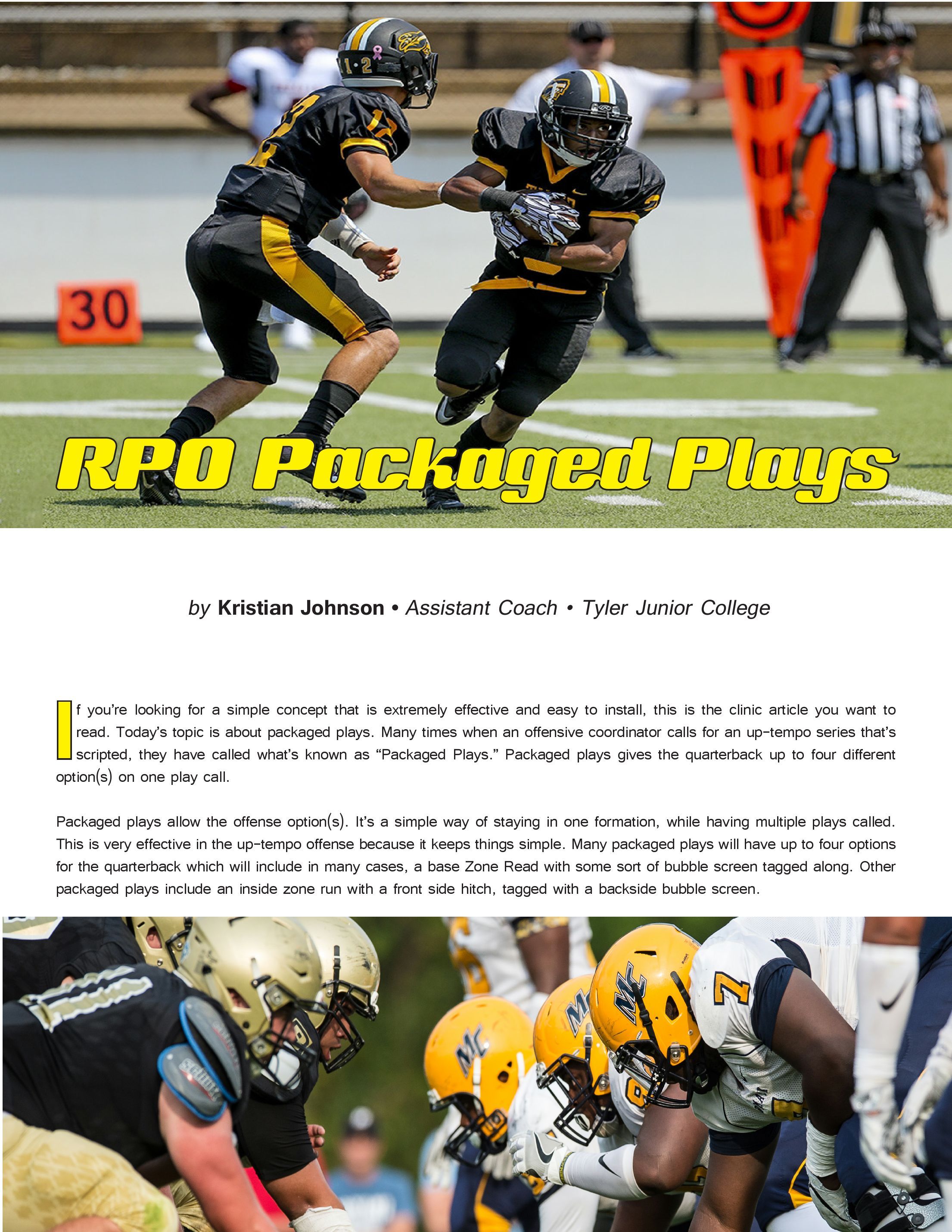
RPO Packaged Plays by Kristian Johnson • Assistant Coach • Tyler Junior College I f you’re looking for a simple concept that is extremely effective and easy to install, this is the clinic article you want to read. Today’s topic is about packaged plays. Many times when an offensive coordinator calls for an up-tempo series that’s scripted, they have called what’s known as “Packaged Plays.” Packaged plays gives the quarterback up to four different option(s) on one play call. Packaged plays allow the offense option(s). It’s a simple way of staying in one formation, while having multiple plays called. This is very effective in the up-tempo offense because it keeps things simple. Many packaged plays will have up to four options for the quarterback which will include in many cases, a base Zone Read with some sort of bubble screen tagged along. Other packaged plays include an inside zone run with a front side hitch, tagged with a backside bubble screen. 4 www.GridironStrategies.com
Page 5
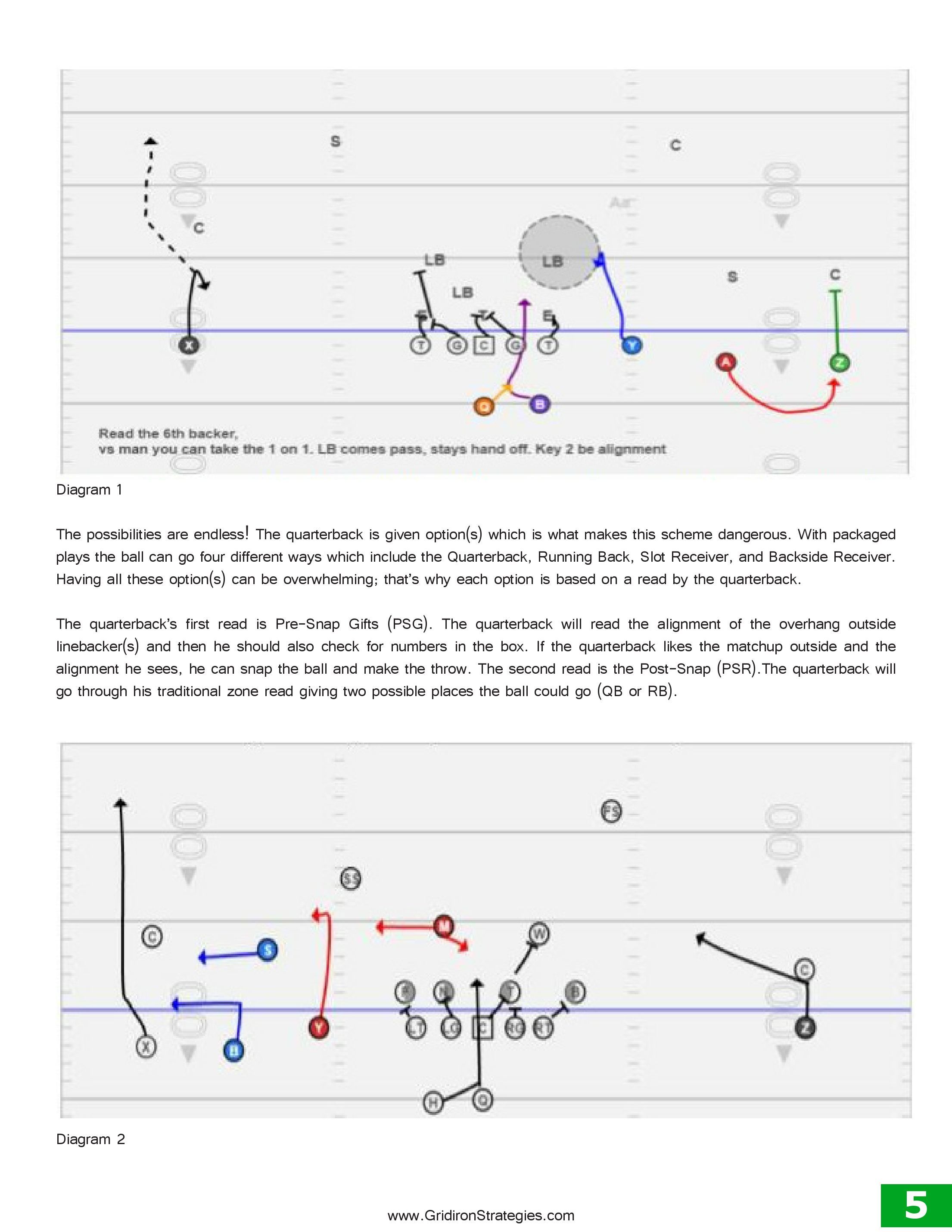
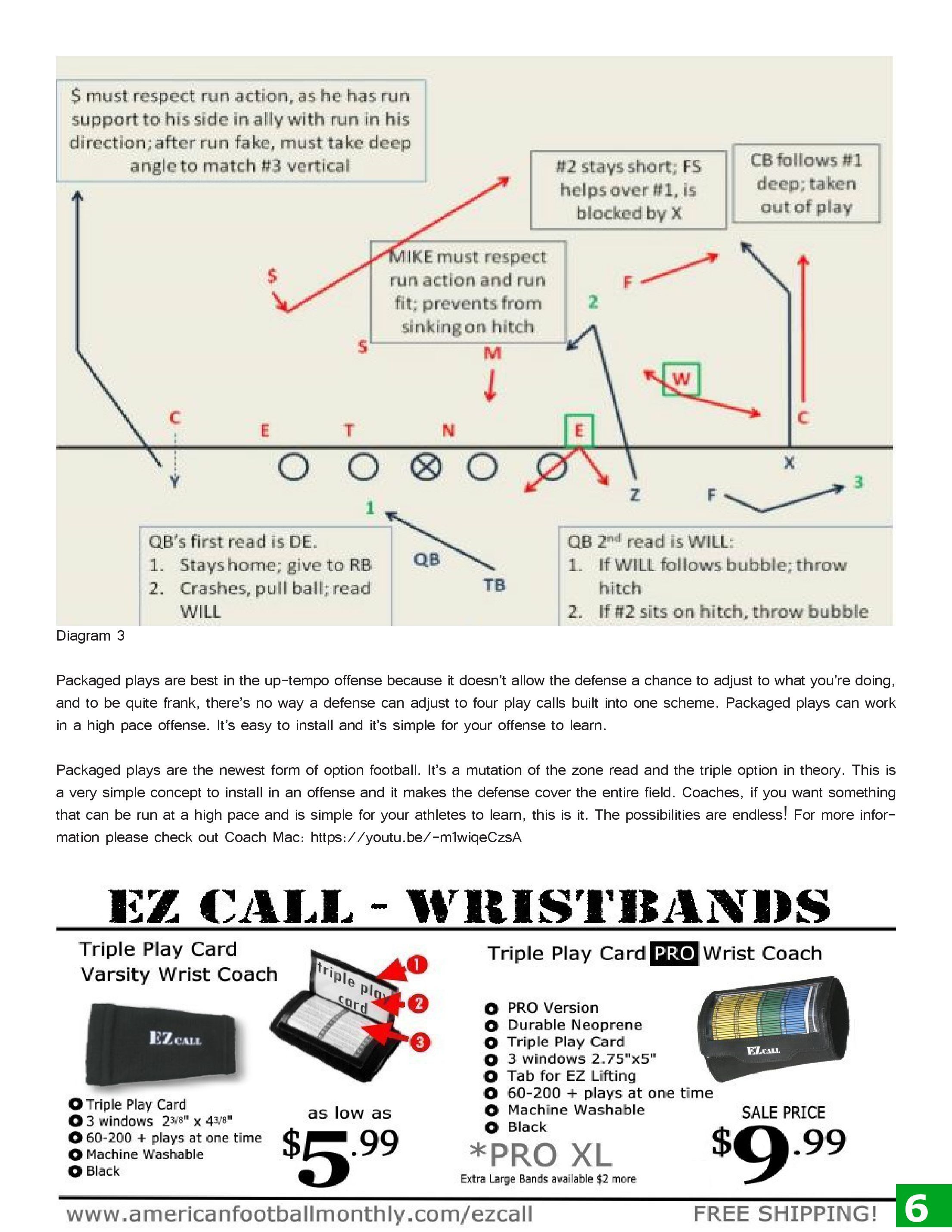
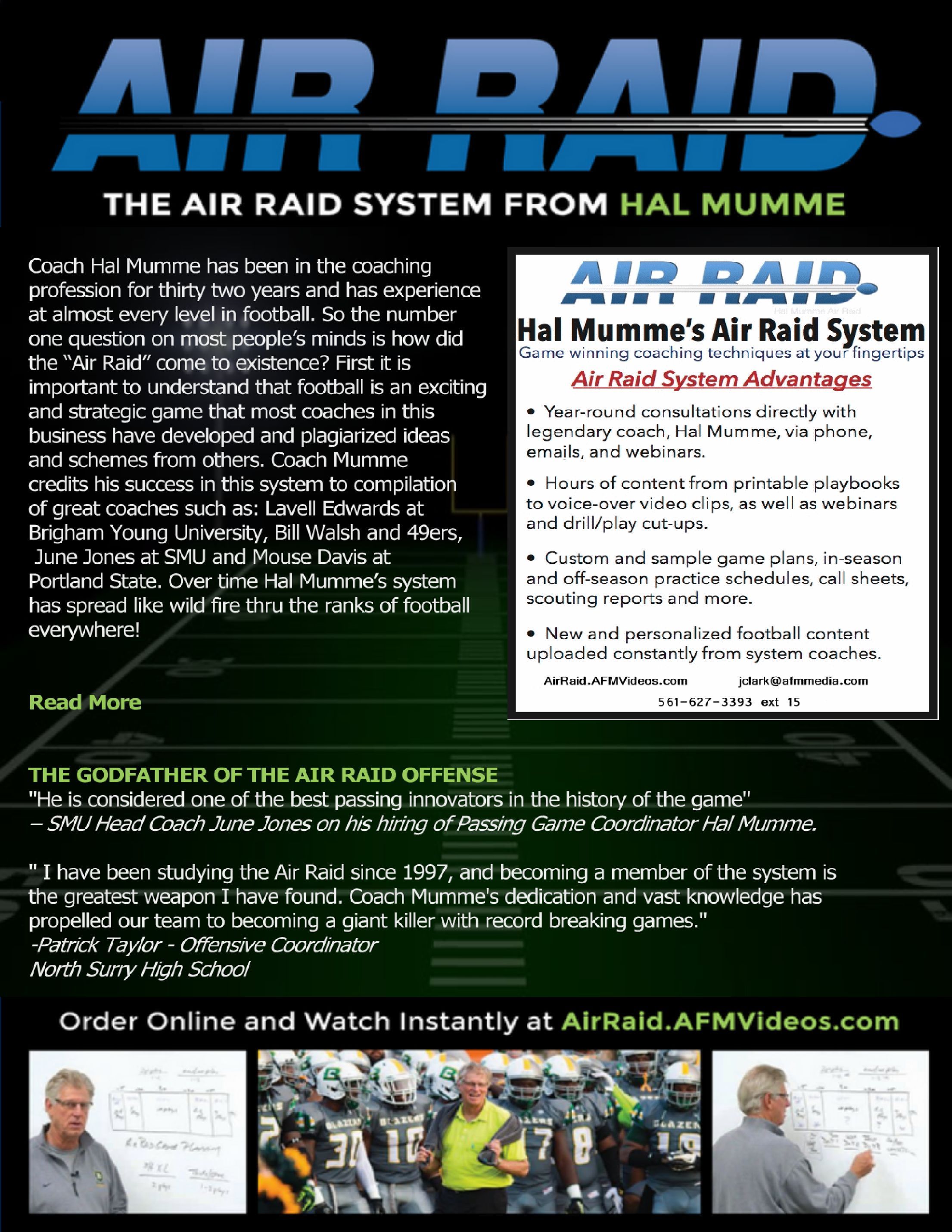
Diagram 1 The possibilities are endless! The quarterback is given option(s) which is what makes this scheme dangerous. With packaged plays the ball can go four different ways which include the Quarterback, Running Back, Slot Receiver, and Backside Receiver. Having all these option(s) can be overwhelming; that’s why each option is based on a read by the quarterback. The quarterback’s first read is Pre-Snap Gifts (PSG). The quarterback will read the alignment of the overhang outside linebacker(s) and then he should also check for numbers in the box. If the quarterback likes the matchup outside and the alignment he sees, he can snap the ball and make the throw. The second read is the Post-Snap (PSR).The quarterback will go through his traditional zone read giving two possible places the ball could go (QB or RB). Diagram 2 5 www.GridironStrategies.com
Page 6
Diagram 3 Packaged plays are best in the up-tempo offense because it doesn’t allow the defense a chance to adjust to what you’re doing, and to be quite frank, there’s no way a defense can adjust to four play calls built into one scheme. Packaged plays can work in a high pace offense. It’s easy to install and it’s simple for your offense to learn. Packaged plays are the newest form of option football. It’s a mutation of the zone read and the triple option in theory. This is a very simple concept to install in an offense and it makes the defense cover the entire field. Coaches, if you want something that can be run at a high pace and is simple for your athletes to learn, this is it. The possibilities are endless! For more information please check out Coach Mac: https://youtu.be/-m1wiqeCzsA 6 www.GridironStrategies.com
Page 7
7 www.GridironStrategies.com
Page 8
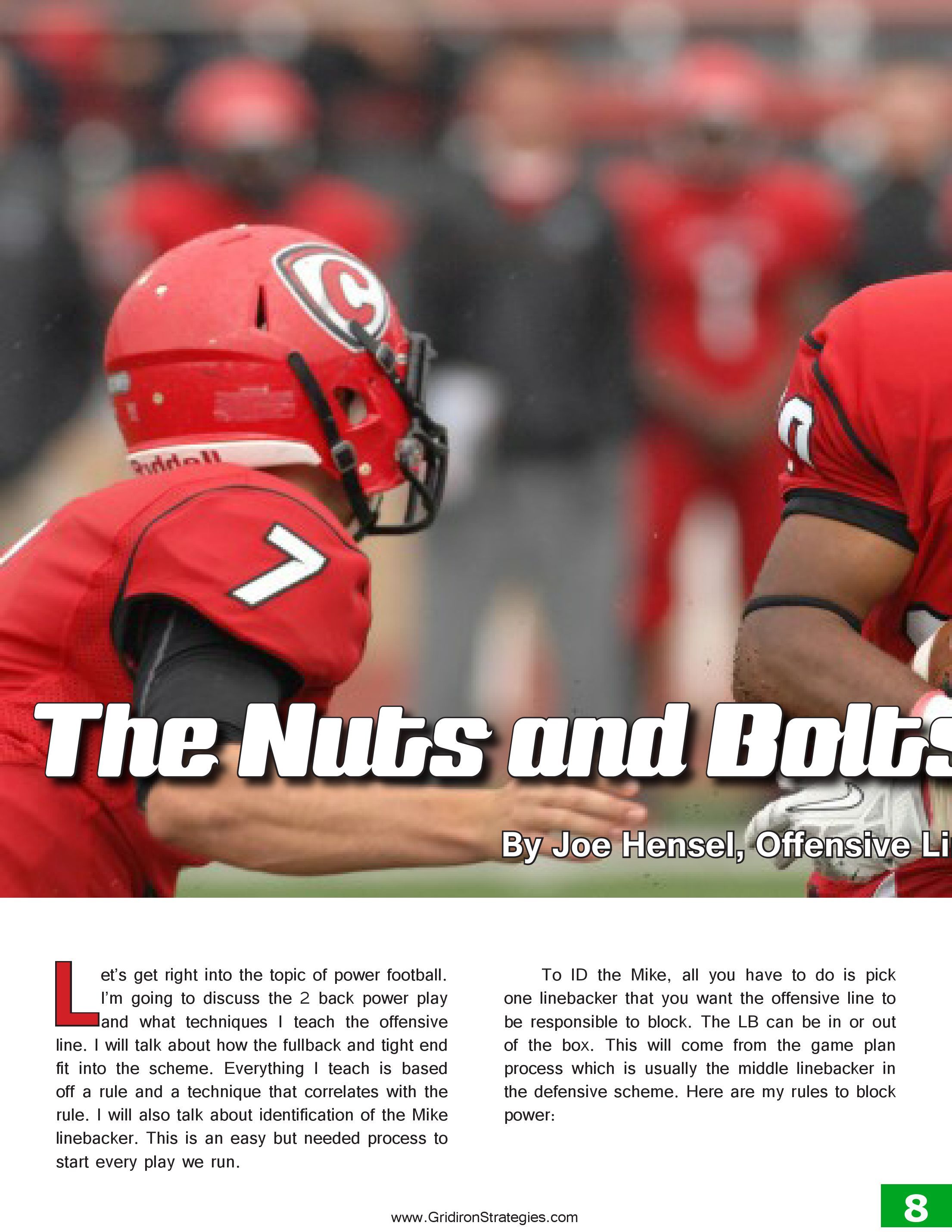
The Nuts and Bolts of Power Football By Joe Hensel, Offensive Line Coach Carthage College L et’s get right into the topic of power football. To ID the Mike, all you have to do is pick one linebacker that you want the offensive line to I’m going to discuss the 2 back power play and what techniques I teach the offensive of the box. This will come from the game plan line. I will talk about how the fullback and tight end be responsible to block. The LB can be in or out fit into the scheme. Everything I teach is based process which is usually the middle linebacker in off a rule and a technique that correlates with the the defensive scheme. Here are my rules to block rule. I will also talk about identification of the Mike power: linebacker. This is an easy but needed process to start every play we run. 8 www.GridironStrategies.com
Page 9
The Nuts and Bolts of Power Football By Joe Hensel, Offensive Line Coach Carthage College Honor all inside calls – These rules give the players a thought process to PST - Look to double, deuce, or trey follow during the play. If the PST has a deuce, he PSG - Deuce or down is done thinking and will execute the deuce block. OC - Base or back If he doesn’t have a deuce block, he will execute a trey block. The same goes for the PSG and the BSG - Pull for Mike center. What block is first in their rule is the first BST - Seal to Gate block they will execute. If the first rule isn’t there, TE - Man on DE they just follow their rule progression. FB - Man on Sam LB 9 www.GridironStrategies.com
Page 10
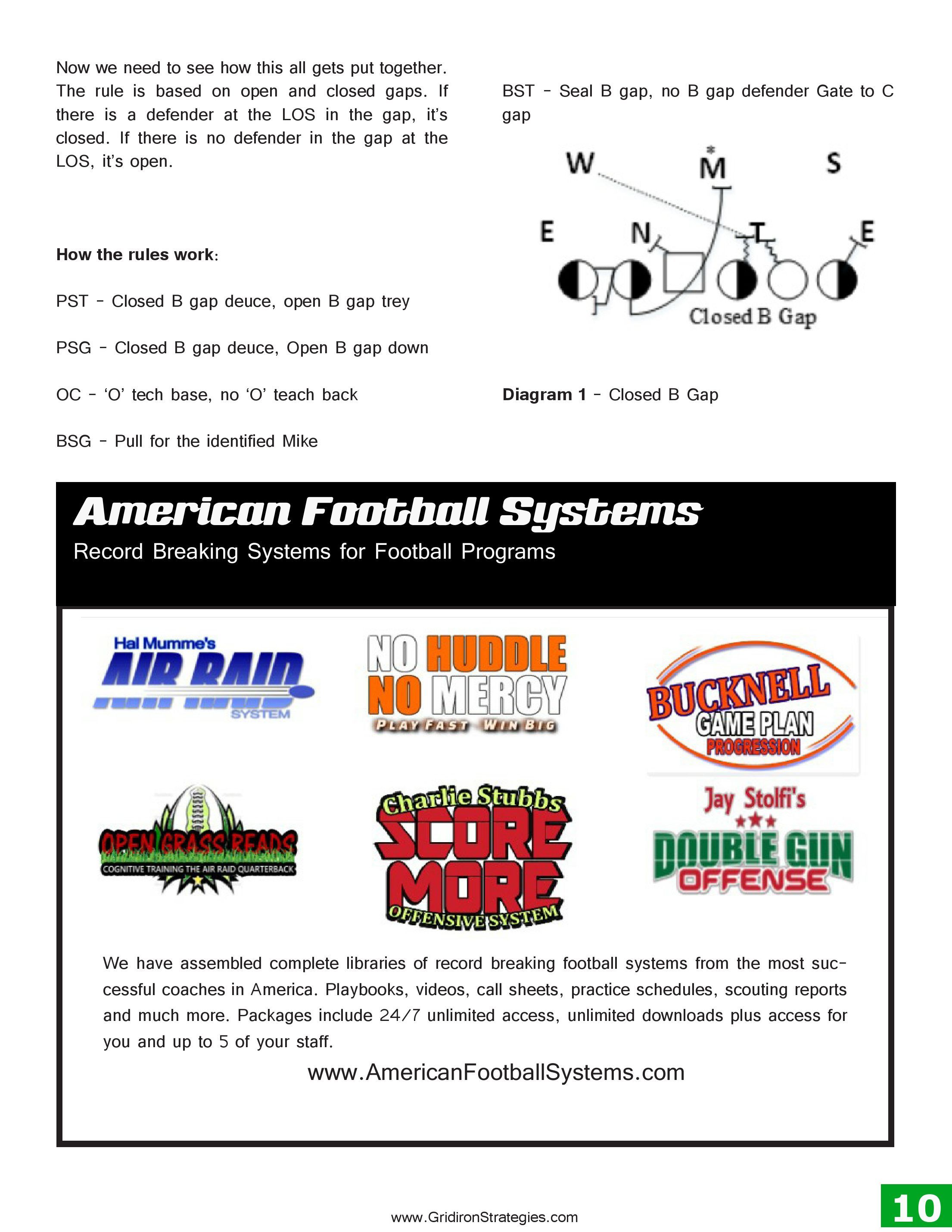
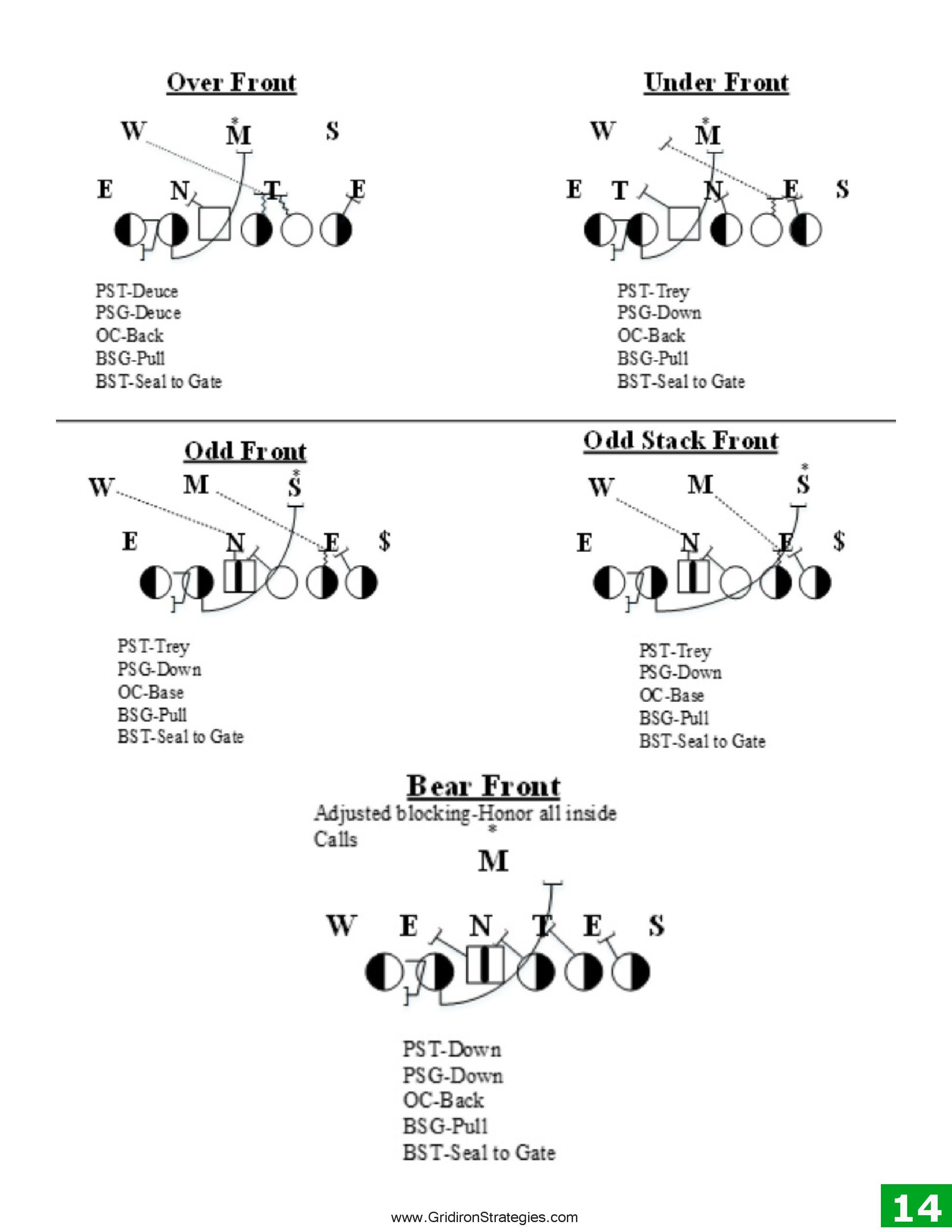
Now we need to see how this all gets put together. The rule is based on open and closed gaps. If BST - Seal B gap, no B gap defender Gate to C there is a defender at the LOS in the gap, it’s gap closed. If there is no defender in the gap at the LOS, it’s open. How the rules work: PST - Closed B gap deuce, open B gap trey PSG - Closed B gap deuce, Open B gap down OC - ‘O’ tech base, no ‘O’ teach back Diagram 1 - Closed B Gap BSG - Pull for the identified Mike American Football Systems Record Breaking Systems for Football Programs We have assembled complete libraries of record breaking football systems from the most successful coaches in America. Playbooks, videos, call sheets, practice schedules, scouting reports and much more. Packages include 24/7 unlimited access, unlimited downloads plus access for you and up to 5 of your staff. www.AmericanFootballSystems.com 10 www.GridironStrategies.com
Page 11
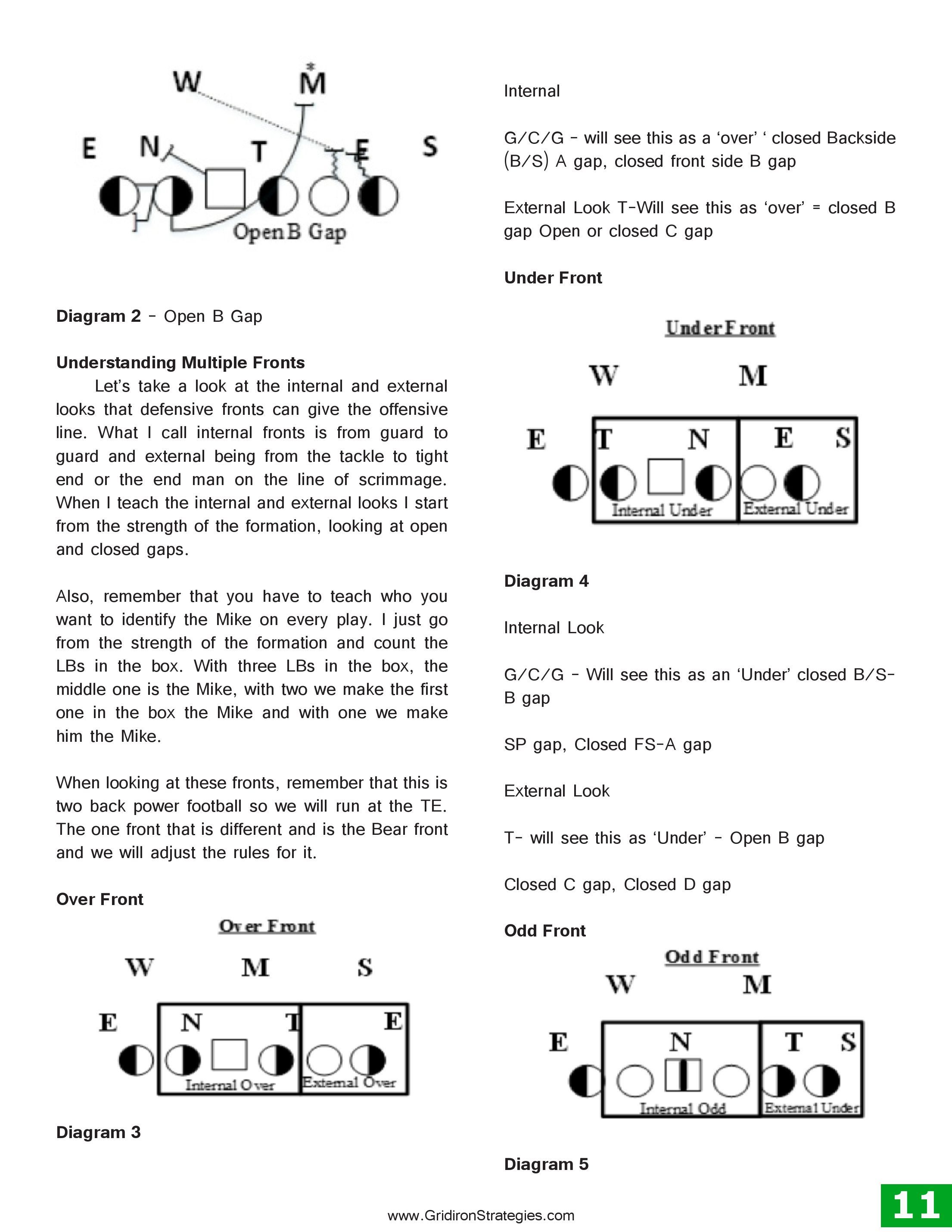
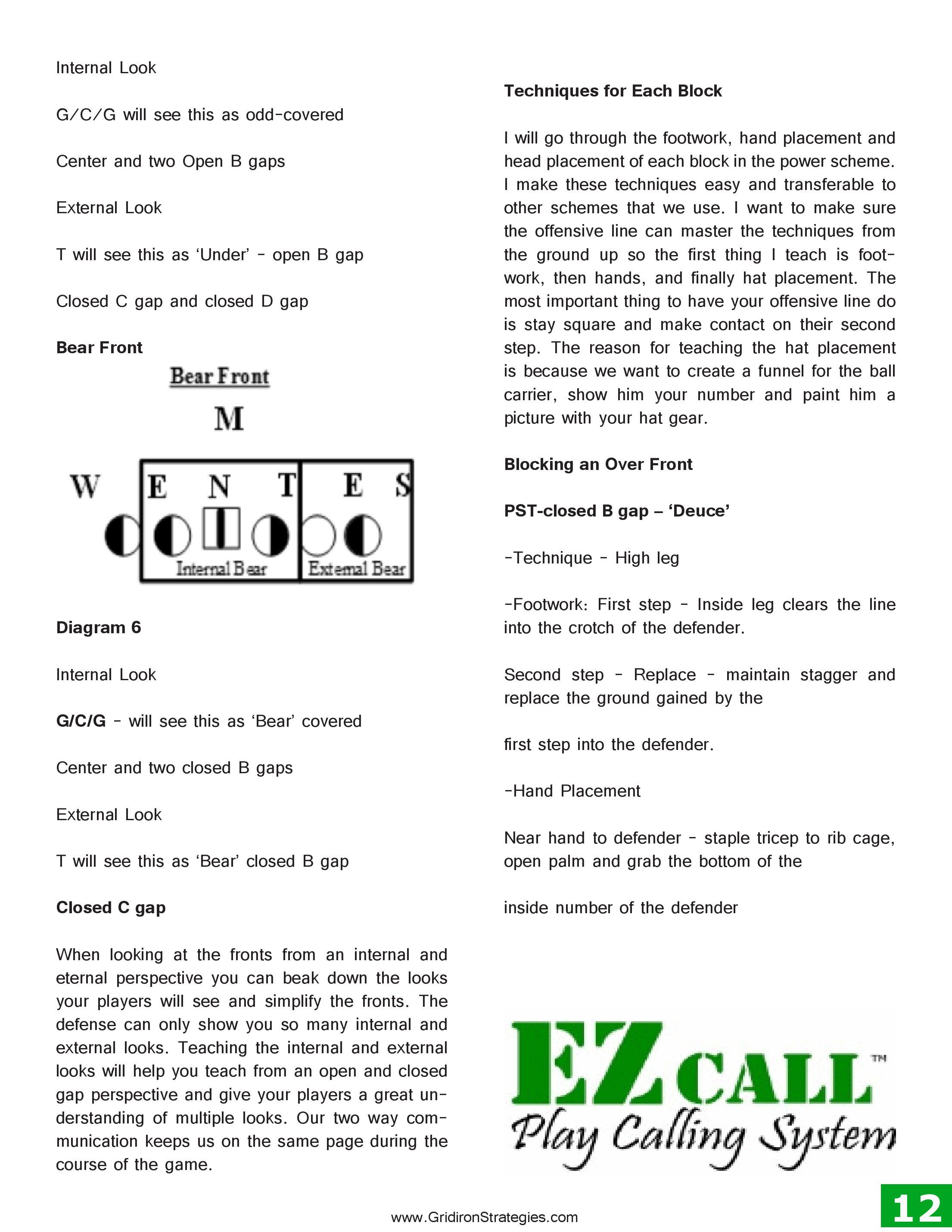
Internal G/C/G - will see this as a ‘over’ ‘ closed Backside (B/S) A gap, closed front side B gap External Look T-Will see this as ‘over’ = closed B gap Open or closed C gap Under Front Diagram 2 - Open B Gap Understanding Multiple Fronts Let’s take a look at the internal and external looks that defensive fronts can give the offensive line. What I call internal fronts is from guard to guard and external being from the tackle to tight end or the end man on the line of scrimmage. When I teach the internal and external looks I start from the strength of the formation, looking at open and closed gaps. Diagram 4 Also, remember that you have to teach who you want to identify the Mike on every play. I just go Internal Look from the strength of the formation and count the LBs in the box. With three LBs in the box, the G/C/G – Will see this as an ‘Under’ closed B/S- middle one is the Mike, with two we make the first B gap one in the box the Mike and with one we make him the Mike. SP gap, Closed FS-A gap When looking at these fronts, remember that this is External Look two back power football so we will run at the TE. The one front that is different and is the Bear front T- will see this as ‘Under’ – Open B gap and we will adjust the rules for it. Closed C gap, Closed D gap Over Front Odd Front Diagram 3 Diagram 5 11 www.GridironStrategies.com
Page 12
Internal Look Techniques for Each Block G/C/G will see this as odd-covered I will go through the footwork, hand placement and Center and two Open B gaps head placement of each block in the power scheme. I make these techniques easy and transferable to External Look other schemes that we use. I want to make sure the offensive line can master the techniques from T will see this as ‘Under’ – open B gap the ground up so the first thing I teach is footwork, then hands, and finally hat placement. The Closed C gap and closed D gap most important thing to have your offensive line do is stay square and make contact on their second Bear Front step. The reason for teaching the hat placement is because we want to create a funnel for the ball carrier, show him your number and paint him a picture with your hat gear. Blocking an Over Front PST-closed B gap – ‘Deuce’ -Technique – High leg -Footwork: First step – Inside leg clears the line Diagram 6 into the crotch of the defender. Internal Look Second step – Replace – maintain stagger and replace the ground gained by the G/C/G – will see this as ‘Bear’ covered first step into the defender. Center and two closed B gaps -Hand Placement External Look Near hand to defender – staple tricep to rib cage, T will see this as ‘Bear’ closed B gap open palm and grab the bottom of the Closed C gap inside number of the defender When looking at the fronts from an internal and eternal perspective you can beak down the looks your players will see and simplify the fronts. The defense can only show you so many internal and external looks. Teaching the internal and external looks will help you teach from an open and closed gap perspective and give your players a great understanding of multiple looks. Our two way communication keeps us on the same page during the course of the game. 12 www.GridironStrategies.com
Page 13
Off hand – Stable tricep to rib cage, open palm of the defender. and grab the bottom of the near (outside number of the defender). Off Hand – Staple tricep to rib cage, open palm and grab the near elbow of the defender – if you -Hat Gear miss you will hit the ribs. Down the middle of the defender – face mask into -Hat Gear his chest and once you take over the 3 tech, snap hat inside on the move. V of the arm pit of the defender to slightly in front – this will keep your hips set and eventually you PSG-closed B gap – ‘Deuce’ will end up with the V of the neck. -Technique-Hard shoulder lift BSG – Pull for ‘Mike’ -Footwork: First step – Inside foot, pop step pick- -Technique – Skip Pull ing it up and placing it back down. -Footwork: First step – Mid-point step back side Second step – Crotch step – clear the line into the foot drop with depth into your crotch. crotch of the defender Second step – Shuffle press off your first step to -Hand Placement keep a base – never cross over – Near hand to defender – Staple tricep to rib cage, stay square through gap. open palm and grab the bottom of the inside number of the defender. -Hand Placement Off Hand – Pump the off arm keeping the player Staple tricep to rib cage, open palm and grab the square. bottom of the numbers of the defender. -Hat Gear -Hat Gear Inside the defender – Facemask in the V of the Down the middle of the defender – Face mask into neck – eyes to the LB. his chest, snapping hat inside on the move. OC – No ‘O’ tech – ‘Back’ BST – Open B Gap – ‘Seal to Gate’ -Technique – over and up-down -Technique – Seal to gate -Footwork: First step –Step over to defender 6 to Footwork: First step – Step over into inside gap 8 inches and set your hips to the defender. gaining width. Second step – Clear the line with hips into the Second step – gate drop with depth to set your defender. hips at about a 45 degree angle. -Hand Placement -Hand Placement Near hand to defender – Staple Tricep to rib cage, Near hand to inside defender – open palm, punchopen palm and grab the bottom of the near number ing the bottom of the near number. 13 www.GridironStrategies.com
Page 14
14 www.GridironStrategies.com
Page 15
On gate punch the bottom of the defender’s num- -Hand Placement ber – turn into a base block. Near hand to defender - Staple tricep to rib cage -Hat Gear and open palm grabbing the bottom of the near number of the defender. Down the middle of the defender – Face mask into his chest, snapping hat inside on the move. Off hand - Staple tricep to rib cage - grab the near elbow of defender - if you miss you will hit the ribs. Blocking an Under Front -Hat Gear PST – Open Gap looking to double – no deuce, then ‘trey’ V of the arm pit of the defender to slightly in front - this will keep your hips set and eventually you -Technique – Hard shoulder lift will end up at the V of the neck. -Footwork OC-No ‘O’ tech then ‘Back’ First step - pop step with inside foot - pick it up -Technique - Over and up ‘Back’ and put it back down -Footwork - First step - Step over - set your hips Second Step - Crotch step - Clear the line into the to the defender crotch of the defender Second step - Step up - clear the line with hips -Hand placement into the defender Near hand to defender - Staple tricep to rib cage -Hand Placement - open palm and grab bottom of the inside number of defender. Near hand to defender - Staple tricep to rib cage - open palm and grab bottom of the near number Off Hand - Pump the off arm keeping the player of defender square. Off hand - staple tricep to rib cage - open palm -Hat Gear and grab the near elbow of the defender - if you miss you will hit the ribs. Inside the defender - Facemask in the V of the neck with eyes on the linebacker -Hat Gear PSG- Open B Gap - No Deuce then ‘Down’ V of the arm pit of the defender to slightly in front. This will keep your hips set and eventually you will -Technique - Over and up end up in the V of the neck. -Footwork BSG – Pull for ‘Mike’ First step - Overset your hips to the defender -Technique – Skip Pull Second step - Step up and clear the line with hips -Footwork – First step – Midpoint step – back side into the defender foot drop with depth into crotch. 15 www.GridironStrategies.com
Page 16
Second step – Shuffle – Press off your first step to keep a base. Never cross over – Stay square through gap. -Hand Placement Stable tricep to rib cage – open palm, grab bottom of the numbers of defender. -Hat Gear Down the middle of the defender – Face mask into his chest and snap hat inside on the move. BST – Closed B Gap – ‘Seal to Gate’ -Technique – Seal to Gate -Footwork – First step – Step over into inside gap, gaining width Second step – Gate (after the OC has taken over the block) – drop with depth to set your hips on approximately a 45 degree angle. -Hand Placement Near hand to inside defender: open palm, punching the bottom of the near number On gate punch the bottom of the defender’s number – turns into a base block -Hat Gear Down the middle of the defender – Face mask into his chest, snapping hat inside with the move. 16 www.GridironStrategies.com
Page 17
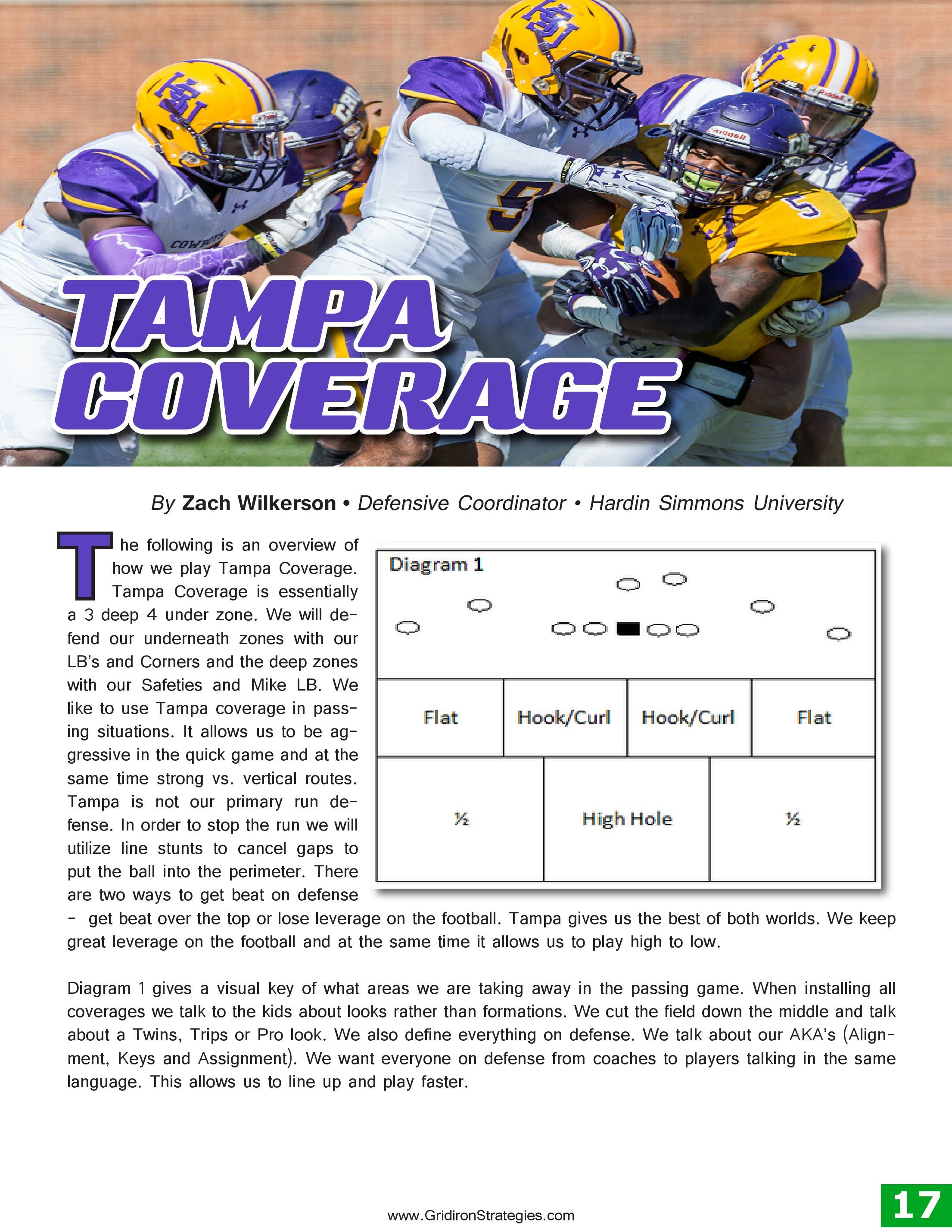
TAMPA COVERAGE By Zach Wilkerson • Defensive Coordinator • Hardin Simmons University T he following is an overview of how we play Tampa Coverage. Tampa Coverage is essentially a 3 deep 4 under zone. We will defend our underneath zones with our LB’s and Corners and the deep zones with our Safeties and Mike LB. We like to use Tampa coverage in passing situations. It allows us to be aggressive in the quick game and at the same time strong vs. vertical routes. Tampa is not our primary run defense. In order to stop the run we will utilize line stunts to cancel gaps to put the ball into the perimeter. There are two ways to get beat on defense - get beat over the top or lose leverage on the football. Tampa gives us the best of both worlds. We keep great leverage on the football and at the same time it allows us to play high to low. Diagram 1 gives a visual key of what areas we are taking away in the passing game. When installing all coverages we talk to the kids about looks rather than formations. We cut the field down the middle and talk about a Twins, Trips or Pro look. We also define everything on defense. We talk about our AKA’s (Alignment, Keys and Assignment). We want everyone on defense from coaches to players talking in the same language. This allows us to line up and play faster. 17 www.GridironStrategies.com
Page 18
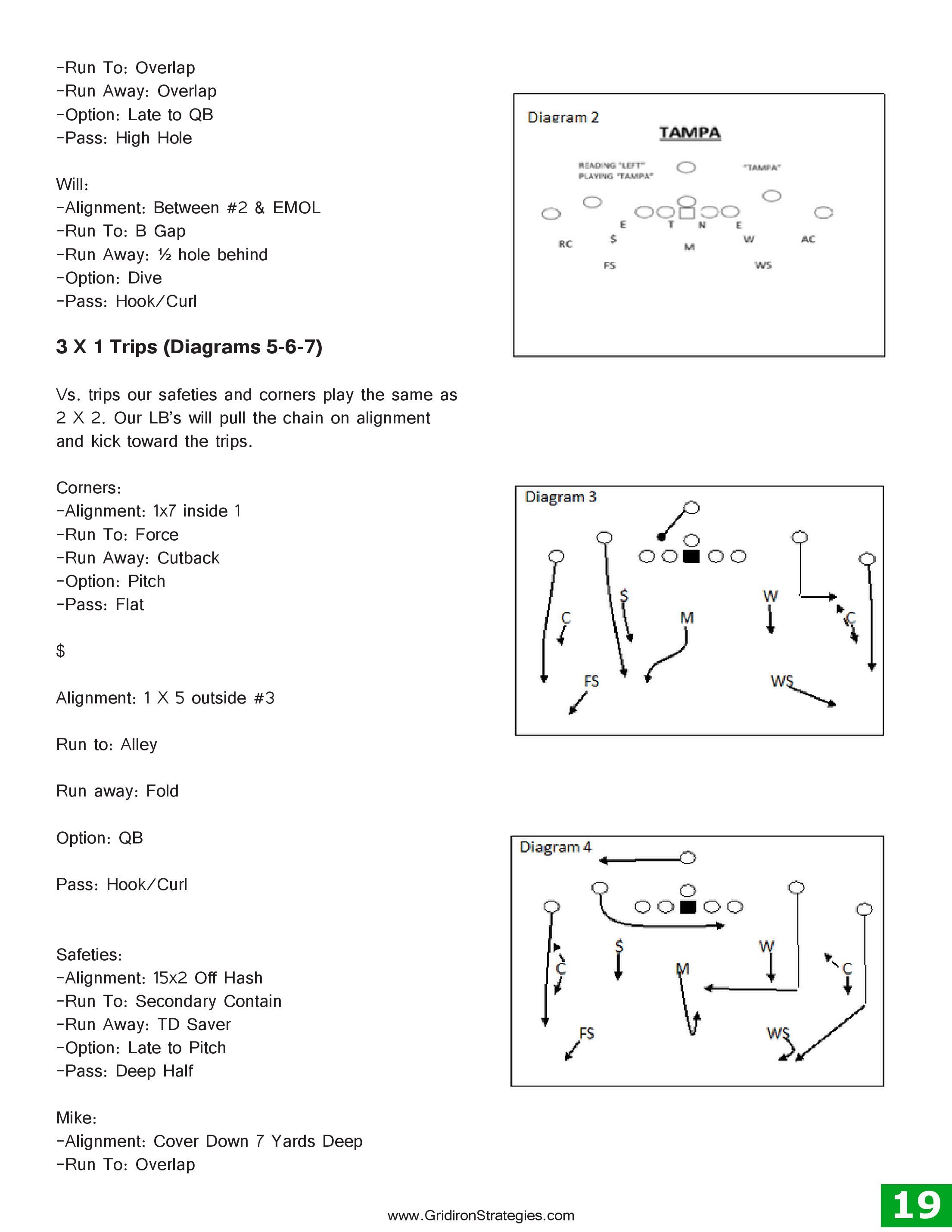
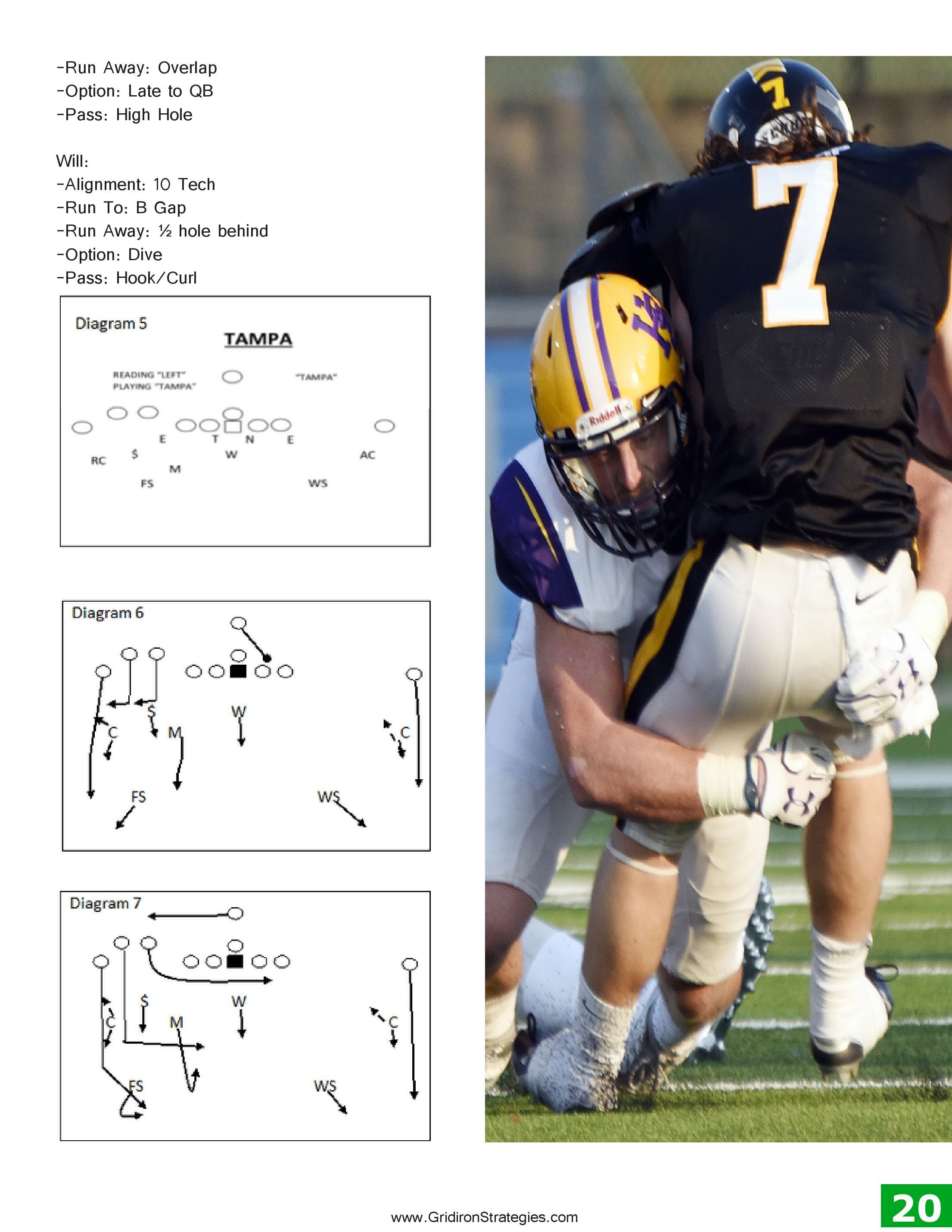
2 x 2 TWINS (Diagram 2) Safeties are the quarterbacks of our defense. The FS will give a reading left or reading right call to talk to the Read Side Corner, $ and M. He will read to the field first and passing strength second. The WS will align to the boundary or away from the passing strength. He will talk to the Away Side Corner and Will. The safeties will align off the hash. They will play deep half and will lean toward #1 WR. They are not part of the run game. On the snap they are reading the QB to the routes. Corners will align inside leverage of the #1 WR. We do not have them get hands on #1. He is our primary force defender vs. the run. If the CB reads run he will pull the trigger. If he reads pass we will read the QB for a3 step to 5 step drop. If it is 3 step drop, we are breaking on the ball. The corner is never wrong. This coverage allows us to take chances with our underneath players vs. the passing game. If it is a 5 step drop, we will sink and read routes. We will not jump underneath routes until the QB tells us to. (Diagrams 3 and 4). $ and the Will LB will align between the #2 WR and EMOL. They are heavy run defenders. If they read run they will pull the trigger. If pass shows, they too are reading 3 step to 5 step. If it is 3 step, they take a shot and are never wrong. If it is 5 step, get depth and read routes. If #2 is out hold curl and find #1. If #2 is vertical get depth and weave inside holding off the seam. If #2 releases inside, get depth and find work. (Diagrams 3 and 4). Mike LB will align 7 yards deep over the ball. He will work a pedal on the snap. He is not a primary run defender. He will be an overlap player vs. the run. If pass shows he will play high hole and will read vertical of #2 to #3. If both are vertical he will play off the QB. If one of the #2 WR’s is not vertical, he can flip his hips and play the other vertical route. (Diagram 3 and 4). Assignments Corners: -Alignment: 1x7 Inside #1 -Run To: Force -Run Away: Cutback -Option: Pitch -Pass: Flat Safeties: -Alignment: 15x2 Off Hash -Run To: Secondary Contain -Run Away: TD Saver -Option: Late to Pitch -Pass: Deep Half $: -Alignment: Between #2 & EMOL -Run To: Alley -Run Away: Fold -Option: QB -Pass: Hook/Curl Mike: -Alignment: 7 yards deep over ball 18 www.GridironStrategies.com
Page 19
-Run To: Overlap -Run Away: Overlap -Option: Late to QB -Pass: High Hole Will: -Alignment: Between #2 & EMOL -Run To: B Gap -Run Away: ½ hole behind -Option: Dive -Pass: Hook/Curl 3 X 1 Trips (Diagrams 5-6-7) Vs. trips our safeties and corners play the same as 2 X 2. Our LB’s will pull the chain on alignment and kick toward the trips. Corners: -Alignment: 1x7 inside 1 -Run To: Force -Run Away: Cutback -Option: Pitch -Pass: Flat $ Alignment: 1 X 5 outside #3 Run to: Alley Run away: Fold Option: QB Pass: Hook/Curl Safeties: -Alignment: 15x2 Off Hash -Run To: Secondary Contain -Run Away: TD Saver -Option: Late to Pitch -Pass: Deep Half Mike: -Alignment: Cover Down 7 Yards Deep -Run To: Overlap 19 www.GridironStrategies.com
Page 20
-Run Away: Overlap -Option: Late to QB -Pass: High Hole Will: -Alignment: 10 Tech -Run To: B Gap -Run Away: ½ hole behind -Option: Dive -Pass: Hook/Curl 20 www.GridironStrategies.com
Page 21
About the Author: Zach Wilkerson is in his 11th year in coaching, 8th year as a Defensive Coordinator. He has been Defensive Coordinator at Hardin Simmons University since 2014. He took over a defense ranked 235th in country giving up 45 points per game, to the 2015 season finishing 27th in the country and allowing 17 points per game. Coach Wilkerson runs a 4-2-5 defense and will base out of Quarters and Tampa coverage. Previously, he was the defensive coordinator at Mississippi College and Southwest Baptist University. 21 www.GridironStrategies.com
Page 22
The Art of Pass Rush By Payam Saadat • Defensive Line Coach • Cal Poly W ith the increased number of up tempo In order to perfect these characteristics and alspread offenses and mobile quarterlow for them to occur unconsciously, the concept backs, the ability to rush the passer and techniques taught must be kept to a minihas become a premium skill and therefore a craft mum. Too many moves and too much thinking unto itself. To see a player, explode out of a can paralyze a pass rusher. Don’t Think… Exstance, negotiate obstacles, and get home is to plode, React and Counter when necessary. see poetry in motion. A player can be recruited to college or courted by the NFL simply by I break the teaching progression down to three mastering or showing that you have the tools to phases: master the craft. Look no further than the MVP of Super Bowl 50 for an example of the affect a 1 – Get off great pass rusher can have on a game. This phase includes the stance, alignment, first step, and reaction to the movement. Characteristics of great pass rushers are: 2 – Aiming Point 1 – A great first step. Defining the type of pass rush by the offensive lineman’s position to a point of reference. 2 – A great reaction system; that is, reaction to the ball being snapped and reaction to the 3 – Finish movements of offensive linemen. Stay on your feet and counter at the depth of the QB. A sack is good, but a caused turnover 3 – A heightened level of both spatial and situis great. ational awareness. 22 www.GridironStrategies.com
Page 23
A great pass rush starts with a great get off. The Once the get off phase is complete, the concenbest pass rush move is often times a great get tration is now placed on understanding the aimoff. The get off is a function of stance, aligning point and how it can affect the type of pass ment, first step and reaction to the snap. Having rush used. In general, the aiming point rests a compact stance with the inside hand down is behind the outside heel of the offensive lineideal (this prevents a pass rush path that takes man. The depth of that point varies to whether you up the field first). Also important is to crowd you are an inside or edge rusher. If you were to the line of scrimmage and to have width in your draw a line from your stance to the QB it should horizontal alignment (your alignment that is parintersect at that point which may require you to allel to the line of scrimmage). However, do not adjust your horizontal alignment as well as havever sacrifice a great first step and/or reaction ing a slight tilt in your stance. The position of for alignment. Some players need to be perfect the offensive lineman to that point will determine with every technique and others are naturally which type of rush is used. We teach two rushexplosive - know the difference. es, speed and power. Each of those share the same counter. Again, it’s the belief in too many In a pass rush situation, the first step is a funcmoves that will create hesitation and decrease tion of the distance one can gain vertically, tothe success in getting home. ward an aiming point with the initial step out of a stance. The greater the distance covered with The goal is to beat the offensive lineman to the the first step directly correlates to the time it will aiming point. By winning the race to the aiming take to get to the aiming point – the faster one point, the offensive lineman is forced to open his can get to the aiming point, the greater success hips and therefore allowing access to the edge of the rush. In the absence of a great step, the with a speed move. When offensive linemen set coaching points of a compact stance as well up on top of the point, most pass rushers at this as vertical and horizontal alignment become that point tend to want to deviate from their path, and much more important. rather than maintaining their pass rush through the aiming point, the result is going up the field The reaction to the movement of the ball is a to get around - the pass rush has been neskill that requires constant training. That training gated. The position of the offensive lineman is must emphasize a focus on the senses that will now dictating that a power rush is needed. An trigger the reaction to explode without hesitation. effective pass rush can still be accomplished but This anticipation is trained throughout the year now the half man puzzle must be solved with a and is a function of both mental and kinesthetic power rush. The reaction time of the transition learning. Studying opponent film, down and disfrom a speed rush to power rush cannot comtance, offensive line and QB behavior in addition promise pad level, speed, or path through the to understanding the play clock are all a part aiming point. of the mental development. We take a holistic approach in the development of the physical Lastly, if the offensive lineman over sets and is attributes of the get off. Our primary objective to the outside of your aiming point, the appropriis to minimize the time it takes to react (get ate reaction would be to counter back inside. The off) to an action (ball/OL movement). Therefore, position that the offensive lineman has chosen is we utilize a variety of action-reaction drills that a function of a pass rusher who has successfully range from full body movement drills (from a two established that he can edge rush. This forces or three-point stance) to wrist/hand movement the offensive lineman to put himself in a position drills (martial arts). where his momentum can be used against him. 23 www.GridironStrategies.com
Page 24
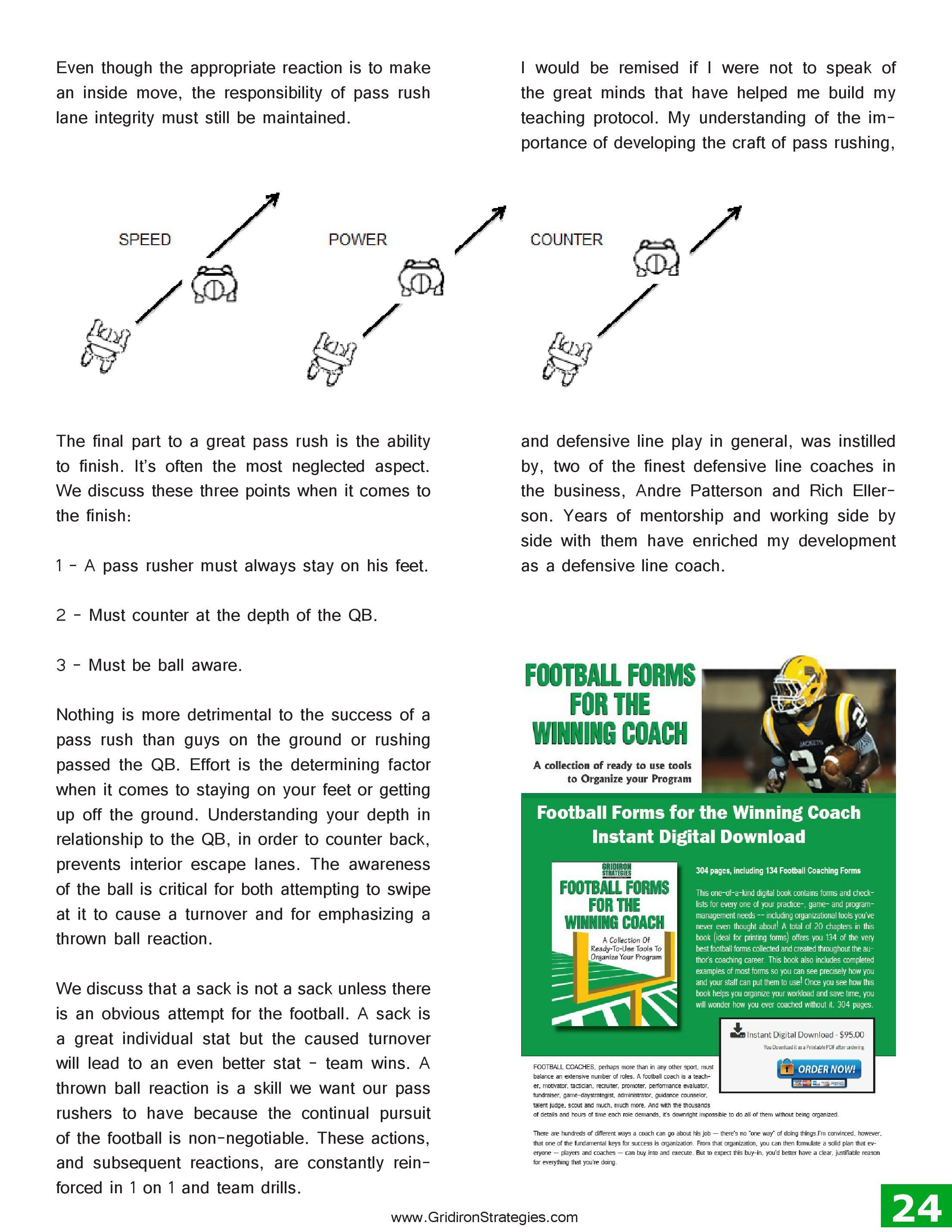
Even though the appropriate reaction is to make I would be remised if I were not to speak of an inside move, the responsibility of pass rush the great minds that have helped me build my lane integrity must still be maintained. teaching protocol. My understanding of the importance of developing the craft of pass rushing, The final part to a great pass rush is the ability and defensive line play in general, was instilled to finish. It’s often the most neglected aspect. by, two of the finest defensive line coaches in We discuss these three points when it comes to the business, Andre Patterson and Rich Ellerthe finish: son. Years of mentorship and working side by side with them have enriched my development 1 – A pass rusher must always stay on his feet. as a defensive line coach. 2 – Must counter at the depth of the QB. 3 – Must be ball aware. Nothing is more detrimental to the success of a pass rush than guys on the ground or rushing passed the QB. Effort is the determining factor when it comes to staying on your feet or getting up off the ground. Understanding your depth in relationship to the QB, in order to counter back, prevents interior escape lanes. The awareness of the ball is critical for both attempting to swipe at it to cause a turnover and for emphasizing a thrown ball reaction. We discuss that a sack is not a sack unless there is an obvious attempt for the football. A sack is a great individual stat but the caused turnover will lead to an even better stat - team wins. A thrown ball reaction is a skill we want our pass rushers to have because the continual pursuit of the football is non-negotiable. These actions, and subsequent reactions, are constantly reinforced in 1 on 1 and team drills. 24 www.GridironStrategies.com
Page 25
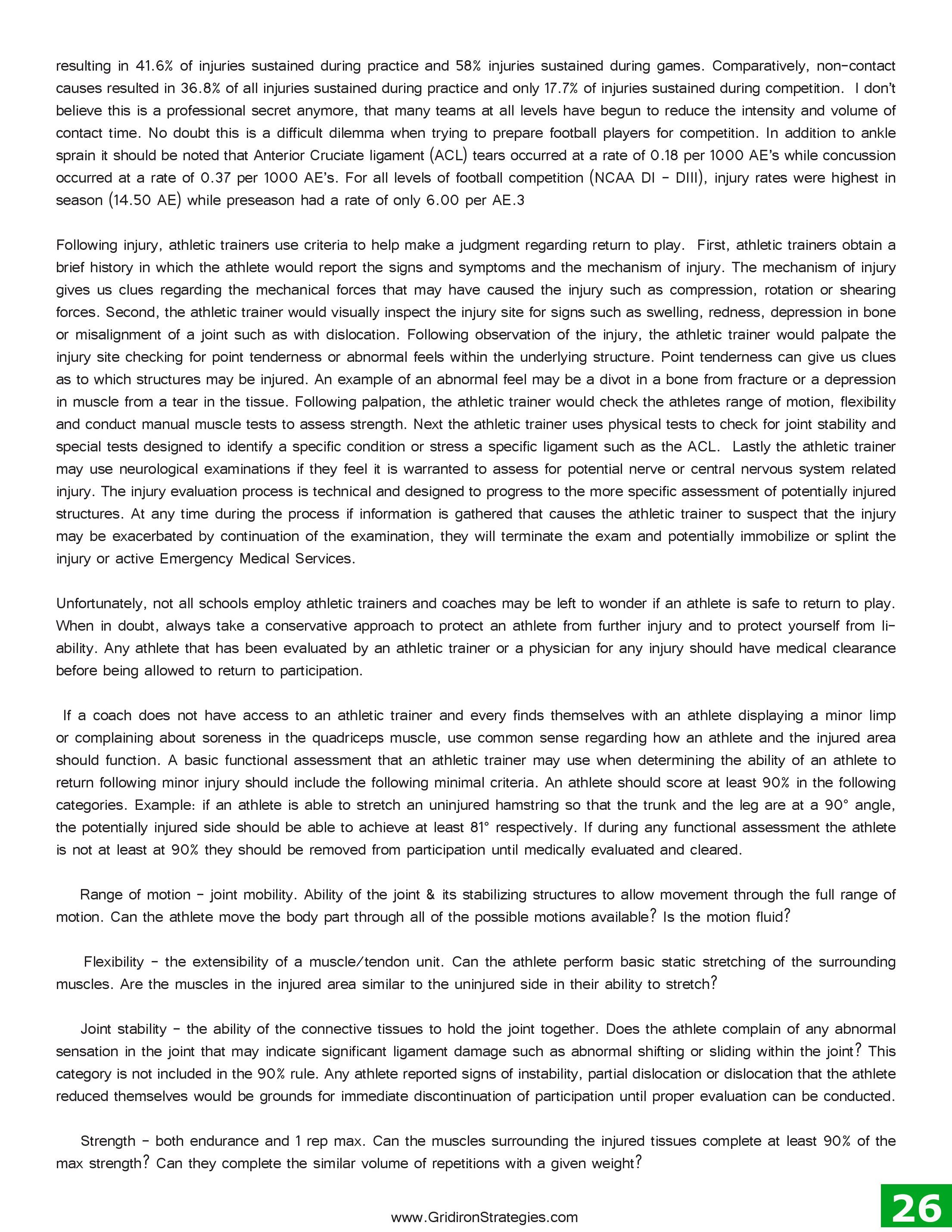
Return to Play Following Musculoskeletal Injury: Basic Assessments to Determine Functional Status By Bryan Dorrel, Assistant Professor Tarleton State University One of the most common questions an athletic trainer will receive from a football coach when a player is injured is “can they go”? This can be a challenging issue and the answer is dependent on several things1,2: • the type of injury • the severity of the injury & symptoms • the psychological status of the athlete • the potential for making the injury worse • the confidence level of the athletic trainer in the initial evaluation results • the functional ability of the athlete • the type of sport being played • the position played by the athlete • time during the season when the injury occurs With so many different types of injuries occurring in the sport of football, it can be confusing when dealing with all the potential criteria that athletic trainers may use when making a judgment on the status of an athlete. There are without a doubt some serious injuries that require immediate removal from practice or play and medical evaluation by athletic trainers and/or the team physician before the athlete may ever continue, such as with suspected concussion. Thankfully, most injuries sustained during a season of American football are bumps, bruises, and minor sprains and strains. In an epidemiological study of injuries to collegiate athletes in fifteen different sports, researchers determined that lower extremity injuries where the most common, specifically the ankle sprain. In men’s football, ankle sprain accounted for 13.6% of all injuries and occurred at a rate of 0.83 sprains per 1000 athlete-exposures (AE). An Athlete exposure was defined as an athlete participating in 1 practice or game.3 Interestingly, lower extremity injuries occurred at nearly the same exact rate regardless of if practicing (53.7%) or playing in a game (53.8%) . There was a noticeable difference between those injuries suffered during contact versus non-contact. Analysis showed that in both games and practices, player contact was the cause of most injuries 25 www.GridironStrategies.com
Page 26
resulting in 41.6% of injuries sustained during practice and 58% injuries sustained during games. Comparatively, non-contact causes resulted in 36.8% of all injuries sustained during practice and only 17.7% of injuries sustained during competition. I don’t believe this is a professional secret anymore, that many teams at all levels have begun to reduce the intensity and volume of contact time. No doubt this is a difficult dilemma when trying to prepare football players for competition. In addition to ankle sprain it should be noted that Anterior Cruciate ligament (ACL) tears occurred at a rate of 0.18 per 1000 AE’s while concussion occurred at a rate of 0.37 per 1000 AE’s. For all levels of football competition (NCAA DI - DIII), injury rates were highest in season (14.50 AE) while preseason had a rate of only 6.00 per AE.3 Following injury, athletic trainers use criteria to help make a judgment regarding return to play. First, athletic trainers obtain a brief history in which the athlete would report the signs and symptoms and the mechanism of injury. The mechanism of injury gives us clues regarding the mechanical forces that may have caused the injury such as compression, rotation or shearing forces. Second, the athletic trainer would visually inspect the injury site for signs such as swelling, redness, depression in bone or misalignment of a joint such as with dislocation. Following observation of the injury, the athletic trainer would palpate the injury site checking for point tenderness or abnormal feels within the underlying structure. Point tenderness can give us clues as to which structures may be injured. An example of an abnormal feel may be a divot in a bone from fracture or a depression in muscle from a tear in the tissue. Following palpation, the athletic trainer would check the athletes range of motion, flexibility and conduct manual muscle tests to assess strength. Next the athletic trainer uses physical tests to check for joint stability and special tests designed to identify a specific condition or stress a specific ligament such as the ACL. Lastly the athletic trainer may use neurological examinations if they feel it is warranted to assess for potential nerve or central nervous system related injury. The injury evaluation process is technical and designed to progress to the more specific assessment of potentially injured structures. At any time during the process if information is gathered that causes the athletic trainer to suspect that the injury may be exacerbated by continuation of the examination, they will terminate the exam and potentially immobilize or splint the injury or active Emergency Medical Services. Unfortunately, not all schools employ athletic trainers and coaches may be left to wonder if an athlete is safe to return to play. When in doubt, always take a conservative approach to protect an athlete from further injury and to protect yourself from liability. Any athlete that has been evaluated by an athletic trainer or a physician for any injury should have medical clearance before being allowed to return to participation. If a coach does not have access to an athletic trainer and every finds themselves with an athlete displaying a minor limp or complaining about soreness in the quadriceps muscle, use common sense regarding how an athlete and the injured area should function. A basic functional assessment that an athletic trainer may use when determining the ability of an athlete to return following minor injury should include the following minimal criteria. An athlete should score at least 90% in the following categories. Example: if an athlete is able to stretch an uninjured hamstring so that the trunk and the leg are at a 90° angle, the potentially injured side should be able to achieve at least 81° respectively. If during any functional assessment the athlete is not at least at 90% they should be removed from participation until medically evaluated and cleared. Range of motion - joint mobility. Ability of the joint & its stabilizing structures to allow movement through the full range of motion. Can the athlete move the body part through all of the possible motions available? Is the motion fluid? Flexibility - the extensibility of a muscle/tendon unit. Can the athlete perform basic static stretching of the surrounding muscles. Are the muscles in the injured area similar to the uninjured side in their ability to stretch? Joint stability - the ability of the connective tissues to hold the joint together. Does the athlete complain of any abnormal sensation in the joint that may indicate significant ligament damage such as abnormal shifting or sliding within the joint? This category is not included in the 90% rule. Any athlete reported signs of instability, partial dislocation or dislocation that the athlete reduced themselves would be grounds for immediate discontinuation of participation until proper evaluation can be conducted. Strength - both endurance and 1 rep max. Can the muscles surrounding the injured tissues complete at least 90% of the max strength? Can they complete the similar volume of repetitions with a given weight? 26 www.GridironStrategies.com
Page 27
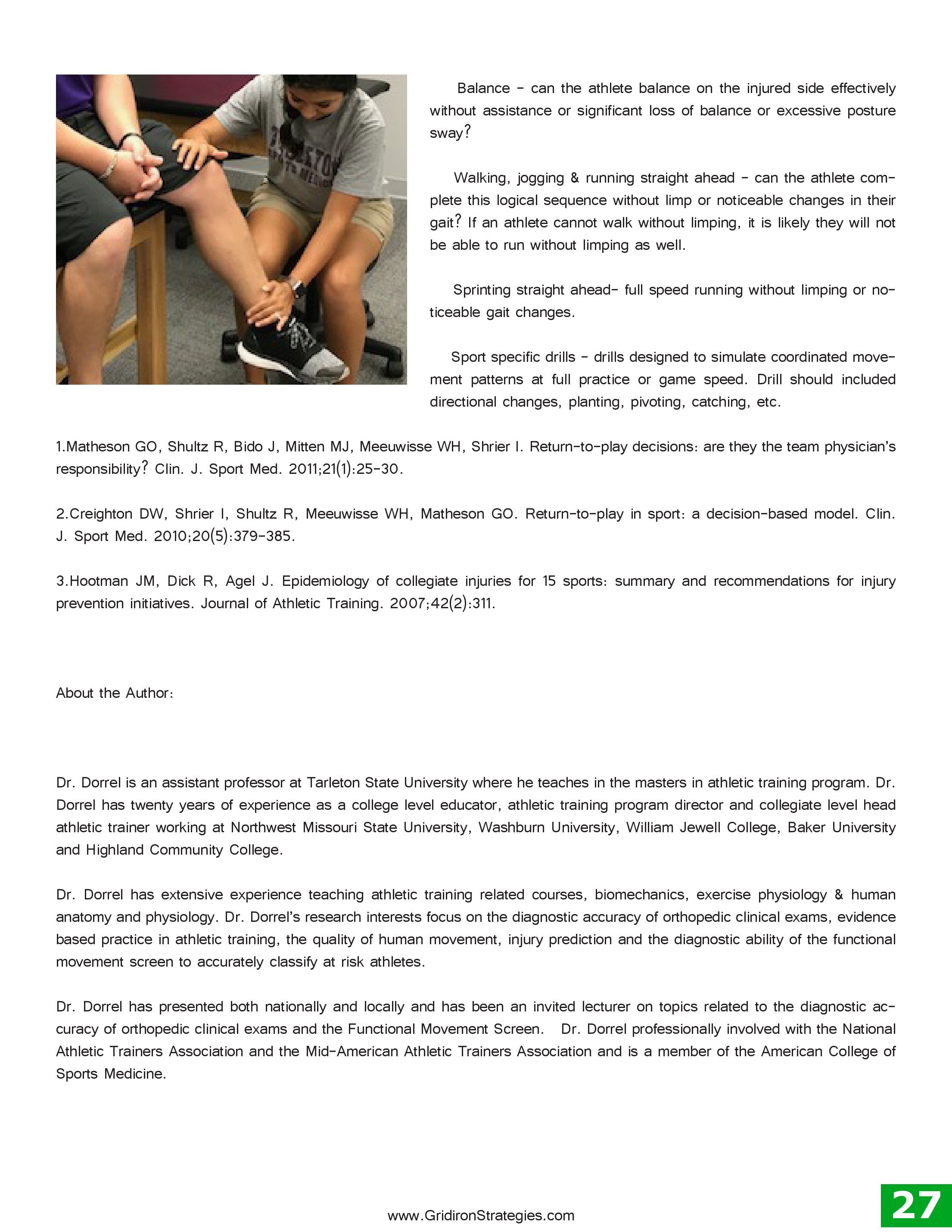
Balance - can the athlete balance on the injured side effectively without assistance or significant loss of balance or excessive posture sway? Walking, jogging & running straight ahead - can the athlete complete this logical sequence without limp or noticeable changes in their gait? If an athlete cannot walk without limping, it is likely they will not be able to run without limping as well. Sprinting straight aheadfull speed running without limping or noticeable gait changes. Sport specific drills - drills designed to simulate coordinated movement patterns at full practice or game speed. Drill should included directional changes, planting, pivoting, catching, etc. 1.Matheson GO, Shultz R, Bido J, Mitten MJ, Meeuwisse WH, Shrier I. Return-to-play decisions: are they the team physician’s responsibility? Clin. J. Sport Med. 2011;21(1):25-30. 2.Creighton DW, Shrier I, Shultz R, Meeuwisse WH, Matheson GO. Return-to-play in sport: a decision-based model. Clin. J. Sport Med. 2010;20(5):379-385. 3.Hootman JM, Dick R, Agel J. Epidemiology of collegiate injuries for 15 sports: summary and recommendations for injury prevention initiatives. Journal of Athletic Training. 2007;42(2):311. About the Author: Dr. Dorrel is an assistant professor at Tarleton State University where he teaches in the masters in athletic training program. Dr. Dorrel has twenty years of experience as a college level educator, athletic training program director and collegiate level head athletic trainer working at Northwest Missouri State University, Washburn University, William Jewell College, Baker University and Highland Community College. Dr. Dorrel has extensive experience teaching athletic training related courses, biomechanics, exercise physiology & human anatomy and physiology. Dr. Dorrel’s research interests focus on the diagnostic accuracy of orthopedic clinical exams, evidence based practice in athletic training, the quality of human movement, injury prediction and the diagnostic ability of the functional movement screen to accurately classify at risk athletes. Dr. Dorrel has presented both nationally and locally and has been an invited lecturer on topics related to the diagnostic accuracy of orthopedic clinical exams and the Functional Movement Screen. Dr. Dorrel professionally involved with the National Athletic Trainers Association and the Mid-American Athletic Trainers Association and is a member of the American College of Sports Medicine. 27 www.GridironStrategies.com
Page 28
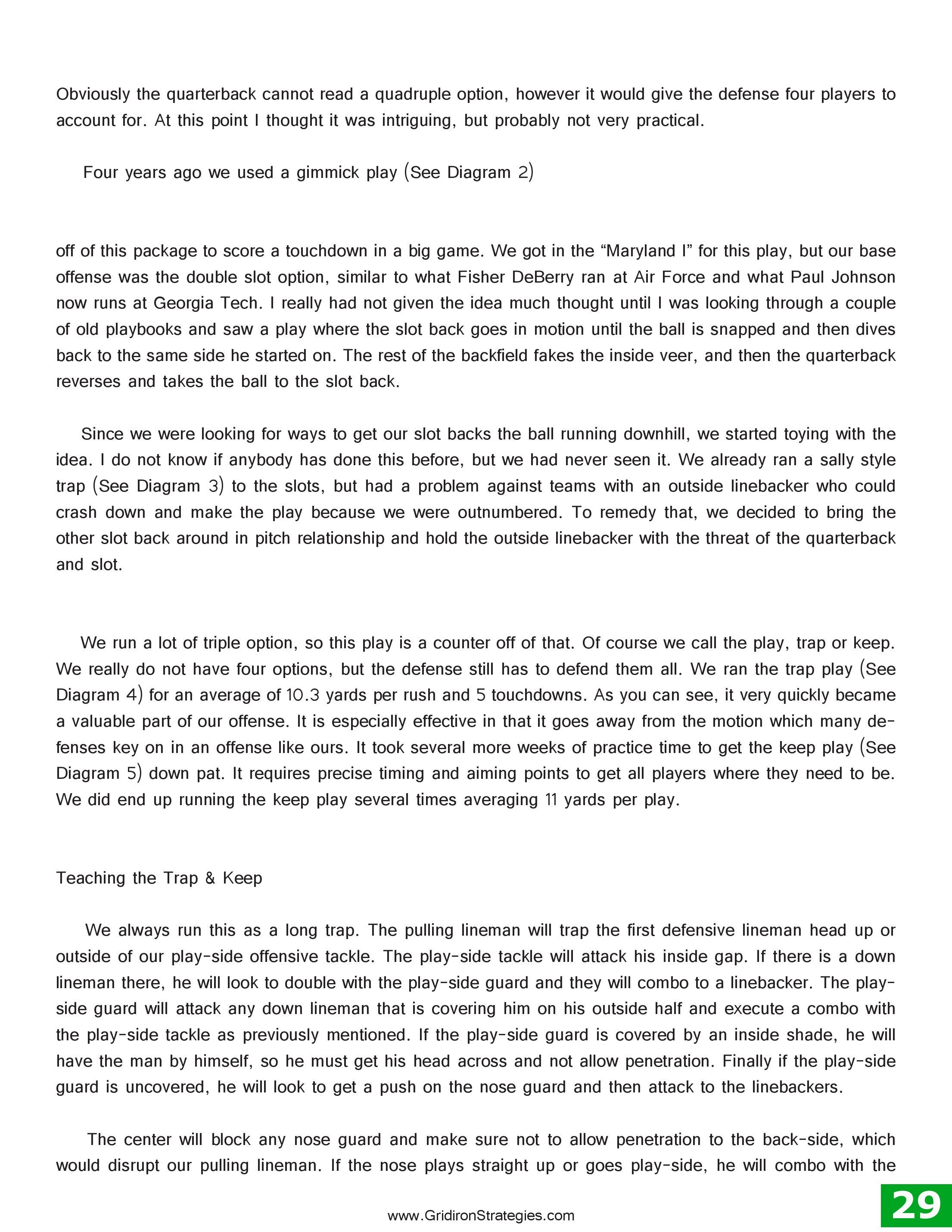
The Quad Option by Rick Martin Offensive Line Coach, Marlboro County High School (SC) About six years ago, while looking at some plays from the “Maryland I”, I thought why not run a “quadruple option”. This play would have the fullback dive to one side and the quarterback open to him, then reverse direction with the middle back diving and the tailback getting in pitch relationship (See Diagram 1). 28 www.GridironStrategies.com
Page 29
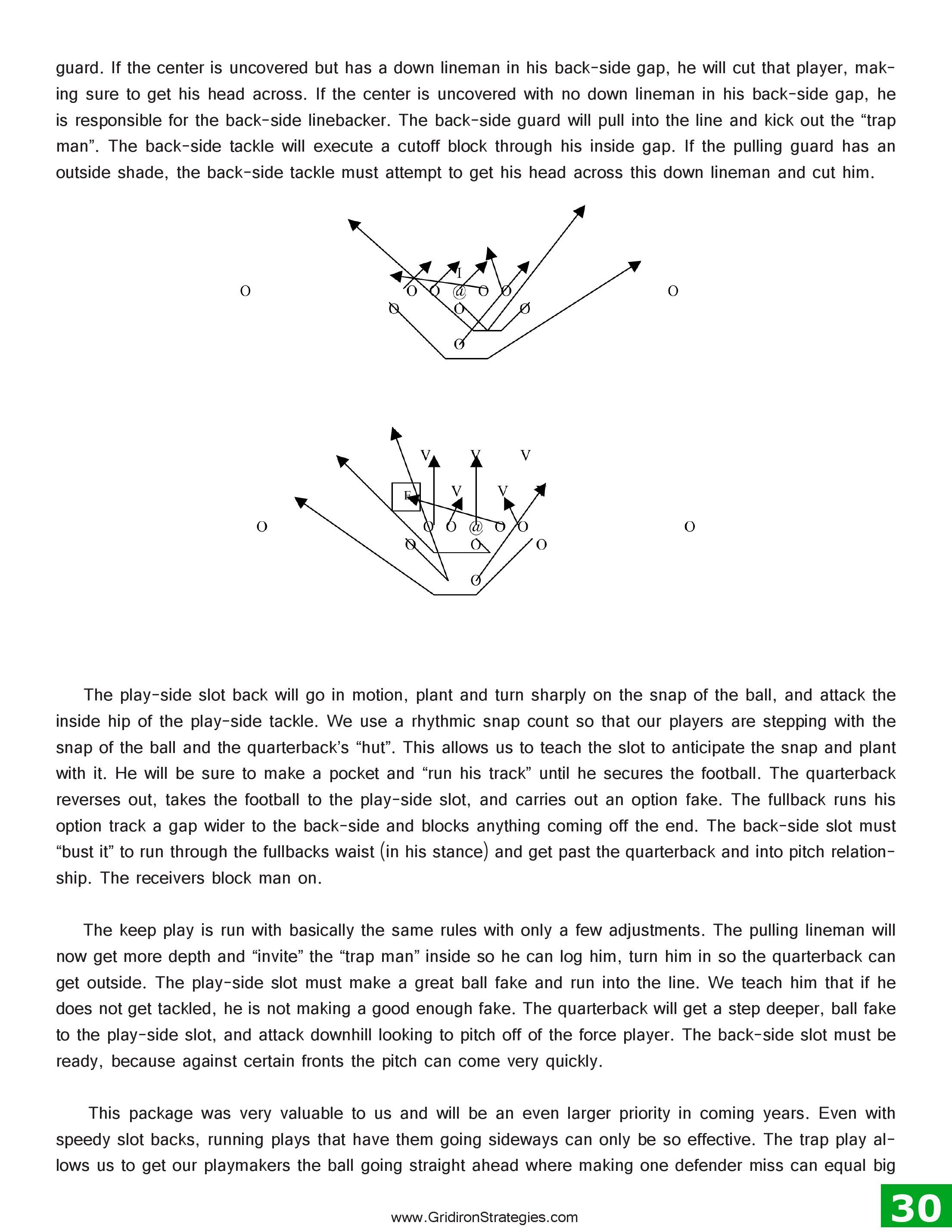
Obviously the quarterback cannot read a quadruple option, however it would give the defense four players to account for. At this point I thought it was intriguing, but probably not very practical. Four years ago we used a gimmick play (See Diagram 2) off of this package to score a touchdown in a big game. We got in the “Maryland I” for this play, but our base offense was the double slot option, similar to what Fisher DeBerry ran at Air Force and what Paul Johnson now runs at Georgia Tech. I really had not given the idea much thought until I was looking through a couple of old playbooks and saw a play where the slot back goes in motion until the ball is snapped and then dives back to the same side he started on. The rest of the backfield fakes the inside veer, and then the quarterback reverses and takes the ball to the slot back. Since we were looking for ways to get our slot backs the ball running downhill, we started toying with the idea. I do not know if anybody has done this before, but we had never seen it. We already ran a sally style trap (See Diagram 3) to the slots, but had a problem against teams with an outside linebacker who could crash down and make the play because we were outnumbered. To remedy that, we decided to bring the other slot back around in pitch relationship and hold the outside linebacker with the threat of the quarterback and slot. We run a lot of triple option, so this play is a counter off of that. Of course we call the play, trap or keep. We really do not have four options, but the defense still has to defend them all. We ran the trap play (See Diagram 4) for an average of 10.3 yards per rush and 5 touchdowns. As you can see, it very quickly became a valuable part of our offense. It is especially effective in that it goes away from the motion which many defenses key on in an offense like ours. It took several more weeks of practice time to get the keep play (See Diagram 5) down pat. It requires precise timing and aiming points to get all players where they need to be. We did end up running the keep play several times averaging 11 yards per play. Teaching the Trap & Keep We always run this as a long trap. The pulling lineman will trap the first defensive lineman head up or outside of our play-side offensive tackle. The play-side tackle will attack his inside gap. If there is a down lineman there, he will look to double with the play-side guard and they will combo to a linebacker. The playside guard will attack any down lineman that is covering him on his outside half and execute a combo with the play-side tackle as previously mentioned. If the play-side guard is covered by an inside shade, he will have the man by himself, so he must get his head across and not allow penetration. Finally if the play-side guard is uncovered, he will look to get a push on the nose guard and then attack to the linebackers. The center will block any nose guard and make sure not to allow penetration to the back-side, which would disrupt our pulling lineman. If the nose plays straight up or goes play-side, he will combo with the 29 www.GridironStrategies.com
Page 30
guard. If the center is uncovered but has a down lineman in his back-side gap, he will cut that player, making sure to get his head across. If the center is uncovered with no down lineman in his back-side gap, he is responsible for the back-side linebacker. The back-side guard will pull into the line and kick out the “trap man”. The back-side tackle will execute a cutoff block through his inside gap. If the pulling guard has an outside shade, the back-side tackle must attempt to get his head across this down lineman and cut him. The play-side slot back will go in motion, plant and turn sharply on the snap of the ball, and attack the inside hip of the play-side tackle. We use a rhythmic snap count so that our players are stepping with the snap of the ball and the quarterback’s “hut”. This allows us to teach the slot to anticipate the snap and plant with it. He will be sure to make a pocket and “run his track” until he secures the football. The quarterback reverses out, takes the football to the play-side slot, and carries out an option fake. The fullback runs his option track a gap wider to the back-side and blocks anything coming off the end. The back-side slot must “bust it” to run through the fullbacks waist (in his stance) and get past the quarterback and into pitch relationship. The receivers block man on. The keep play is run with basically the same rules with only a few adjustments. The pulling lineman will now get more depth and “invite” the “trap man” inside so he can log him, turn him in so the quarterback can get outside. The play-side slot must make a great ball fake and run into the line. We teach him that if he does not get tackled, he is not making a good enough fake. The quarterback will get a step deeper, ball fake to the play-side slot, and attack downhill looking to pitch off of the force player. The back-side slot must be ready, because against certain fronts the pitch can come very quickly. This package was very valuable to us and will be an even larger priority in coming years. Even with speedy slot backs, running plays that have them going sideways can only be so effective. The trap play allows us to get our playmakers the ball going straight ahead where making one defender miss can equal big 30 www.GridironStrategies.com
Page 31
yards. We had big plays of 59, 31, 31, and 21 yards in one season on the trap play. The keep can also get big yards when you have begun hurting a defense with the trap. You want to call the keep when they begin crashing down to stop the trap with their outside defenders. We were able to get ten yards or more on the keep play several times this year as it compliments the trap quite well. 31 www.GridironStrategies.com
Page 32
32 www.GridironStrategies.com