

Read this issue as text
Page 1
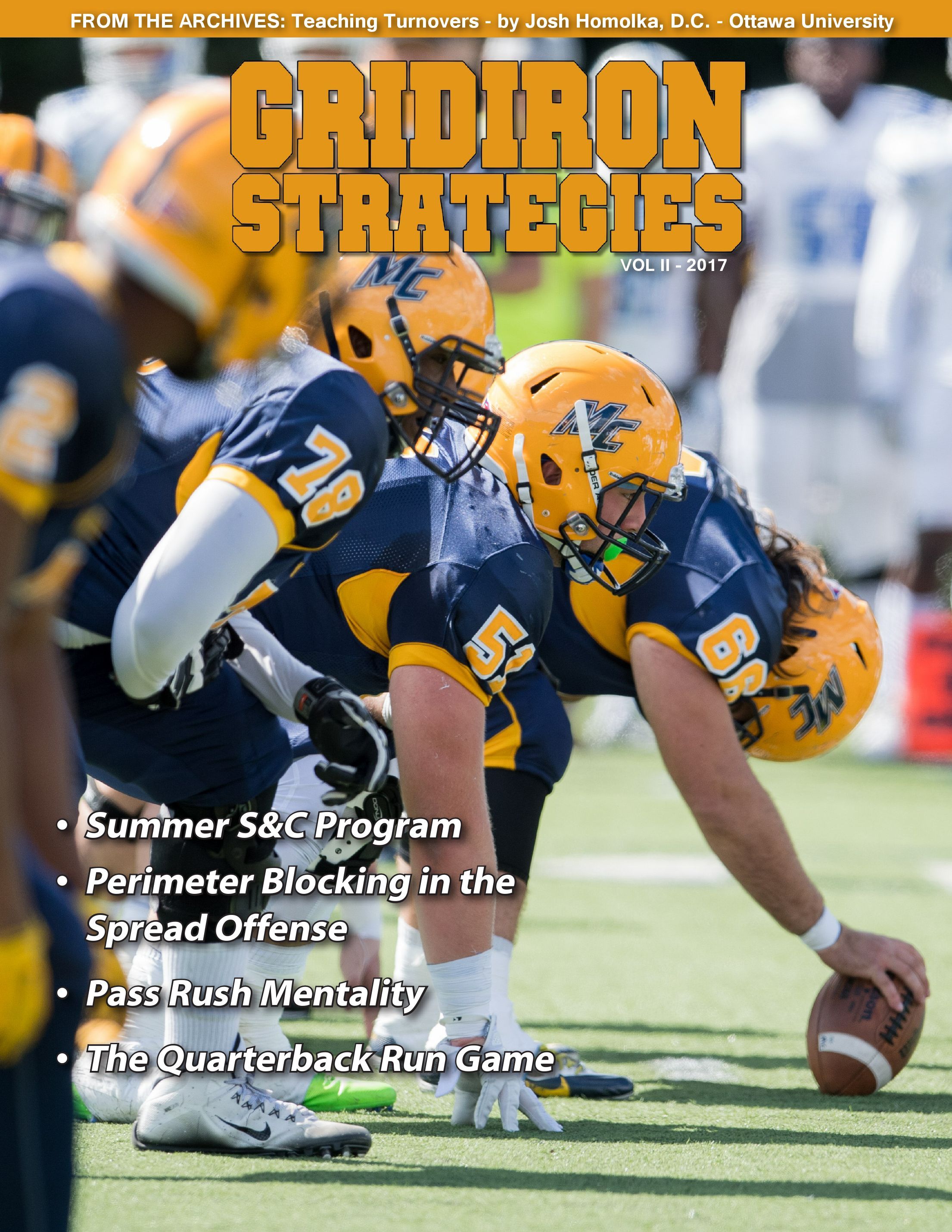
FROM THE ARCHIVES: Teaching Turnovers - by Josh Homolka, D.C. - Ottawa University VOL II - 2017 • Summer S&C Program • Perimeter Blocking in the Spread Offense • Pass Rush Mentality • The Quarterback Run Game 1 www.GridironStrategies.com
Page 2
Letter from the Editor - A Summer Strength and Conditioning Program Toby Jacobi had been a strength and conditioning coach on the college level for 15 years and recently became a coach on the high school level. While a college coach, he completed a series of DVDs with AFM. At Charleston Southern University at the time, a few of the videos included: - ‘Team and Individual Motivation in the Weight Room’ - ‘Position Specific Football Strength Training’ - ‘Developing a Summer Football Strength Program’ - ‘Developing an Off-Season Strength and Conditioning Program - ‘Developing an In-Season Strength and Conditioning Program Now, Coach Jacobi has detailed a complete and comprehensive summer strength and conditioning program just for high school student-athletes. With just about everyone’s equipment and station level different, Coach Jacobi prepares an overall plan that should fit everyone’s needs. He breaks it down into: strength training, a running program, football practice, additional competitions such as AAU baseball, 7 on 7 competitions, and college camps and, finally, toughness competitions. Whatever your level of expertise, this program should work well at your school. The article begins on page 18. Additionally, this issue includes a new section entitled, ‘Looking Back.’ It’s a reprint of an archived clinic that was published in GS over the last decade. For this issue, the clinic article is ‘Teaching Turnovers” by Josh Homolka, the defensive coordinator at Ottawa University. This first appeared in the January-February issue of GS in 2014. The article is complete with a detailed practice circuit and diagrams. We hope you enjoy this digital issue of GS and welcome your feedback. Rex Lardner - Managing Editor Gridiron Strategies 2 www.GridironStrategies.com www.GridironStrategies.com
Page 3
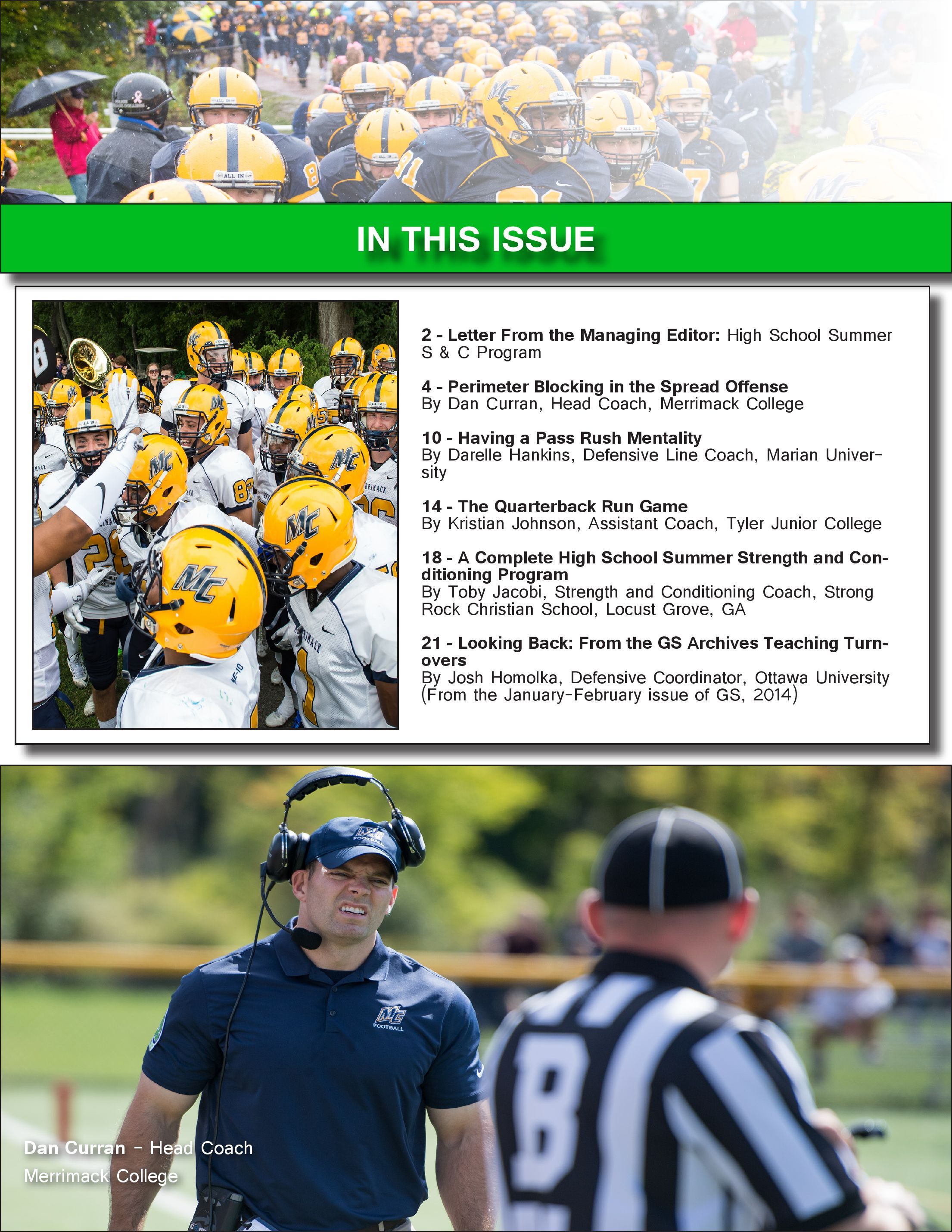
IN THIS ISSUE 2 - Letter From the Managing Editor: High School Summer S & C Program 4 - Perimeter Blocking in the Spread Offense By Dan Curran, Head Coach, Merrimack College 10 - Having a Pass Rush Mentality By Darelle Hankins, Defensive Line Coach, Marian University 14 - The Quarterback Run Game By Kristian Johnson, Assistant Coach, Tyler Junior College 18 - A Complete High School Summer Strength and Conditioning Program By Toby Jacobi, Strength and Conditioning Coach, Strong Rock Christian School, Locust Grove, GA 21 - Looking Back: From the GS Archives Teaching Turnovers By Josh Homolka, Defensive Coordinator, Ottawa University (From the January-February issue of GS, 2014) Dan Curran - Head Coach Merrimack College 3 3 www.GridironStrategies.com www.GridironStrategies.comwww.GridironStrategies.com
Page 4
Perimeter Blocking in the Spread Offense By Dan Curran, Head Coach, Merrimack College 4 www.GridironStrategies.com www.GridironStrategies.com
Page 5
Perimeter Blocking in the Spread Offense By Dan Curran, Head Coach, Merrimack College 5 www.GridironStrategies.com www.GridironStrategies.com
Page 6
and is more of a technique driven block that focuses on maintaining leverage, having patience, and playing with discipline. The outside number block technique would be utilized when the goal of the offense is to get the ball out on the perimeter or sidelines, for example, a bubble screen, jet sweep, or a B slip screen. The technique relies heavily on rules and guidelines to follow and may even include combo blocks between two wide receivers working to two defenders much like an offensive line would do so communication is critical. The #1 rule for outside number blocks are to always maintain leverage on the defender which means you want to be on the defenders outside pad. Rule #2 O ur offense at Merrimack College is a spread atis to be as wide as the widest defender but shallow enough to ensure that you are able to block who ultitack and our goal is always to make the defense try to defend the entire field, both in our drop play. These two rules help bring an understanding and back game as well as in our run game. The majority mately becomes the most dangerous defender on the of our run game has some sort of attachments tagged consistency to what the offense is trying to accomplish to each play, so it is imperative that we have great with the play which is to get the ball to the sidelines. execution with our perimeter blocking. Formation sets (2 x 2 or 3 x 1) as well as which We challenge the wide receivers group to be comreceiver you are (#1, #2, or #3) will dictate responsiplete football players who excel not only in the tradibilities and execution on any given play that involves tional skill set that are required to be productive at the outside number block technique. When a defender is Wide Receiver position such as route running, catchhead up or outside leverage of the #2 or #3 receiver, ing, and running after the catch, but also to take pride that defender becomes the responsibility of the rein being dominant with their perimeter blocking. We ceiver outside of you (because you no longer have have multiple blocking techniques that we teach and leverage which is rule #1) and we handle that with an we clearly define the difference between each and ev- “Exit” block or potential combo block. ery one of them. We have four different techniques that Having rules and guidelines are certainly important we utilize including our aggressive base block, crack in getting everyone on the same page which will result block, and our kick out block. The blocking technique in more consistent execution, but probably even more that we utilize the most would be our outside number critical to being a great outside number block team are block. The first three techniques I mentioned are a the fundamentals and techniques that you teach and much more “pin your ears back” aggressive mindset drill on a regular basis. The receiver needs to come that focuses on eliminating false steps, taking proper off the ball and take a controlled lateral shuffle at a 45 angles and finishing with an aggressive fit and finish degree angle always maintaining leverage on the most mentality. The outside number block is less aggressive dangerous defender. 6 www.GridironStrategies.com www.GridironStrategies.com
Page 7
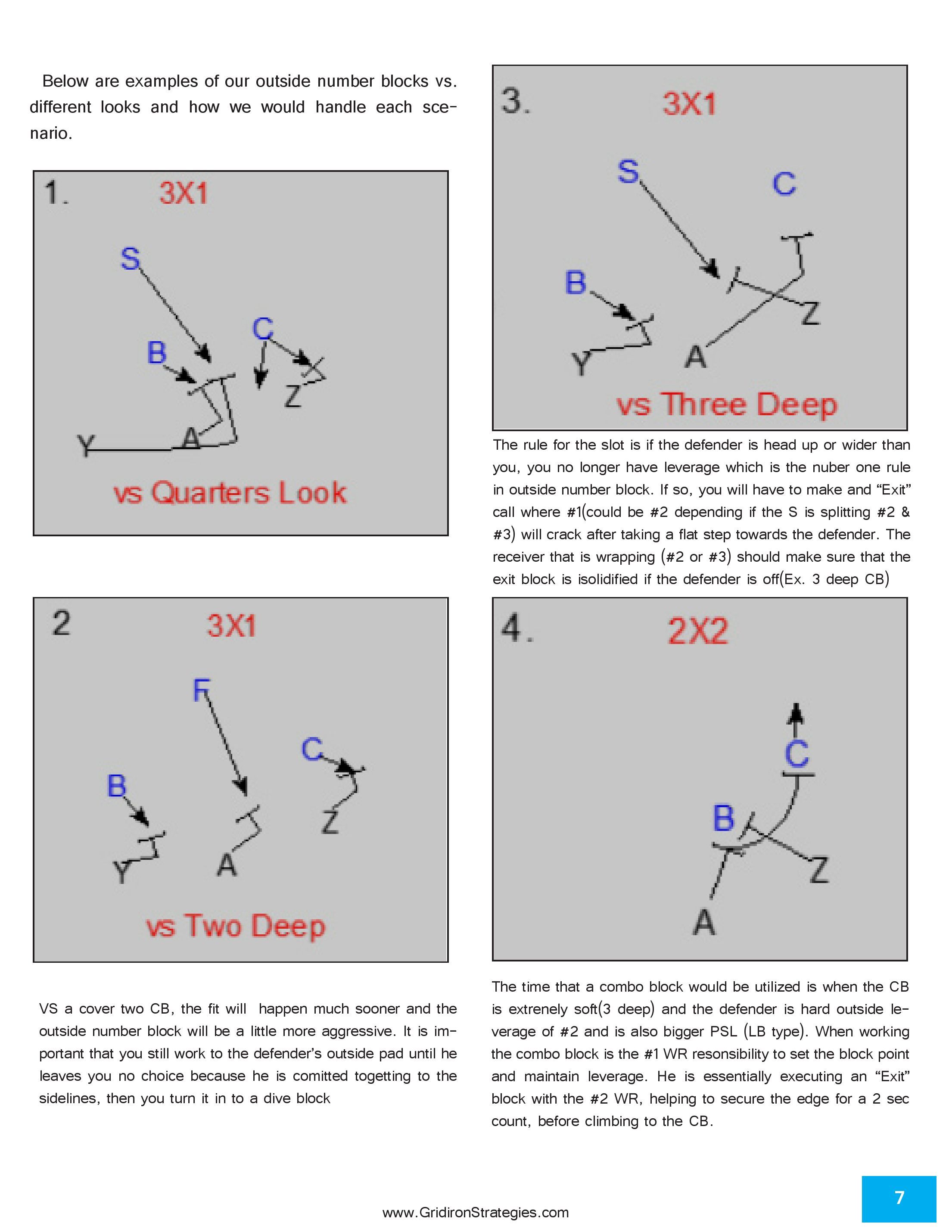
Below are examples of our outside number blocks vs. different looks and how we would handle each scenario. The rule for the slot is if the defender is head up or wider than you, you no longer have leverage which is the nuber one rule in outside number block. If so, you will have to make and “Exit” call where #1(could be #2 depending if the S is splitting #2 & #3) will crack after taking a flat step towards the defender. The receiver that is wrapping (#2 or #3) should make sure that the exit block is isolidified if the defender is off(Ex. 3 deep CB) The time that a combo block would be utilized is when the CB VS a cover two CB, the fit will happen much sooner and the is extrenely soft(3 deep) and the defender is hard outside leoutside number block will be a little more aggressive. It is imverage of #2 and is also bigger PSL (LB type). When working portant that you still work to the defender’s outside pad until he the combo block is the #1 WR resonsibility to set the block point leaves you no choice because he is comitted togetting to the and maintain leverage. He is essentially executing an “Exit” sidelines, then you turn it in to a dive block block with the #2 WR, helping to secure the edge for a 2 sec count, before climbing to the CB. 7 www.GridironStrategies.com www.GridironStrategies.com
Page 8
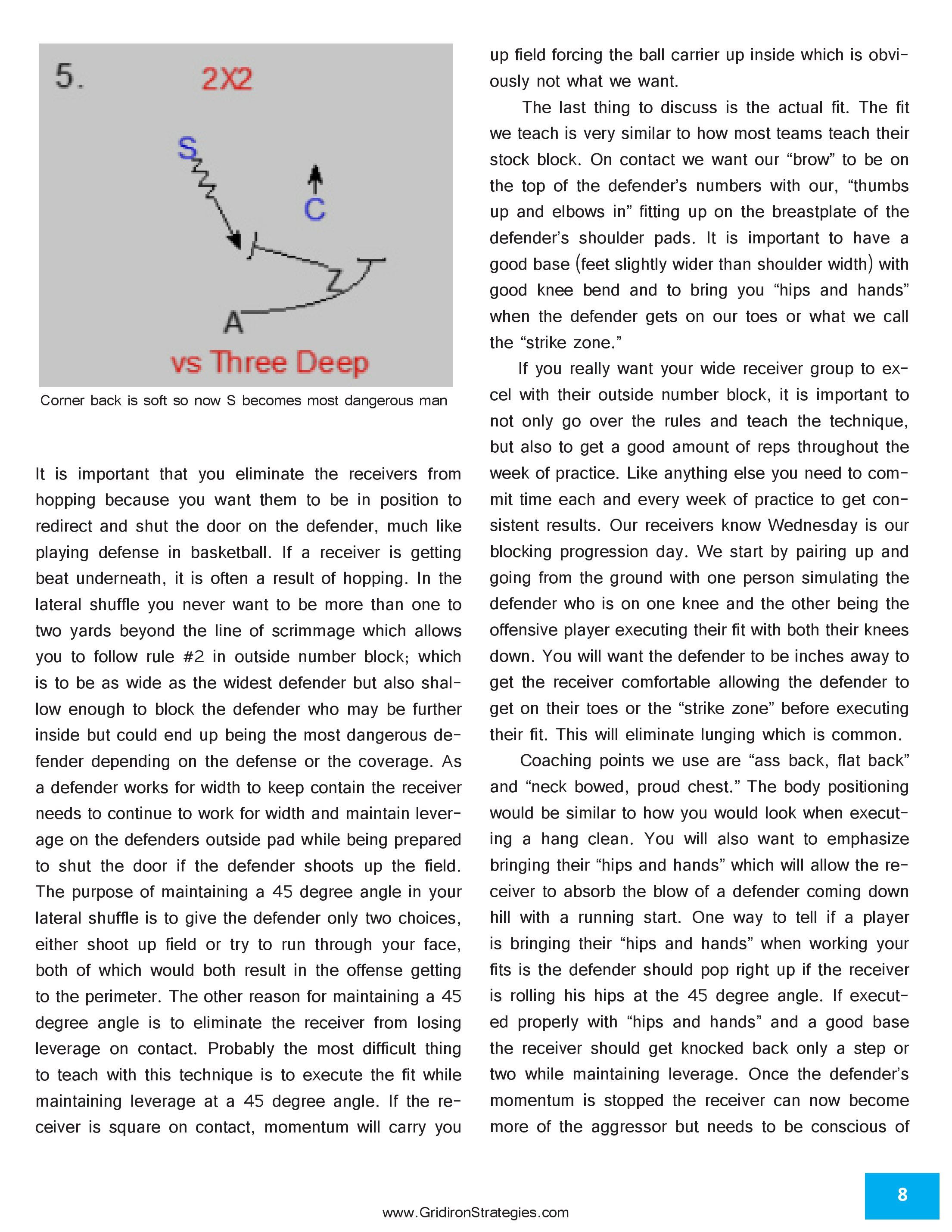
up field forcing the ball carrier up inside which is obviously not what we want. The last thing to discuss is the actual fit. The fit we teach is very similar to how most teams teach their stock block. On contact we want our “brow” to be on the top of the defender’s numbers with our, “thumbs up and elbows in” fitting up on the breastplate of the defender’s shoulder pads. It is important to have a good base (feet slightly wider than shoulder width) with good knee bend and to bring you “hips and hands” when the defender gets on our toes or what we call the “strike zone.” If you really want your wide receiver group to ex- Corner back is soft so now S becomes most dangerous man cel with their outside number block, it is important to not only go over the rules and teach the technique, but also to get a good amount of reps throughout the It is important that you eliminate the receivers from week of practice. Like anything else you need to comhopping because you want them to be in position to mit time each and every week of practice to get conredirect and shut the door on the defender, much like sistent results. Our receivers know Wednesday is our playing defense in basketball. If a receiver is getting blocking progression day. We start by pairing up and beat underneath, it is often a result of hopping. In the going from the ground with one person simulating the lateral shuffle you never want to be more than one to defender who is on one knee and the other being the two yards beyond the line of scrimmage which allows offensive player executing their fit with both their knees you to follow rule #2 in outside number block; which down. You will want the defender to be inches away to is to be as wide as the widest defender but also shalget the receiver comfortable allowing the defender to low enough to block the defender who may be further get on their toes or the “strike zone” before executing inside but could end up being the most dangerous detheir fit. This will eliminate lunging which is common. fender depending on the defense or the coverage. As Coaching points we use are “ass back, flat back” a defender works for width to keep contain the receiver and “neck bowed, proud chest.” The body positioning needs to continue to work for width and maintain leverwould be similar to how you would look when executage on the defenders outside pad while being prepared ing a hang clean. You will also want to emphasize to shut the door if the defender shoots up the field. bringing their “hips and hands” which will allow the re- The purpose of maintaining a 45 degree angle in your ceiver to absorb the blow of a defender coming down lateral shuffle is to give the defender only two choices, hill with a running start. One way to tell if a player either shoot up field or try to run through your face, is bringing their “hips and hands” when working your both of which would both result in the offense getting fits is the defender should pop right up if the receiver to the perimeter. The other reason for maintaining a 45 is rolling his hips at the 45 degree angle. If executdegree angle is to eliminate the receiver from losing ed properly with “hips and hands” and a good base leverage on contact. Probably the most difficult thing the receiver should get knocked back only a step or to teach with this technique is to execute the fit while two while maintaining leverage. Once the defender’s maintaining leverage at a 45 degree angle. If the remomentum is stopped the receiver can now become ceiver is square on contact, momentum will carry you more of the aggressor but needs to be conscious of 8 www.GridironStrategies.com www.GridironStrategies.com
Page 9
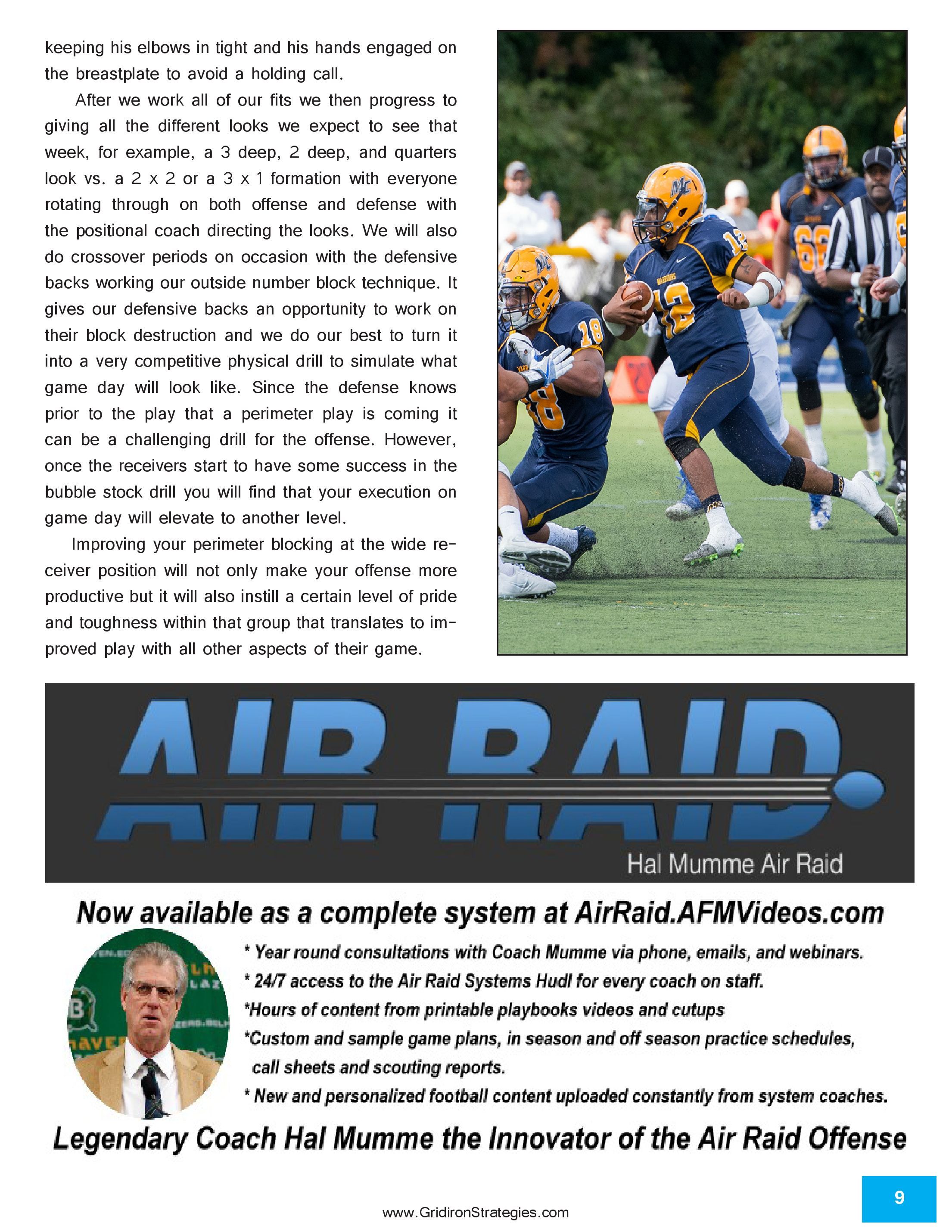
keeping his elbows in tight and his hands engaged on the breastplate to avoid a holding call. After we work all of our fits we then progress to giving all the different looks we expect to see that week, for example, a 3 deep, 2 deep, and quarters look vs. a 2 x 2 or a 3 x 1 formation with everyone rotating through on both offense and defense with the positional coach directing the looks. We will also do crossover periods on occasion with the defensive backs working our outside number block technique. It gives our defensive backs an opportunity to work on their block destruction and we do our best to turn it into a very competitive physical drill to simulate what game day will look like. Since the defense knows prior to the play that a perimeter play is coming it can be a challenging drill for the offense. However, once the receivers start to have some success in the bubble stock drill you will find that your execution on game day will elevate to another level. Improving your perimeter blocking at the wide receiver position will not only make your offense more productive but it will also instill a certain level of pride and toughness within that group that translates to improved play with all other aspects of their game. 9 www.GridironStrategies.com www.GridironStrategies.com
Page 10
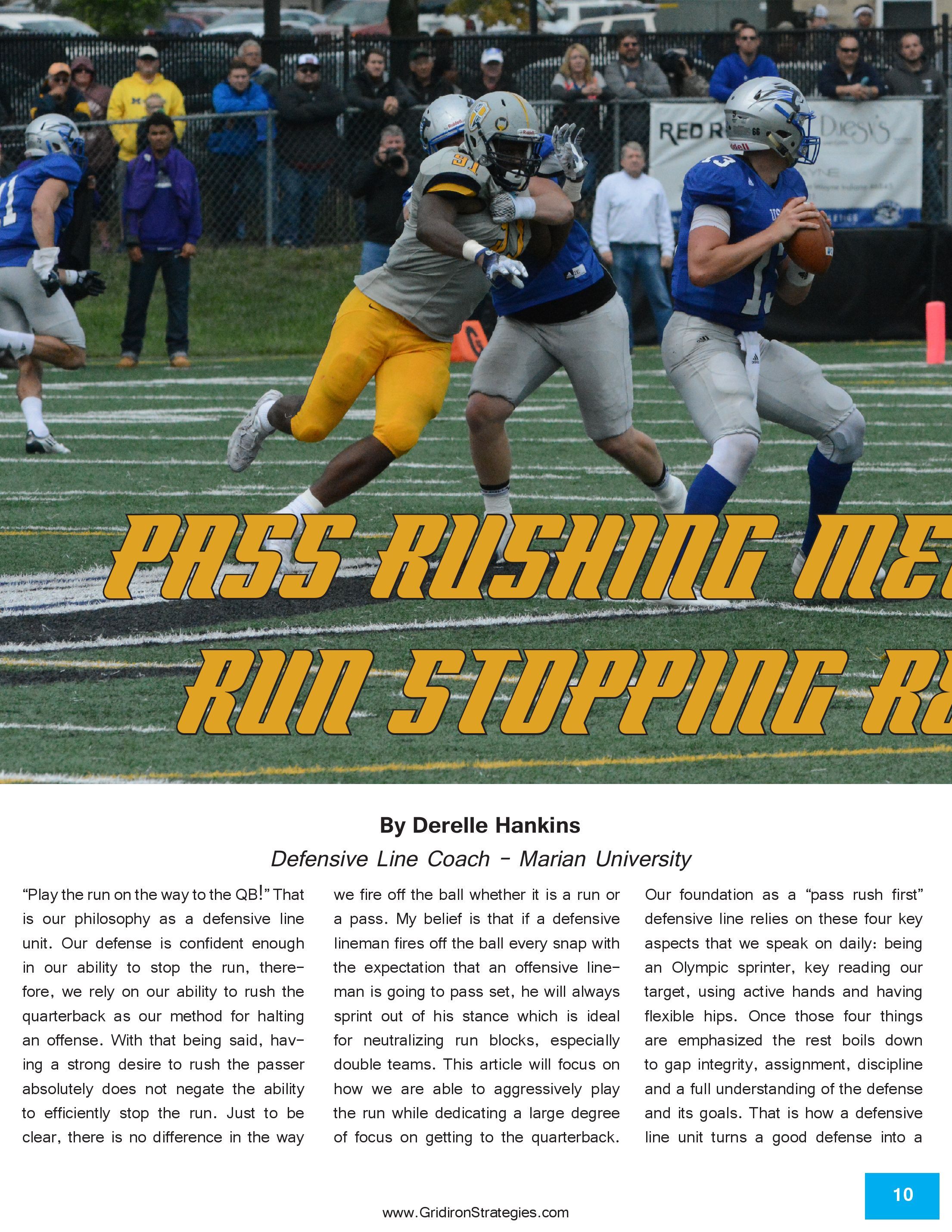
PASS RUSHING MENTALITY RUN STOPPING REALITY By Derelle Hankins Defensive Line Coach - Marian University “Play the run on the way to the QB!” That we fire off the ball whether it is a run or Our foundation as a “pass rush first” is our philosophy as a defensive line a pass. My belief is that if a defensive defensive line relies on these four key unit. Our defense is confident enough lineman fires off the ball every snap with aspects that we speak on daily: being in our ability to stop the run, therethe expectation that an offensive linean Olympic sprinter, key reading our fore, we rely on our ability to rush the man is going to pass set, he will always target, using active hands and having quarterback as our method for halting sprint out of his stance which is ideal flexible hips. Once those four things an offense. With that being said, havfor neutralizing run blocks, especially are emphasized the rest boils down ing a strong desire to rush the passer double teams. This article will focus on to gap integrity, assignment, discipline absolutely does not negate the ability how we are able to aggressively play and a full understanding of the defense to efficiently stop the run. Just to be the run while dedicating a large degree and its goals. That is how a defensive clear, there is no difference in the way of focus on getting to the quarterback. line unit turns a good defense into a 10 www.GridironStrategies.com www.GridironStrategies.com
Page 11
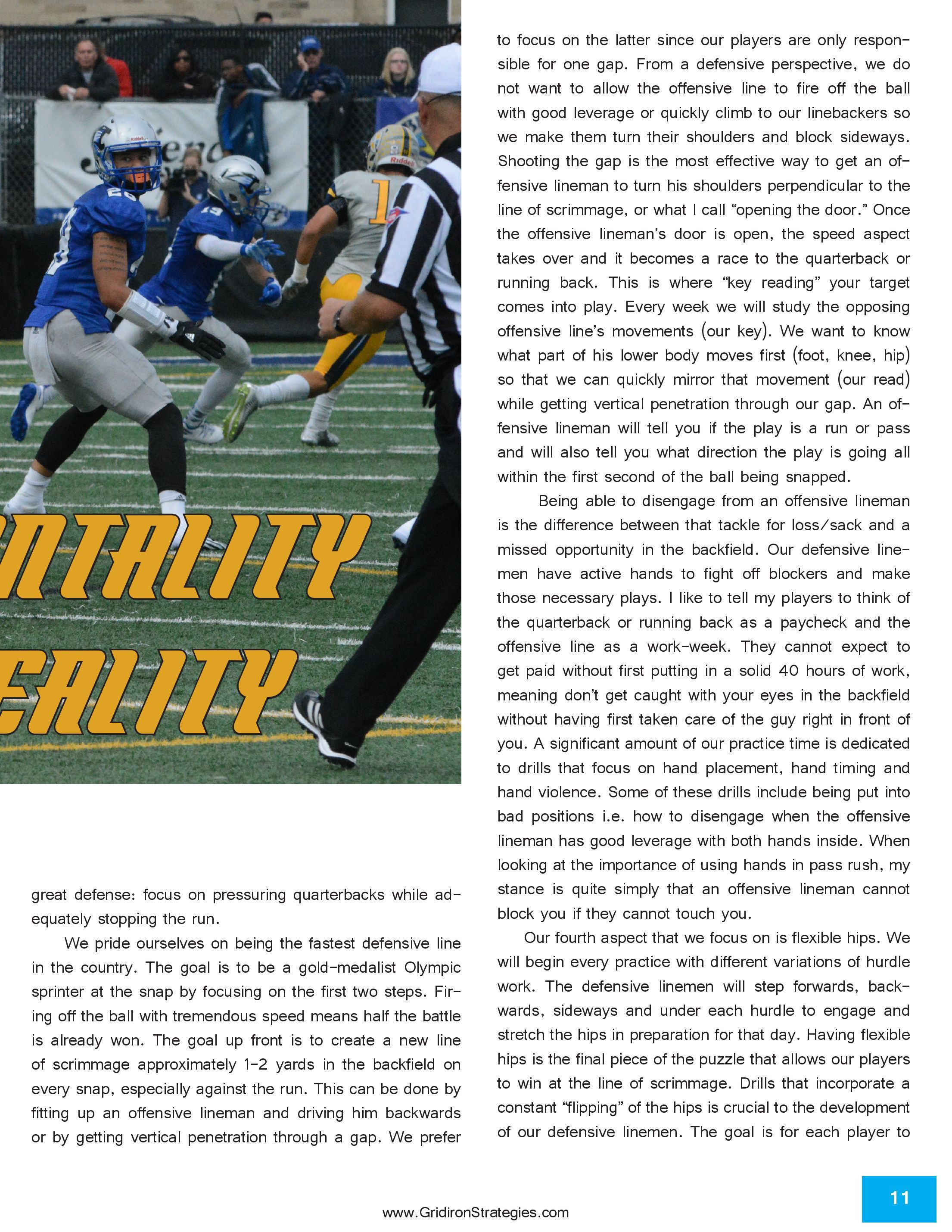
to focus on the latter since our players are only responsible for one gap. From a defensive perspective, we do not want to allow the offensive line to fire off the ball with good leverage or quickly climb to our linebackers so we make them turn their shoulders and block sideways. Shooting the gap is the most effective way to get an offensive lineman to turn his shoulders perpendicular to the line of scrimmage, or what I call “opening the door.” Once the offensive lineman’s door is open, the speed aspect takes over and it becomes a race to the quarterback or running back. This is where “key reading” your target comes into play. Every week we will study the opposing offensive line’s movements (our key). We want to know what part of his lower body moves first (foot, knee, hip) so that we can quickly mirror that movement (our read) while getting vertical penetration through our gap. An offensive lineman will tell you if the play is a run or pass and will also tell you what direction the play is going all within the first second of the ball being snapped. Being able to disengage from an offensive lineman PASS RUSHING MENTALITY missed opportunity in the backfield. Our defensive lineis the difference between that tackle for loss/sack and a men have active hands to fight off blockers and make those necessary plays. I like to tell my players to think of the quarterback or running back as a paycheck and the offensive line as a work-week. They cannot expect to RUN STOPPING REALITY get paid without first putting in a solid 40 hours of work, meaning don’t get caught with your eyes in the backfield without having first taken care of the guy right in front of you. A significant amount of our practice time is dedicated to drills that focus on hand placement, hand timing and hand violence. Some of these drills include being put into bad positions i.e. how to disengage when the offensive lineman has good leverage with both hands inside. When looking at the importance of using hands in pass rush, my great defense: focus on pressuring quarterbacks while adstance is quite simply that an offensive lineman cannot equately stopping the run. block you if they cannot touch you. We pride ourselves on being the fastest defensive line Our fourth aspect that we focus on is flexible hips. We in the country. The goal is to be a gold-medalist Olympic will begin every practice with different variations of hurdle sprinter at the snap by focusing on the first two steps. Firwork. The defensive linemen will step forwards, backing off the ball with tremendous speed means half the battle wards, sideways and under each hurdle to engage and is already won. The goal up front is to create a new line stretch the hips in preparation for that day. Having flexible of scrimmage approximately 1-2 yards in the backfield on hips is the final piece of the puzzle that allows our players every snap, especially against the run. This can be done by to win at the line of scrimmage. Drills that incorporate a fitting up an offensive lineman and driving him backwards constant “flipping” of the hips is crucial to the development or by getting vertical penetration through a gap. We prefer of our defensive linemen. The goal is for each player to 11 www.GridironStrategies.com www.GridironStrategies.com
Page 12
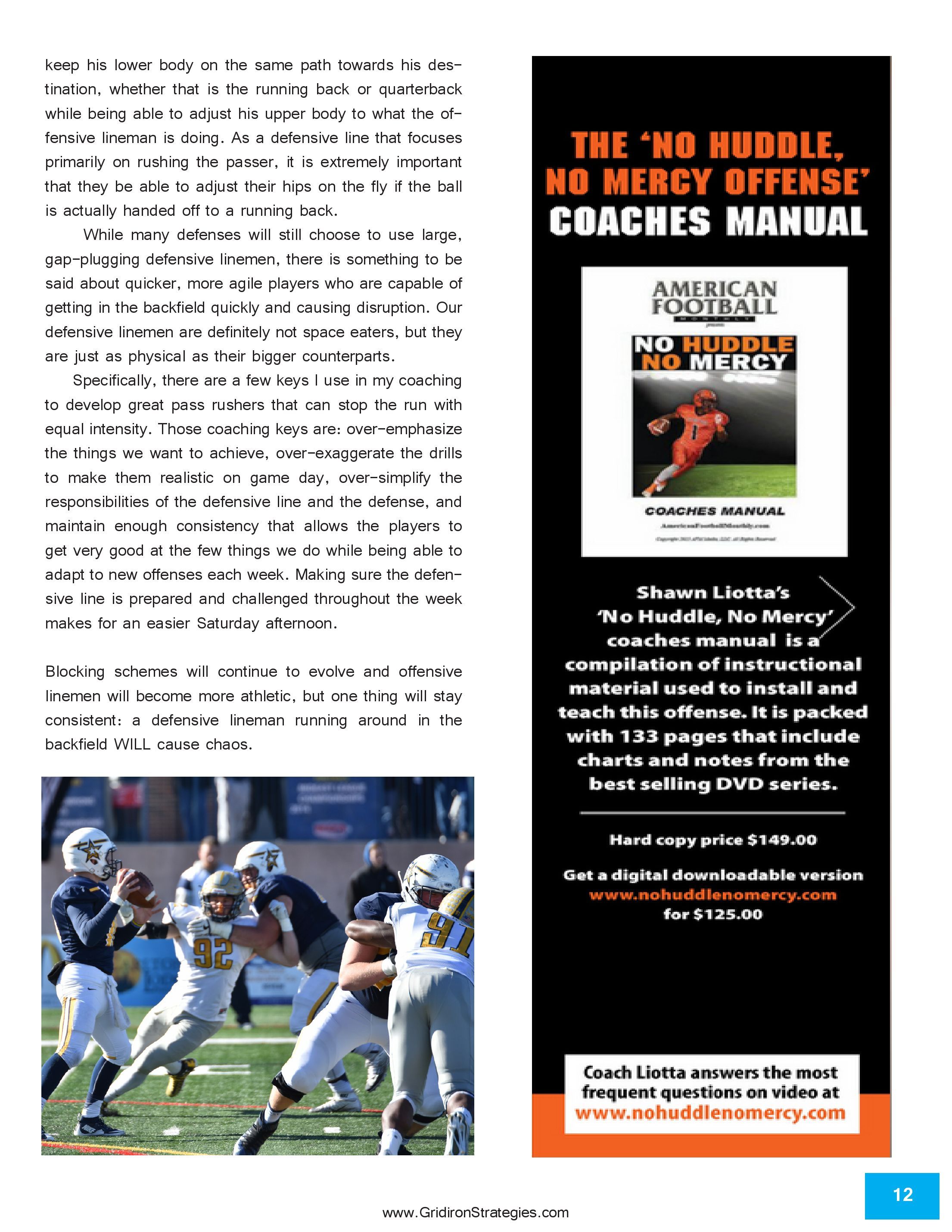
keep his lower body on the same path towards his destination, whether that is the running back or quarterback while being able to adjust his upper body to what the offensive lineman is doing. As a defensive line that focuses primarily on rushing the passer, it is extremely important that they be able to adjust their hips on the fly if the ball is actually handed off to a running back. While many defenses will still choose to use large, gap-plugging defensive linemen, there is something to be said about quicker, more agile players who are capable of getting in the backfield quickly and causing disruption. Our defensive linemen are definitely not space eaters, but they are just as physical as their bigger counterparts. Specifically, there are a few keys I use in my coaching to develop great pass rushers that can stop the run with equal intensity. Those coaching keys are: over-emphasize the things we want to achieve, over-exaggerate the drills to make them realistic on game day, over-simplify the responsibilities of the defensive line and the defense, and maintain enough consistency that allows the players to get very good at the few things we do while being able to adapt to new offenses each week. Making sure the defensive line is prepared and challenged throughout the week makes for an easier Saturday afternoon. Blocking schemes will continue to evolve and offensive linemen will become more athletic, but one thing will stay consistent: a defensive lineman running around in the backfield WILL cause chaos. 12 www.GridironStrategies.com www.GridironStrategies.com
Page 13
13 www.GridironStrategies.com www.GridironStrategies.com
Page 14
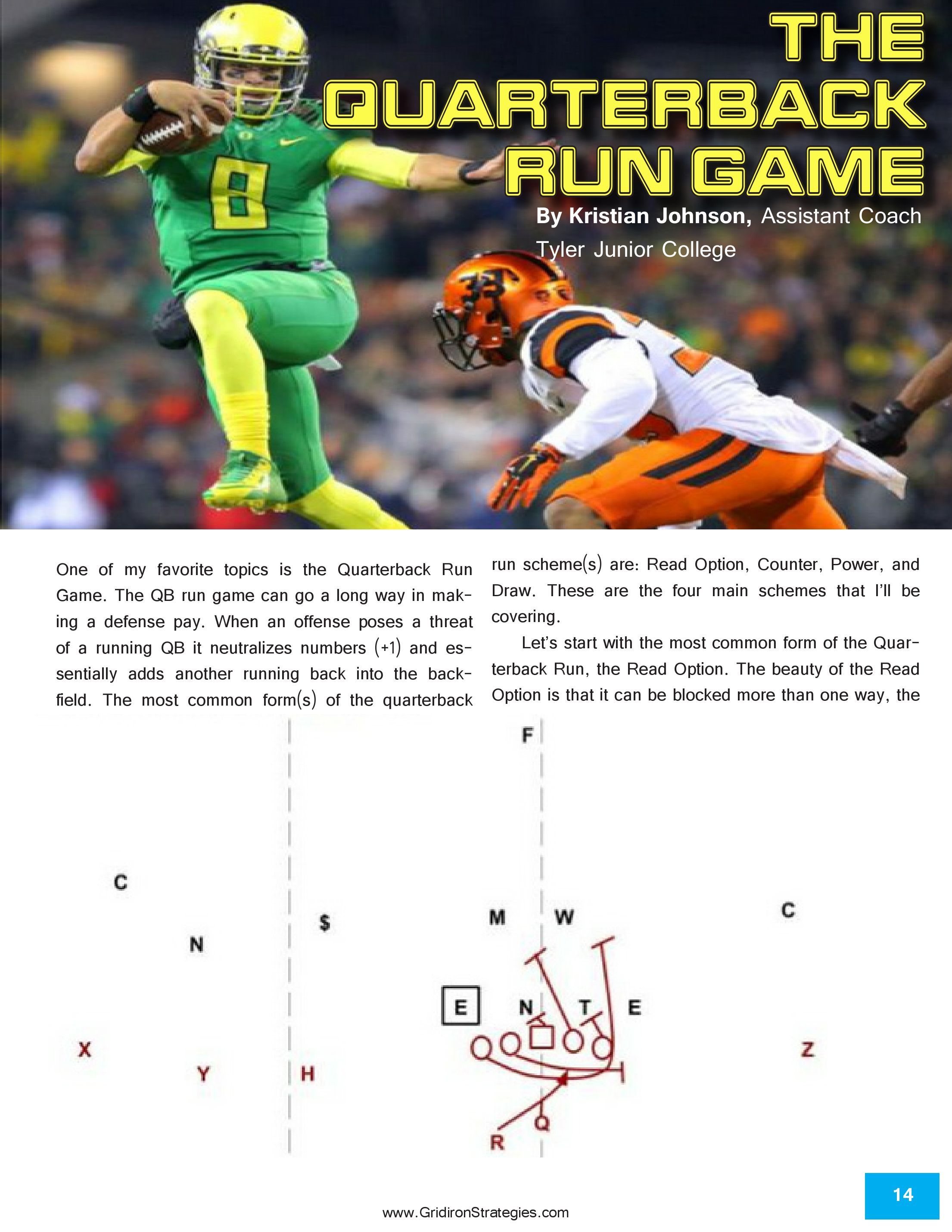
THE Quarterback Run Game By Kristian Johnson, Assistant Coach Tyler Junior College One of my favorite topics is the Quarterback Run run scheme(s) are: Read Option, Counter, Power, and Game. The QB run game can go a long way in mak- Draw. These are the four main schemes that I’ll be ing a defense pay. When an offense poses a threat covering. of a running QB it neutralizes numbers (+1) and es- Let’s start with the most common form of the Quarsentially adds another running back into the backterback Run, the Read Option. The beauty of the Read field. The most common form(s) of the quarterback Option is that it can be blocked more than one way, the 14 www.GridironStrategies.com www.GridironStrategies.com
Page 15
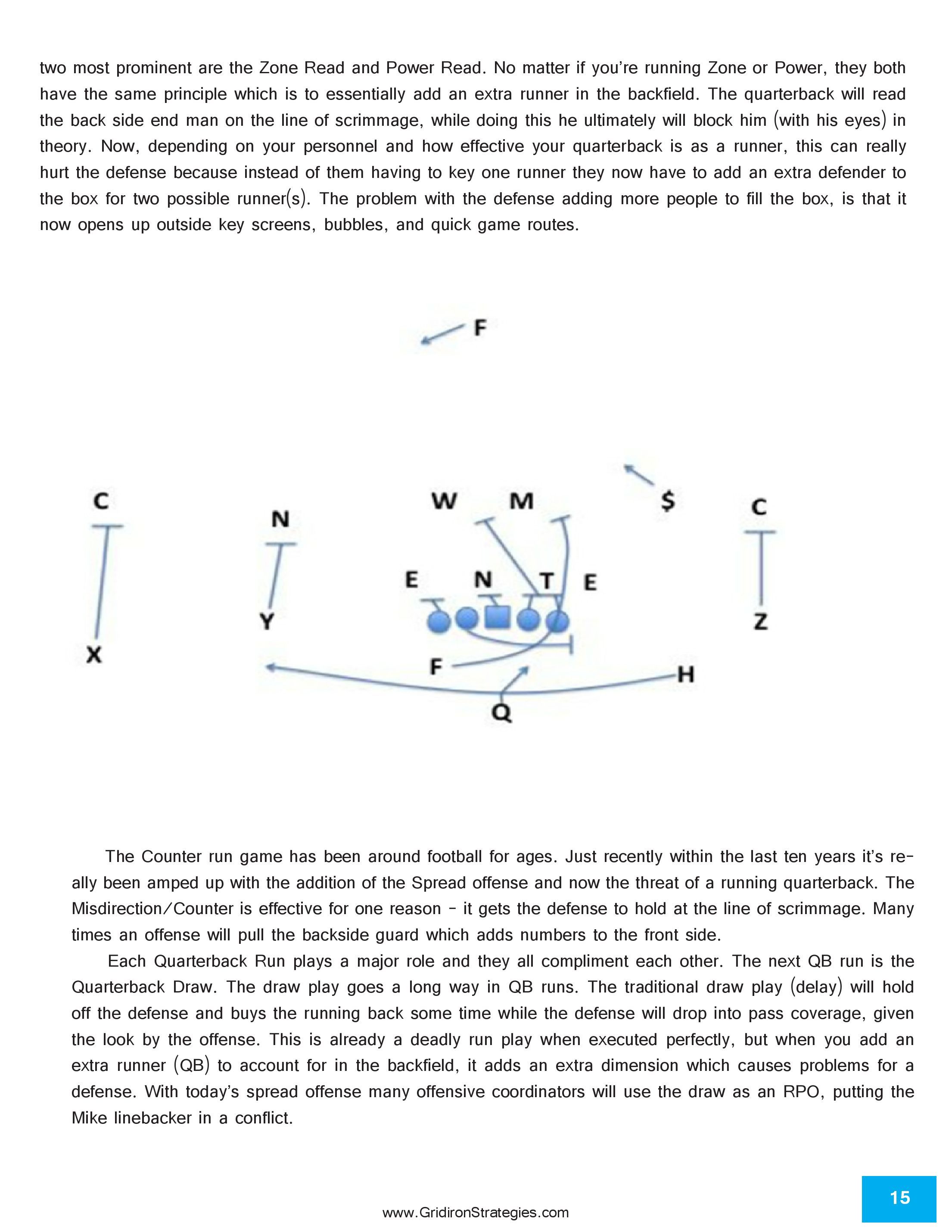
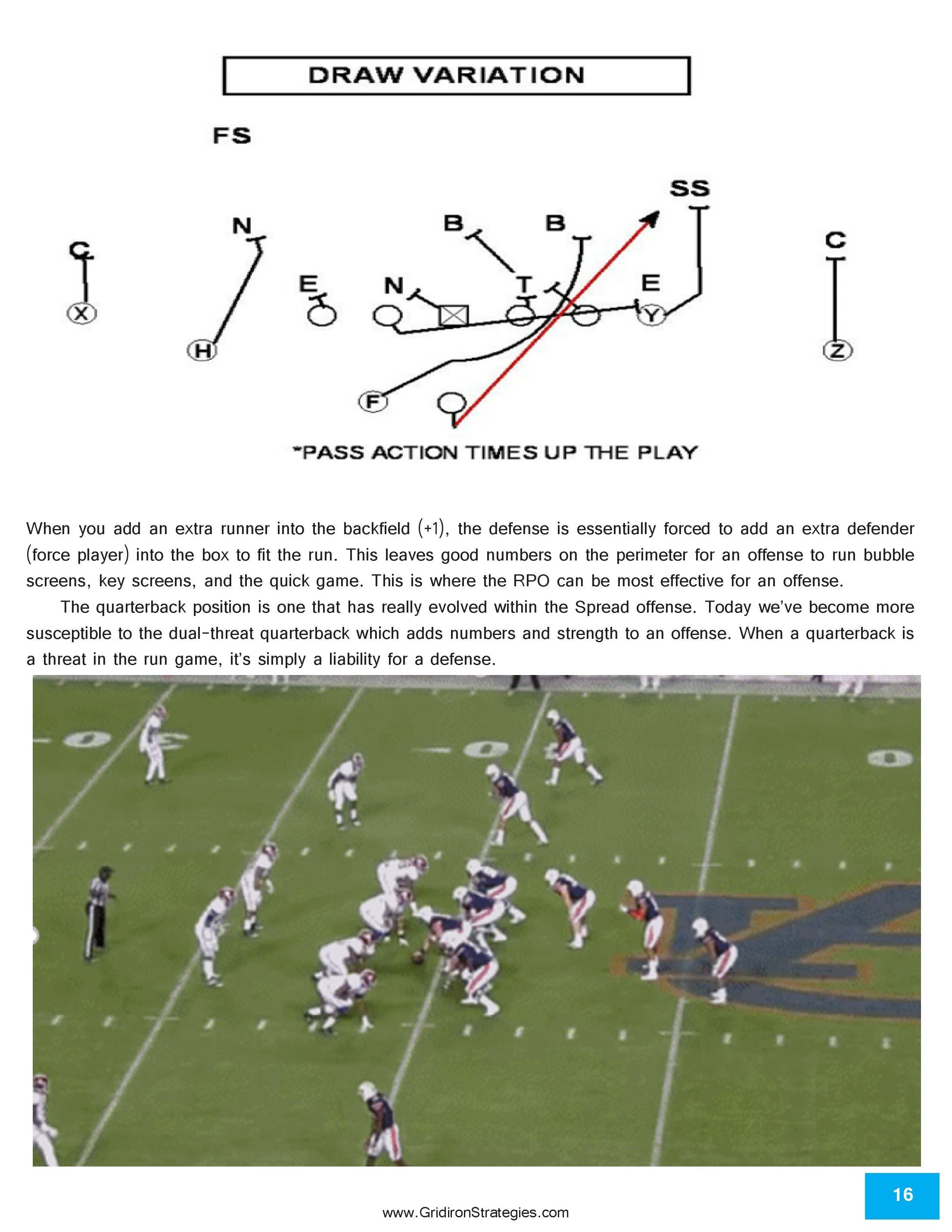
two most prominent are the Zone Read and Power Read. No matter if you’re running Zone or Power, they both have the same principle which is to essentially add an extra runner in the backfield. The quarterback will read the back side end man on the line of scrimmage, while doing this he ultimately will block him (with his eyes) in theory. Now, depending on your personnel and how effective your quarterback is as a runner, this can really hurt the defense because instead of them having to key one runner they now have to add an extra defender to the box for two possible runner(s). The problem with the defense adding more people to fill the box, is that it By Kristian Johnson, Assistant Coach now opens up outside key screens, bubbles, and quick game routes. Tyler Junior College The Counter run game has been around football for ages. Just recently within the last ten years it’s really been amped up with the addition of the Spread offense and now the threat of a running quarterback. The Misdirection/Counter is effective for one reason - it gets the defense to hold at the line of scrimmage. Many times an offense will pull the backside guard which adds numbers to the front side. Each Quarterback Run plays a major role and they all compliment each other. The next QB run is the Quarterback Draw. The draw play goes a long way in QB runs. The traditional draw play (delay) will hold off the defense and buys the running back some time while the defense will drop into pass coverage, given the look by the offense. This is already a deadly run play when executed perfectly, but when you add an extra runner (QB) to account for in the backfield, it adds an extra dimension which causes problems for a defense. With today’s spread offense many offensive coordinators will use the draw as an RPO, putting the Mike linebacker in a conflict. 15 www.GridironStrategies.com www.GridironStrategies.com
Page 16
When you add an extra runner into the backfield (+1), the defense is essentially forced to add an extra defender (force player) into the box to fit the run. This leaves good numbers on the perimeter for an offense to run bubble screens, key screens, and the quick game. This is where the RPO can be most effective for an offense. The quarterback position is one that has really evolved within the Spread offense. Today we’ve become more susceptible to the dual-threat quarterback which adds numbers and strength to an offense. When a quarterback is a threat in the run game, it’s simply a liability for a defense. 16 www.GridironStrategies.com www.GridironStrategies.com
Page 17
American Football Systems Record Breaking Systems fo Football Programs We have assembled complete libraries of record breaking football systems from the most successful coaches in America. Playbooks, videos, call sheets, practice schedules, scouting reports and much more. Packages include 24/7 unlimited access, unlimited downloads plus access for you and up to 5 of your staff. www.AmericanFootballSystems.com 17 www.GridironStrategies.com www.GridironStrategies.com
Page 18
A Complete High School Summer Strength & Conditioning Program By Tobias Jacobi, Director of Strength and Conditioning Strong Rock Christian High School (GA) I have had the privilege to coach at multiple levels of athletics Friday night. In this article; I will discuss some things that a and something that has seemed to become prevalent at all levels high school strength & conditioning coach should be aware of is a year-round approach to training. The summer program at when developing his plan for football summer training. the high school level could possibly be the single most impactful 1. Strength Training – No matter what your philosophy training phase to a football program at any level. The reason I when it comes to lifting, when properly planning your summer believe this is that at least at the college level you still have the program you must consider when you are lifting on what days. “off-season” training program which lasts anywhere from 6-10 During our summer program our Strength Training is based off weeks, something most high school programs do not have due of our running program. One of the major things we do is when to the multi-sport athlete. At the professional level, it’s a whole we squat heavy on the last strength training day of the week, different situation as the professional players do a significant to ensure that our legs will be as fresh as possible to perform amount of their preparation on their own due to the player asall our speed work. Also, we lift 4 straight days during the sociation rules on when they can be together and when they summer to give our kids a 3-day weekend each week. cannot. A properly planned and implemented summer training program can be the difference between winning and losing on 18 www.GridironStrategies.com www.GridironStrategies.com
Page 19
2. Running Program – Another part of your training 4. AAU Basketball, Travel Baseball, 7vs. 7 program is the running program, and as it was stated earlier, Events,Competitions, and College Camps – All the above we base our lifting around the running program. We perform are things as a high school strength & conditioning coach we our linear speed development on our upper body emphasis – must learn to navigate to be successful. With all the previous change of direction our lower body emphasis days. Your prolisted gaining, more and more of a foothold on aspiring athgram should also consider how many kids you have playing letes it is critical for strength professionals to understand the both sides of the football. If a higher number of your players demands on the human body of our athletes. The sad part is play “both ways” then conditioning may become more of a when it comes to this subject is that the high school strength focus to ensure your players will have enough gas in the tank coach is typically the only one who truly has the kids best into play 4 quarters. terest at heart, as opposed to all the others involved even the parents. Bottom line is you cannot have a kid train 100% and practice football 100%, then go to baseball practice, lessons, or games and play 100%, and then on to basketball practice, lessons, or game and play at 100%. The human body needs to rest and recover and I am seeing more and more of this which is disappointing. 3. Football Practice – Now depending on what state you reside everyone is different when it comes to what you can do and cannot do during the summer months. When it comes to coaches and players working together – coaches can work the summer months with our kids, practicing a certain date. With 5. Toughness & Competitions – Performing exercises that understanding we have our coaches perform specific work and drills that emphasize toughness while being competitive is 2-3 days per week during the summer. This helps continue to a must during the summer months. Now with that said when fine tune our kids football skills and helps continue their position having kids do things that help develop toughness as a coach development. It also helps continue to improve our conditioning you must be smart and know where the line is you cannot levels which is always a plus since we are small school and cross before it become dangerous. For us performing a finishmany of our athletes play both sides of the football. ing circuit of exercises is always fantastic way to get acces- 19 www.GridironStrategies.com www.GridironStrategies.com
Page 20
sory work and helps develop toughness as well. Competition is something we use to help develop intrinsic motivation with our kids. Intrinsically motivated kids are few and far between so everything we can extrinsically to motivate kids to work the better and competitions are the easiest way to get this done. As I said earlier because of the unique job the high school strength & conditioning coach has during the summer months is critical for the results the team has during the fall. Planning a well-organized program with the ability to navigate all the things discussed in this article gives a coach a good chance to help their team to have a successful fall. I live by statement, “failing to plan is planning to fail” so it’s my job as a high school strength & conditioning coach to put together the best plan for my kids to be successful. If you have any questions please feel free to reach out to me via email tjacobi@strong-rock.com . HOW TO PRINT THIS MAGAZINE 20 www.GridironStrategies.com www.GridironStrategies.com
Page 21
TEACHING TURNOVERS By Josh Homolka Defensive Coordinator • Ottawa University critical factor to our success has been our ability to take the ball away. With a high-power, fast offense we have created more op- • On the throw, all the players yell “ball”. The player who catches the ball A portunities to score and have made it clear that every defensive snap will give a “right, right” call or a “left, left” call. This designates where the is an opportunity to cause a turnover. Every game week, we have three player intends to run the ball. drills that start every practice. We designate each as a ten-minute segment. We are not focused on time but are more focused on looking for effort and • The player who intercepts the ball is looking to run on the top of the techniques are being performed properly. The three drills we perform weekly numbers.This gives the player the ability to read blocks and gives him room are the INT Drill, Turnover Circuit and Tackle Circuit. Here is our strategy to cut toward the sideline or toward the middle of the field. and technique for the INT Drill and the Turnover Circuit. During our game week, we come in Sunday afternoon for film review • The defender closest to the player who intercepts the ball is required to and a light workout. Monday is our players’ day off. Game plan installation is block the intended receiver. In this drill there is not an actual receiver so this Tuesday with a longer practice. Wednesday is a shorter clean-up practice, is simulated. After he simulates the block, he rallies back and finds another Thursday is a polish day and Friday is a walk through. At the beginning of block. There are two players who consistently make the tackle on an INT, each of these practices, we will start with one of the three drills. one of those being the intended receiver. • The backside defensive end away from the “right” or “left” call is required to block the quarterback. The second player who consistently makes a tackle on the INT is the QB so we make sure to designate a player to block him. • The final eight players are running to the numbers off the “right” or “left” call to create a convoy for the defender who intercepted the ball. The main point of emphasis is do not follow the same colored jersey - spread out and develop a convoy. • All players are to run through the coach in the end zone. After running through the coach, the players gather around the coach with their feet buzzing around the coach (Diagram 1). The first drill is the INT Drill (Diagram 1).This concept was something we actually implemented after attending a clinic. When we cause an interception, we should look like we are running a designed play. We make sure we make our defenders think on every play. Here is how the drill works: • We want a minimum of three full defenses, 1st, 2nd, and 3rd, all lined up in the back of the end zone. • We have a coach on the goal line who will give the front and the coverage. This coach will simulate the snap, and he will also be the designated thrower. We have two coaches five yards deep in the end zone where the players would be. They grade effort and are the breakdown coaches for this drill. • The coach on the goal line calls out the first defense. They then sprint out and get the call, lining up according to the call and the strength of the offense called by the coach. The next drill is the Turnover Circuit (Diagram 2). We have three stations within this circuit. We have a station on the goal line between the hash • The coach will give a simulated snap. On that snap, the defensive line and the numbers, another station on the other side of the field on the goal does an up down and rushes the coach with hands up. The back seven drop into the coverage called. 21 www.GridironStrategies.com www.GridironStrategies.com
Page 22
line between the hash and the numbers, and the last station in the middle of the field on the 25-yard line. The first drill is a hoop and strip drill. We • Equipment simulate rushing the passer and swiping the top shoulder or the throwing - three cones arm of the quarterback. Everyone in our defense will be asked to blitz and - two balls rush the passer so this is a relevant drill for all. The second drill is a fit and strip drill. We will have a runner, tackler and ball stripper for this drill. • We form a triangle with our cones. The ball carrier will have his back to We will fit up a good form tackle, and then have the third man come in the end zone, the tackler will be at a cone three yards from the ball carrier, and rip the ball out. The final drill is the tip drill. We have a single file line and and the ball stripper will be three yards away from the ball carrier on the the coach calls the first man out and tips the ball to the man behind him. We right or left side. We alternate sides week to week. have our entire defense work on catching tips or bad balls. We start each drill in our position groups (DL, LBs, DBs). We make sure each individual gets at • On the whistle, the players form up on a good stiff tackle. We want it least two to three reps in each drill. It is a rapid fire drill. At the whistle, each to be a firm tackle. If the ball carrier is driven, it will have a bad effect on group sprints to the next drill clockwise. the drill. Hoop and Strip Drill • The ball carrier is instructed to carry the ball on the side the ball stripper is lined up on for drill purposes. • Equipment • When the tackle has been fit up, this will trigger the ball stripper to go - Hoop, or hose, or cones. This is to create an arch for the players into the drill. He is told to look and find the ball. When the ball is located, to run off. we want the player to reach his hand to the tip of the ball where the fingers are located. We tell the player to rip the fingers off of the ball. The fingers - Have three or more balls to make sure the drill is rapid fire. will be on the nose of the ball. Our players are instructed to simulate starting a chain saw or a lawnmower. We want their elbow to fly up. When - Player or coach who will stand at the end of the arch and simulate done correctly, the ball will come out end over end. as the QB. You will want to rotate week-to-week on which side you rush the passer. • After the ball comes out, the ball stripper is to locate the ball and scoop and score. We want great knee bend and both hands on the ball. We - Coach or player will simulate a snap. This ensures they are keyrequire them to sprint through the goal line. ing the ball and practicing get offs as either defensive linemen or as blitzers. Tip Drill • We have a cone or starting point for the blitzing defender. • Equipment - two or three balls • We have a cone for the scooper. - one cone on the hash • We have a coach who will simulate a snap for the defender approximately • We have our players in a single file line on the hash. We will put a cone two yards from the starting point of the defender. down for the players to stand behind. • We arch the hoop at an angle that best represents the path of an edge • Our coach is lined up on the opposite hash with a ball. rusher to the QB. This is between 6 and 7 yards from the simulated snap. • On the coaches command, the first player jogs toward the coach. The • We are looking for great get offs on the snap followed by a tight fit on second player follows closely behind the first player. the arch. • The coach will throw a ball to the player above the first player’s shoul- • We are aiming for the QB’s elbow to ensure we hit his forearm. We hit ders. The first player is instructed to tip the ball. the forearm of the QB witch will make the QB’s hand flex and jar the ball loose. The QB is a player who will rotate after he has completed the drill • The second player is required to locate the ball and make a catch. as the defender. After catching the ball, he sprints and simulates a score past the coach (Diagram 2). • When the ball is knocked out, the scooper uses great knee bend and both hands to scoop and score. He is making sure he sprints and finishes Taking time and teaching how to create turnovers has been a huge through a designated point established by the coach. benefit for our program. It is easy to do and takes only a small segment of time if done properly. Make sure your drills resemble a game situation. • We will rotate clockwise through the drill from the defender becoming This ensures that players see how it can directly benefit them during an the QB, the QB becoming the scooper and the scooper becoming the actual game. p defender. About the Author: Josh Homolka enters his seventh season this fall Fit and Strip Drill as defensive coordinator for Ottawa University. He also serves as the defensive backs coach. Homolka previously coached at both Dakota State University and Pittsburg State. As an undergraduate, he was a letterman as a linebacker at the University of Kansas. 22 www.GridironStrategies.com www.GridironStrategies.com
Page 23
23 www.GridironStrategies.com www.GridironStrategies.com